Map of England showing where the Tibbits arms are recorded
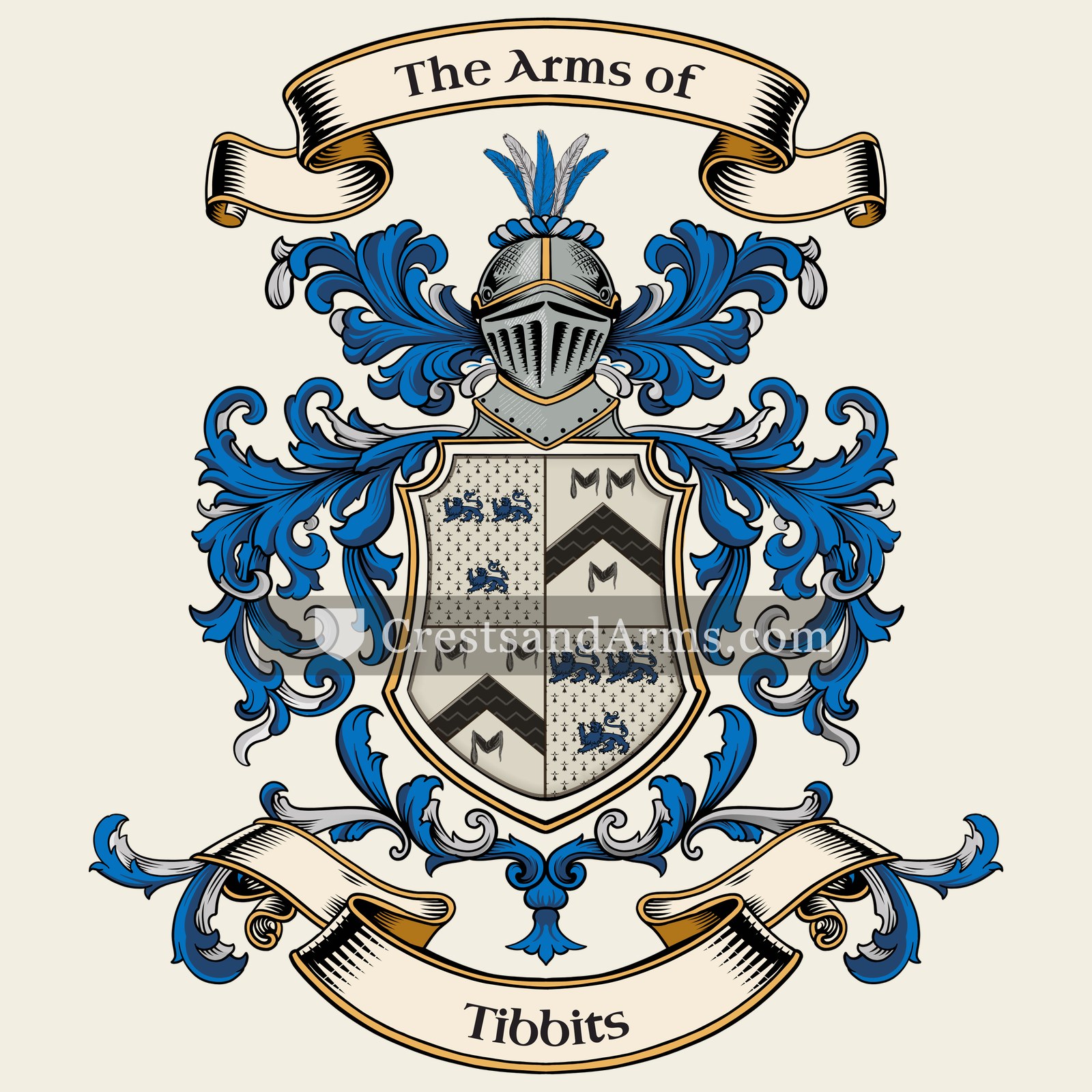
The Tibbits arms were recorded in Northampton, c. 1620.
Northamptonshire was grazing and hunting country in the middle of England, thick with manor houses. Its families were numerous and long-settled, and a settled landed family almost always ended up with arms.
This is where the arms were entered in the register. Families often moved to other parts of the country, so the same name can turn up in more than one region.
The body that granted and recorded arms in England in this period.
James VI and I
Sovereign of the period
James VI and I
1603–1625
Reigning in England when the Tibbits arms are first recorded.
How Arms Worked in England
English heraldry allowed arms to be shared by all legitimate descendants of the original owner. These symbols were treated as personal property that moved through the generations to all children. While the eldest son kept the original design, other family members could use the same shield without needing to change it or register their own unique versions.
Granting authority
The College of Arms in London has regulated the use of coats of arms throughout England and Wales since 1484.
How they got arms
Families typically obtained their coats of arms through a formal grant from the Crown or by proving their ancient right to them.
Where arms were recorded
All official coats of arms are recorded in the registers kept at the College of Arms, which date back to the fifteenth century.
The family's standing
Recorded among the armigerous families of Northampton.
Origin & History of the Tibbits Family in England
The family name Tibbits originated in England as a patronymic surname, which means it was derived from the first name of a father or ancestor. It is a diminutive form of the name Theobald, which combines the Germanic elements for "people" and "bold." Over several centuries, the name evolved through various spellings such as Tibbetts, Tibbits, and Tebbits as it was recorded by local clerks. By the year 1620, members of the Tibbits family were well-established in the county of Northampton. During this period, the family was primarily composed of yeoman farmers and tradespeople who played active roles in the social and economic life of their local parishes. These early ancestors lived through a time of significant transition in English history, and their presence in Northampton suggests they were part of the stable middle class that formed the backbone of rural English society before the great migrations to the American colonies.
Related Branches & Arms
Root word
Theobald
Derived from the Germanic elements for people and bold or brave.
This name
TibbitsA diminutive form of the name meaning brave people or bold leader.
also spelled
Tibbett
Tibet
Tybbet
Related arms
Tibbettvariant spelling
Documented Sources
Sir Bernard Burke, The General Armory of England, Scotland, Ireland and Wales, London: Harrison & Sons, 1884
Bardsley, Charles Wareing, A Dictionary of English and Welsh Surnames, 1901
Reaney, P.H., A Dictionary of British Surnames, 1958


 chevronProtection, and faithful service completed
 lionCourage, strength and royalty
 maunchThe lady's sleeve, worn as a favour
 chevronProtection, and faithful service completed
 lionCourage, strength and royalty
 maunchThe lady's sleeve, worn as a favour