A record of documented arms, meaning and origin, researched for the Tillery family lines. Documented in 2 countries.
Reg. 5083 · French, T–V
Meaning of the Tillery family crest colors & symbols
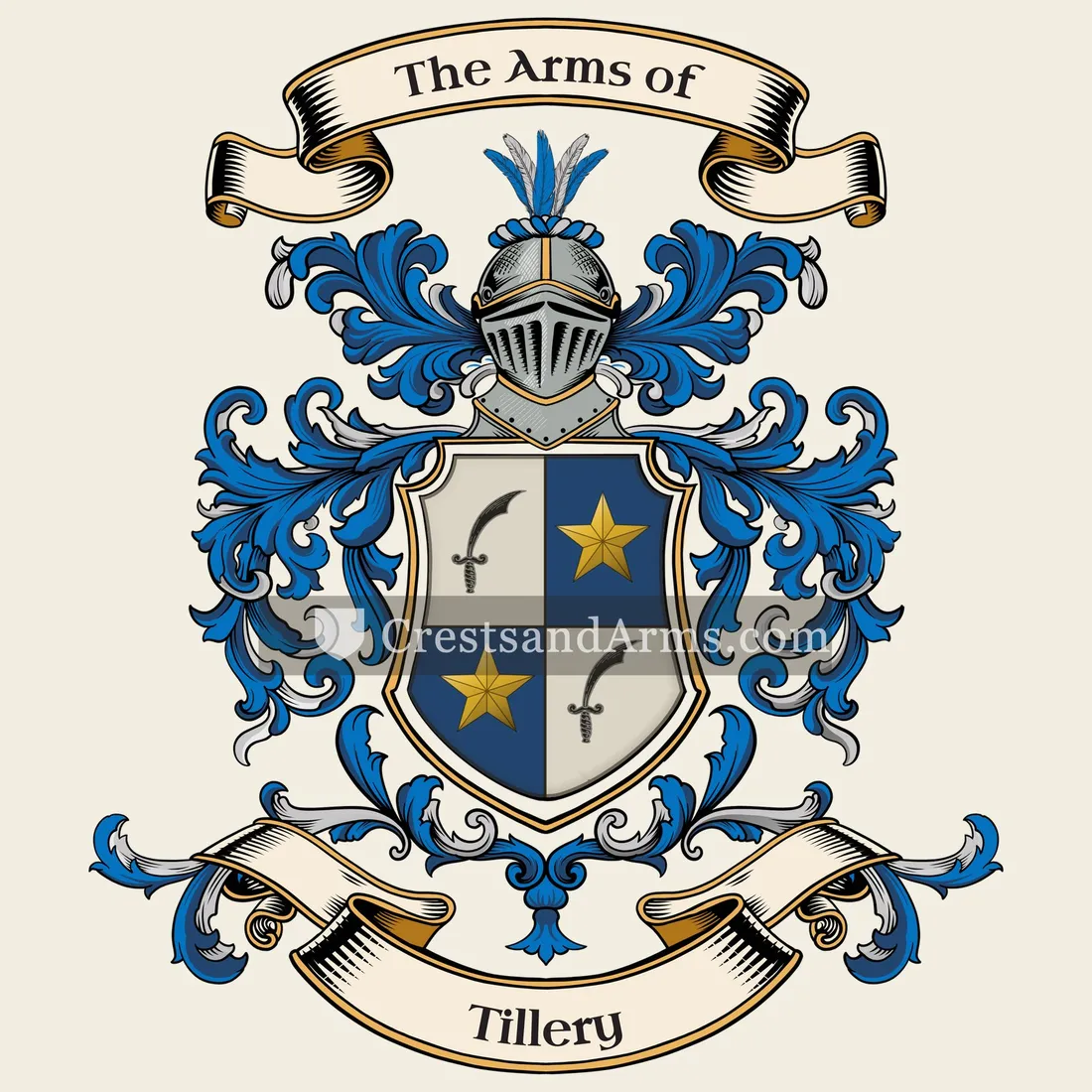
Symbols on this shield
swordJustice, and military honour
mulletThe third son, and a divine quality from above
Colours
Silver (Argent)Means: Peace and sincerity
Blue (Azure)Means: Loyalty and truth
Gold (Or)Means: Generosity
Historical info
Source
J. B. Rietstap, Armorial Général, Gouda: G. B. van Goor Zonen, 1884–87
Blazon (the actual original written record)
“Ec.: aux 1 et 4 d'arg. à une épée d'arg., garnie d'or, posée en bande, accolée d'un rameau de laurier de sin., fruité de gu.; aux 2 et 3 d'azur à une étoile (5) d'or. Deux cq. cour. C.: 1º trois pl. d'aut., une d'arg. entre deux d'azur; l. d'arg. et d'azur; 2º un vol à l'antique d'azur et d'or, l'aile d'azur ch. d'une étoile (5) d'or; l. d'or et d'azur.”
Francec. 1849
Digital archive packCoat of arms PNG, gold border print PDF, vector SVG and the certificate of authenticity. Sent to your email in minutes.
Map of France showing where the Tillery arms are recorded
The Tillery arms were recorded in France, c. 1849.
Arms such as these were typically recorded in Bretagne.
More families held coats of arms in Bretagne than anywhere else in France. The land was divided into many small estates rather than a few large ones, so far more households counted as gentry, and each needed a shield of its own to be told apart.
This is where the arms were entered in the register. Families often moved to other parts of the country, so the same name can turn up in more than one region.
The body that granted and recorded arms in France in this period.
How Arms Worked in France
In France, a coat of arms was a mark of honor that passed down through the male line to all legitimate descendants. Families often used the same shield without changes to show their shared heritage. If a branch wanted to stand out, they could add a small mark to their shield to show their specific place in the family tree.
Granting authority
The Juge d'armes de France acted as the official authority that regulated and verified coats of arms across the country.
How they got arms
Families typically inherited their arms from ancestors, though they could also receive them through royal grants or by proving their noble status.
Where arms were recorded
Coats of arms were officially recorded in the Armorial Général de France, which began its main collection in the year 1696.
The family's standing
Recorded among the armigerous families of France.
Origin & History of the Tillery Family in France
The name Tillery is deeply rooted in the historical landscape of the Brittany region of France. By the mid-19th century, families bearing this name were well-established in the local communities of Bretagne, a province known for its distinct cultural identity and maritime traditions. The name likely evolved from local geographic markers or occupational descriptions common to the rural populations of western France. During the 1840s, the region was undergoing significant social changes as the industrial revolution began to influence traditional farming and fishing lifestyles. Families like the Tillerys were part of this transition, living through a period where local records began to meticulously track births, marriages, and property ownership. These early members of the family were likely deeply connected to the land and the unique social structures that defined life in the French countryside during the 1800s.
Meaning of the Tillery family crest colors & symbols
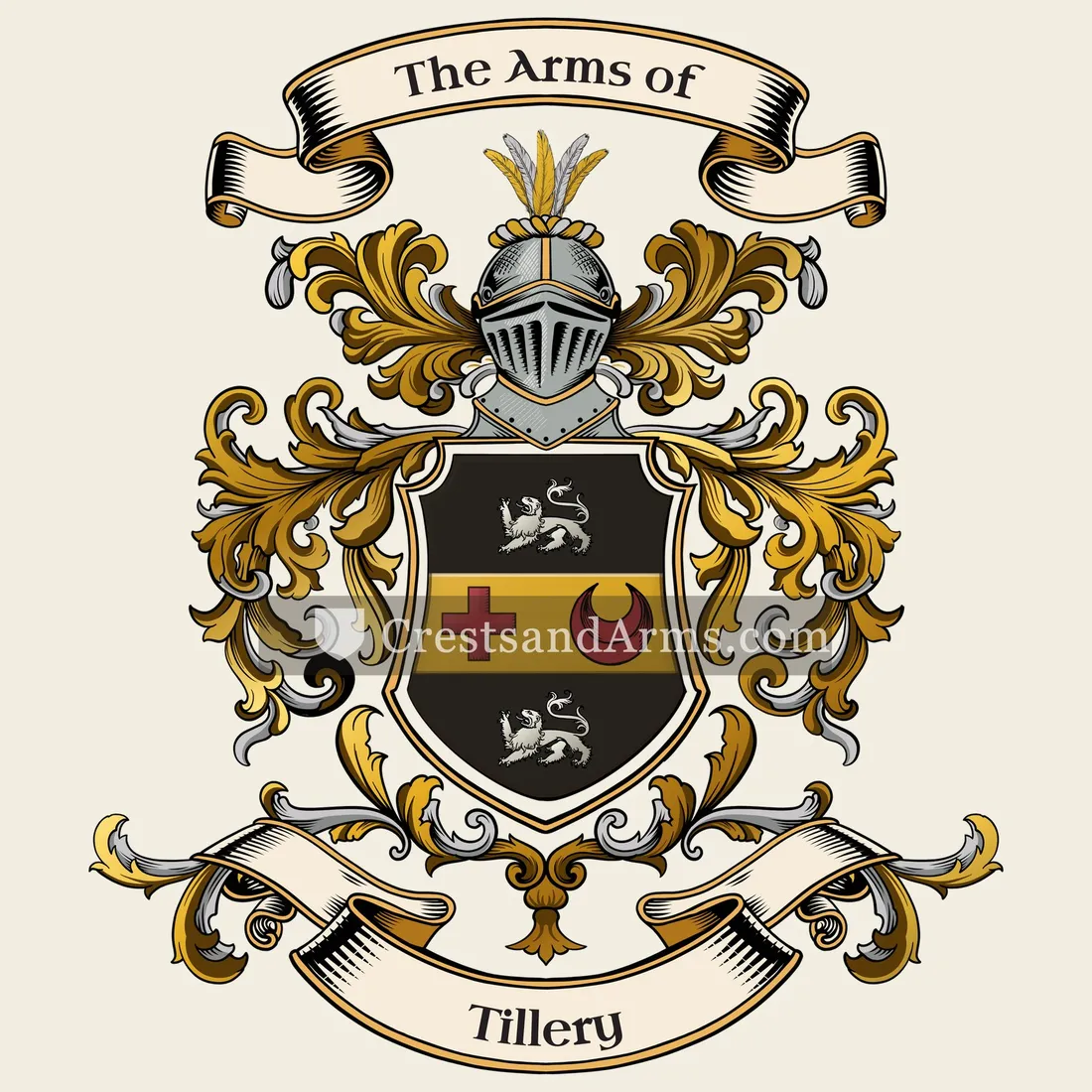
Symbols on this shield
fessThe military belt, and readiness to serve
cross symbolChristian faith and service
lionCourage, strength and royalty
crescentHonour by the sovereign, and the second son
Colours
Black (Sable)Means: Constancy
Gold (Or)Means: Generosity
Silver (Argent)Means: Peace and sincerity
Red (Gules)Means: Military strength
Historical info
Source
Sir Bernard Burke, The General Armory of England, Scotland, Ireland and Wales, London: Harrison & Sons, 1884
Blazon (the actual original written record)
“Sa. on a fess or, betw. two cats pass. ar. a cross formée enclosed by as many crescents gu”
MiddlesexMiddlesex, c. 1620
Digital archive packCoat of arms PNG, gold border print PDF, vector SVG and the certificate of authenticity. Sent to your email in minutes.
Map of England showing where the Tillery arms are recorded
The Tillery arms were recorded in Middlesex, c. 1620.
Middlesex was the county around London, and City money flowed straight into it. Merchants and officials bought estates within reach of the capital, and a new estate brought a coat of arms with it.
This is where the arms were entered in the register. Families often moved to other parts of the country, so the same name can turn up in more than one region.
The body that granted and recorded arms in England in this period.
James VI and I
Sovereign of the period
James VI and I
1603–1625
Reigning in France when the Tillery arms are first recorded.
How Arms Worked in England
English heraldry allowed arms to be shared by all legitimate descendants of the original owner. These symbols were treated as personal property that moved through the generations to all children. While the eldest son kept the original design, other family members could use the same shield without needing to change it or register their own unique versions.
Granting authority
The College of Arms in London has regulated the use of coats of arms throughout England and Wales since 1484.
How they got arms
Families typically obtained their coats of arms through a formal grant from the Crown or by proving their ancient right to them.
Where arms were recorded
All official coats of arms are recorded in the registers kept at the College of Arms, which date back to the fifteenth century.
The family's standing
Recorded among the armigerous families of Middlesex.
Origin & History of the Tillery Family in England
The Tillery family name finds its historical roots in the landscape of medieval England, where it likely emerged as a topographic surname for people living near a specific landmark or a small stream. By the early 17th century, the family had established a notable presence in the county of Middlesex. Records from 1620 confirm that members of the Tillery family were active in this region during a time of significant social and political change. As residents of a county that served as the gateway to London, these early ancestors were likely involved in the bustling trade, agriculture, or administrative life that defined the area surrounding the capital. Their presence in Middlesex suggests they were part of a growing class of families who were beginning to settle into more permanent roles within English society before many of their contemporaries began looking toward the colonies in the Americas.
Tillery Meaning & Related Branches
Root word
Tilleul
A linden or lime tree.
This name
TilleryA topographic name for someone who lived near a prominent linden tree.
also spelled
Tille
Tiler
Tillar
Tyller
Tyllar
Documented Sources
J. B. Rietstap, Armorial Général, Gouda: G. B. van Goor Zonen, 1884–87
Archives départementales d'Ille-et-Vilaine, État civil de Bretagne (1849)
Le Moyne de La Borderie, Arthur, Histoire de Bretagne, 1896
Meyer, Jean, Histoire de la Bretagne, 1966
Digital archive packCoat of arms PNG, gold border print PDF, vector SVG and the certificate of authenticity. Sent to your email in minutes.


 swordJustice, and military honour
 mulletThe third son, and a divine quality from above
 swordJustice, and military honour
 mulletThe third son, and a divine quality from above

 fessThe military belt, and readiness to serve
 cross symbolChristian faith and service
 lionCourage, strength and royalty
 crescentHonour by the sovereign, and the second son