Map of England showing where the Tineo arms are recorded
The Tineo arms were recorded in Lancaster, c. 1571.
Lancashire was divided among a great many small landed families, more than most northern counties. Estates were passed down whole rather than split up, so the same names hold the same ground for centuries in the records.
This is where the arms were entered in the register. Families often moved to other parts of the country, so the same name can turn up in more than one region.
The body that granted and recorded arms in England in this period.
Elizabeth I of England
Sovereign of the period
Elizabeth I of England
1558–1603
Reigning in England when the Tineo arms are first recorded.
How Arms Worked in England
English heraldry allowed arms to be shared by all legitimate descendants of the original owner. These symbols were treated as personal property that moved through the generations to all children. While the eldest son kept the original design, other family members could use the same shield without needing to change it or register their own unique versions.
Granting authority
The College of Arms in London has regulated the use of coats of arms throughout England and Wales since 1484.
How they got arms
Families typically obtained their coats of arms through a formal grant from the Crown or by proving their ancient right to them.
Where arms were recorded
All official coats of arms are recorded in the registers kept at the College of Arms, which date back to the fifteenth century.
The family's standing
Recorded among the armigerous families of Lancaster.
Origin & History of the Tineo Family in England
The family name Tineo carries a rich history that traces its roots back to the northern regions of Spain, specifically within the Asturias province. The name is locative in origin, meaning it was originally derived from the town of Tineo, where early ancestors established their presence. By the late 16th century, the family had expanded their reach significantly, as evidenced by records confirming that members of the Tineo family were settled in Lancaster, England, by 1571. This migration suggests that the family was involved in the active trade networks or religious movements that connected the Iberian Peninsula to Northern Europe during the Renaissance. As these early family members integrated into English society, they maintained the identity of their ancestral home while adapting to the cultural landscape of their new surroundings.
Related Branches & Arms
Root word
Tin
Derived from the Latin word tinus, referring to a laurel tree.
This name
TineoA locational surname originating from the town of Tineo in Asturias, Spain.
also spelled
Twyn
Twyne
Documented Sources
Sir Bernard Burke, The General Armory of England, Scotland, Ireland and Wales, London: Harrison & Sons, 1884
Lancashire Archives, Lancaster Parish Registers: Baptisms, Marriages and Burials (1571)
Canseco, Vicente de Cadenas y, Repertorio de blasones de la comunidad hispánica, 1987
Madoz, Pascual, Diccionario geográfico-estadístico-histórico de España y sus posesiones de Ultramar, 1849
Digital archive packCoat of arms PNG, gold border print PDF, vector SVG and the certificate of authenticity. Sent to your email in minutes.


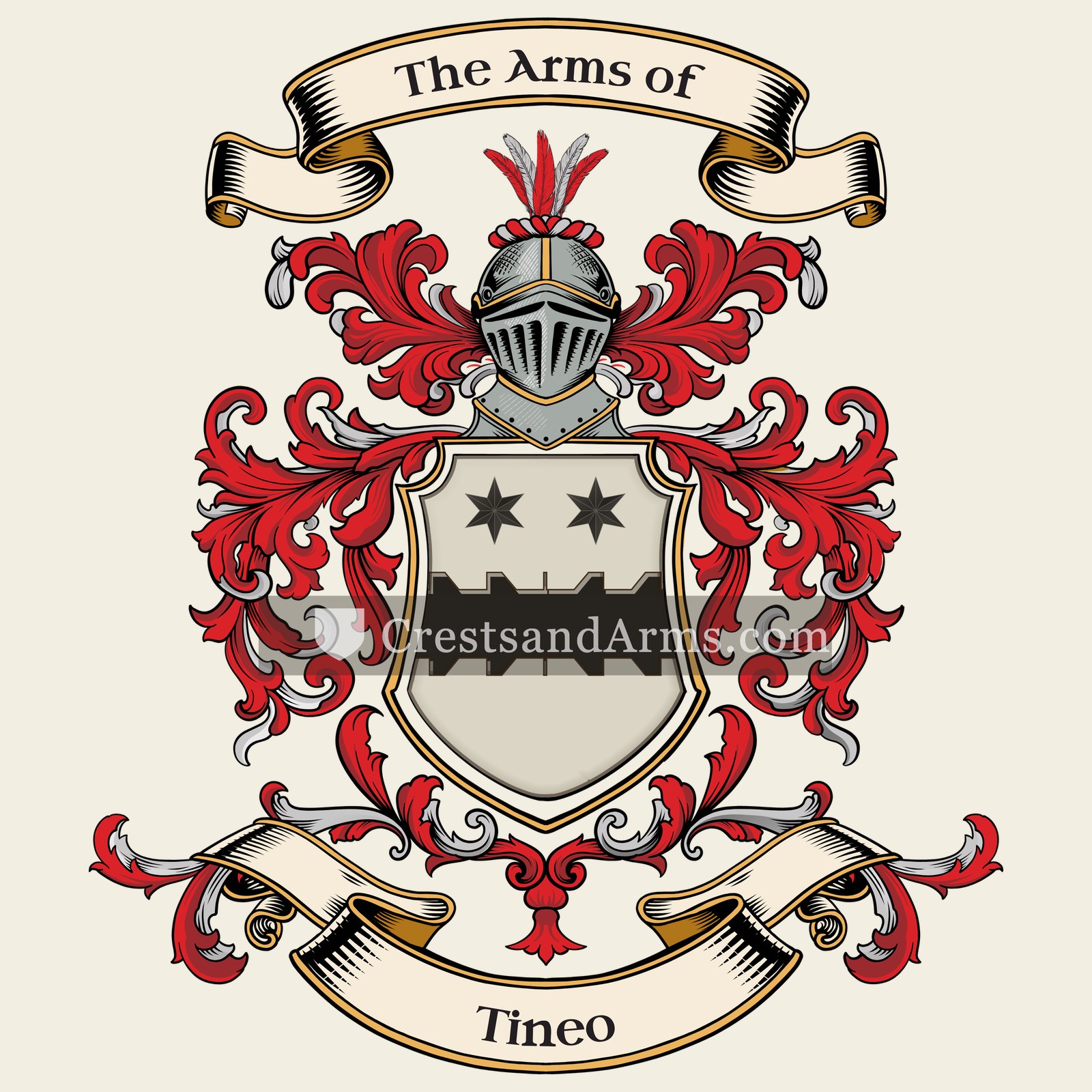
 fessThe military belt, and readiness to serve
 starThe celestial goddess, and nobility
 fessThe military belt, and readiness to serve
 starThe celestial goddess, and nobility