A record of documented arms, meaning and origin, researched for the Tipping family lines. Documented in 3 countries.
Reg. 7603 · Britain, T–V
Coat of Arms & Family Crest Details
Symbols on this shield
bendDefence, and the scarf of a commander
arms pheon arrowheadReadiness for battle, and the broad arrow of the sovereign
Colours
Gold (Or)Means: Generosity
Green (Vert)Means: Hope
Historical info
Source
J. B. Rietstap, Armorial Général, Gouda: G. B. van Goor Zonen, 1884–87
Blazon (the actual original written record)
“D'or à la bande engr. de sin., ch. de trois phéons du champ, posés dans le sens de la bande, les pointes en bas. Cq. cour. C.: une tête et col d'antelope de sin., accornée et crinée d'or.”
OxfordshireOxfordshire, c. 1697
Digital archive packCoat of arms PNG, gold border print PDF, vector SVG and the certificate of authenticity. Sent to your email in minutes.
Map of Britain showing where the Tipping arms are recorded
The Tipping arms were recorded in Oxfordshire, c. 1697.
This is where the arms were entered in the register. Families often moved to other parts of the country, so the same name can turn up in more than one region.
The body that granted and recorded arms in Britain in this period.
William III of England
Sovereign of the period
William III of England
1694–1702
Reigning in Britain when the Tipping arms are first recorded.
How Arms Worked in Britain
English heraldry allowed arms to be shared by all legitimate descendants of the original owner. These symbols were treated as personal property that moved through the generations to all children. While the eldest son kept the original design, other family members could use the same shield without needing to change it or register their own unique versions.
Granting authority
The College of Arms in London has regulated the use of coats of arms throughout England and Wales since 1484.
How they got arms
Families typically obtained their coats of arms through a formal grant from the Crown or by proving their ancient right to them.
Where arms were recorded
All official coats of arms are recorded in the registers kept at the College of Arms, which date back to the fifteenth century.
The family's standing
Recorded among the armigerous families of Oxfordshire.
Origin & History of the Tipping Family in Britain
The surname Tipping is an ancient English name that likely originated as a descriptive nickname for a person who possessed a distinct physical trait or a specific manner of speaking. By the late seventeenth century, the family had established a notable presence in Oxfordshire, where they were integrated into the local social and economic fabric. Historical records from 1697 confirm that members of the Tipping family were active landowners and participants in the community life of the region. During this period, families with this name were often associated with the rural gentry, moving through the countryside as farmers and local officials. While the name began as a simple identifier for an individual, it eventually became a permanent family marker that persisted across generations as the family expanded their influence throughout Southern England.
Coat of Arms & Family Crest Details
Symbols on this shield
chevronProtection, and faithful service completed
lionCourage, strength and royalty
axeThe execution of military duty
Colours
Blue (Azure)Means: Loyalty and truth
Gold (Or)Means: Generosity
Historical info
Source
Sir Bernard Burke, The General Armory of England, Scotland, Ireland and Wales, London: Harrison & Sons, 1884
Blazon (the actual original written record)
“Az. on a chev. betw. three lions' heads erased or, three battle axes of the first”
LancasterPreston · Lancaster, c. 1620
Digital archive packCoat of arms PNG, gold border print PDF, vector SVG and the certificate of authenticity. Sent to your email in minutes.
Map of England showing where the Tipping arms are recorded
The Tipping arms were recorded in Lancaster, c. 1620.
Lancashire was divided among a great many small landed families, more than most northern counties. Estates were passed down whole rather than split up, so the same names hold the same ground for centuries in the records.
This is where the arms were entered in the register. Families often moved to other parts of the country, so the same name can turn up in more than one region.
The body that granted and recorded arms in England in this period.
James VI and I
Sovereign of the period
James VI and I
1603–1625
Reigning in Britain when the Tipping arms are first recorded.
How Arms Worked in England
English heraldry allowed arms to be shared by all legitimate descendants of the original owner. These symbols were treated as personal property that moved through the generations to all children. While the eldest son kept the original design, other family members could use the same shield without needing to change it or register their own unique versions.
Granting authority
The College of Arms in London has regulated the use of coats of arms throughout England and Wales since 1484.
How they got arms
Families typically obtained their coats of arms through a formal grant from the Crown or by proving their ancient right to them.
Where arms were recorded
All official coats of arms are recorded in the registers kept at the College of Arms, which date back to the fifteenth century.
The family's standing
Recorded among the armigerous families of Lancaster.
Origin & History of the Tipping Family in England
The Tipping family name finds its historical roots in the northern regions of England, particularly within the county of Lancashire. By the early 17th century, the family was well-established in this area, as evidenced by records confirming their presence in Lancaster by 1620. The name itself is thought to be topographical or locational in origin, likely derived from an Old English term describing a person who lived near a specific landmark or a small settlement. During this period, families in Lancashire were often deeply connected to the local agricultural economy and the growing trade networks of the north. As the family grew, members spread across the region, participating in the local governance and social life of their parishes. This steady presence in Lancashire helped the name persist through centuries of social and economic change in England.
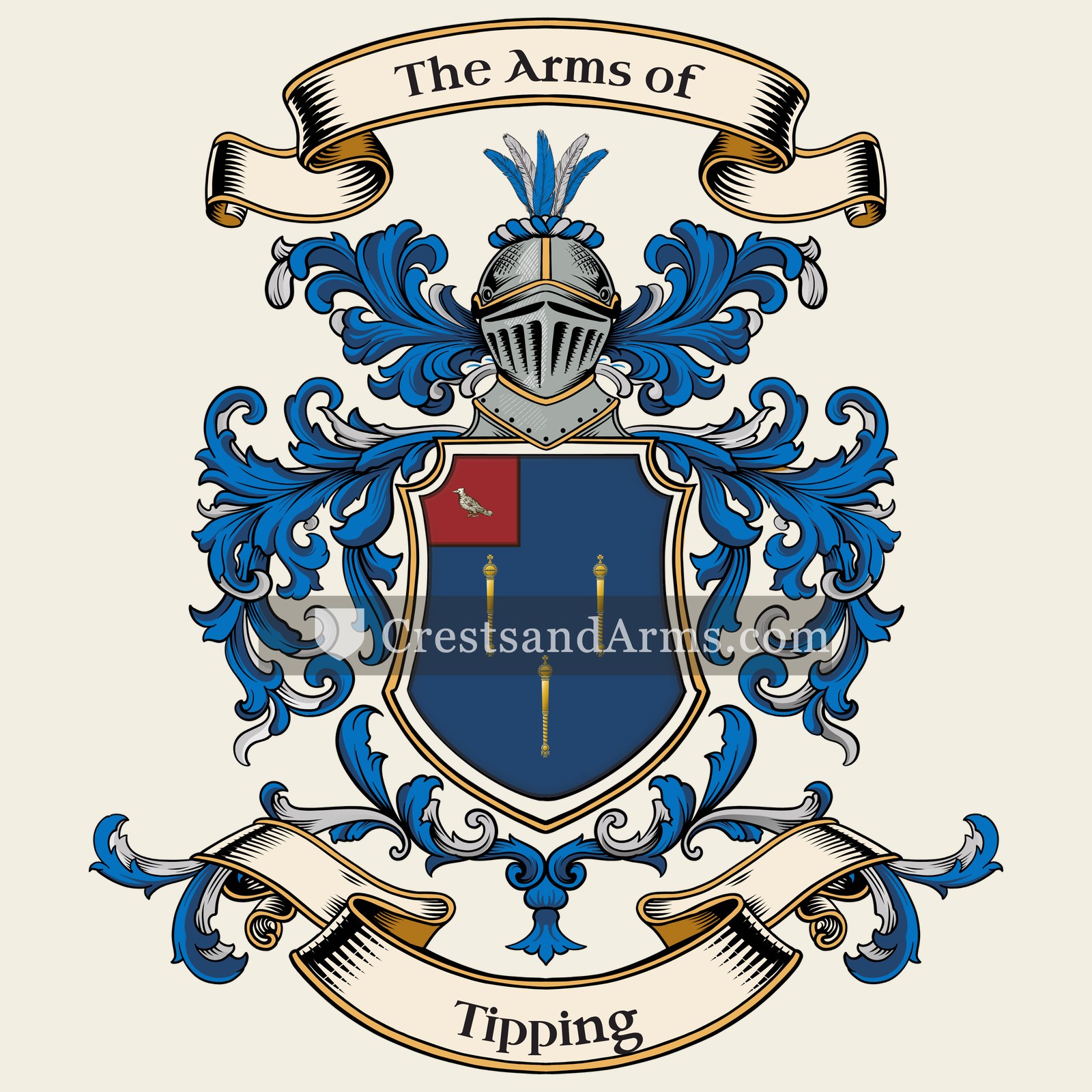
Coat of Arms & Family Crest Details
Symbols on this shield
cantonA mark of honour granted by the sovereign
sceptreRoyal authority and justice
dovePeace, love and the Holy Spirit
Colours
Blue (Azure)Means: Loyalty and truth
Red (Gules)Means: Military strength
Gold (Or)Means: Generosity
Silver (Argent)Means: Peace and sincerity
Historical info
Source
Sir Bernard Burke, The General Armory of England, Scotland, Ireland and Wales, London: Harrison & Sons, 1884
Blazon (the actual original written record)
“Az. three sceptres erect or, on a canton gu. a dove ar. holding in the beak an olive branch ppr”
LouthBeaulieu · Louth, c. 1645
Digital archive packCoat of arms PNG, gold border print PDF, vector SVG and the certificate of authenticity. Sent to your email in minutes.
Map of Ireland showing where the Tipping arms are recorded
The Tipping arms were recorded in Louth, c. 1645.
Louth is the smallest Irish county but sat on the road north from Dublin. Norman families took it early, held it under arms, and stayed, which is what put their shields on record.
This is where the arms were entered in the register. Families often moved to other parts of the country, so the same name can turn up in more than one region.
The body that granted and recorded arms in Ireland in this period.
Charles I of England
Sovereign of the period
Charles I of England
1625–1649
Reigning in Britain when the Tipping arms are first recorded.
How Arms Worked in Ireland
The Ulster King of Arms granted coats of arms to individuals who proved their social standing and good character. These symbols were typically inherited by all legitimate descendants of the original holder. If a family branch wanted a unique look, they could apply for a specific change to their design through the office to ensure their identity remained distinct.
Granting authority
The Ulster King of Arms acted as the official body that regulated and issued all coats of arms throughout Ireland.
How they got arms
Families obtained their arms through formal grants issued by the office after proving their eligibility and paying the required fees.
Where arms were recorded
All official grants were recorded in the registers held by the Ulster King of Arms starting from the year 1552.
The family's standing
Recorded among the armigerous families of Louth.
Origin & History of the Tipping Family in Ireland
The Tipping family established a notable presence in County Louth by the middle of the seventeenth century, a period marked by significant political and social upheaval in Ireland. Records from 1645 confirm that members of the family were settled in this region, which served as a strategic gateway between Dublin and the north. During this era, the family became integrated into the local landholding class, often navigating the complex transitions of property ownership that followed the Cromwellian conquest. By settling in Louth, the Tippings participated in the broader movement of families who helped shape the administrative and agricultural landscape of the area during the seventeenth and eighteenth centuries. Their history in the region reflects the broader patterns of migration and land settlement that defined the lives of many families in eastern Ireland during this transformative time.
Related Branches & Arms
Root word
Tip
A diminutive form of the medieval personal name Theobald.
This name
TippingA patronymic surname meaning son of Tip, derived from the name Theobald.
also spelled
Typing
Tippin
Tiping
Related arms
Makelfeldrecorded with Tipping, same area
Mekelfeldrecorded with Tipping, same area
Montgomeryrecorded with Tipping, same area
Pilkingtonrecorded with Tipping, same area
Documented Sources
J. B. Rietstap, Armorial Général, Gouda: G. B. van Goor Zonen, 1884–87
Bardsley, Charles Wareing, A Dictionary of English and Welsh Surnames, 1901
Reaney, P.H., A Dictionary of British Surnames, 1958
Oxfordshire History Centre, Quarter Sessions Records, 1697
Digital archive packCoat of arms PNG, gold border print PDF, vector SVG and the certificate of authenticity. Sent to your email in minutes.


 bendDefence, and the scarf of a commander
 arms pheon arrowheadReadiness for battle, and the broad arrow of the sovereign
 bendDefence, and the scarf of a commander
 arms pheon arrowheadReadiness for battle, and the broad arrow of the sovereign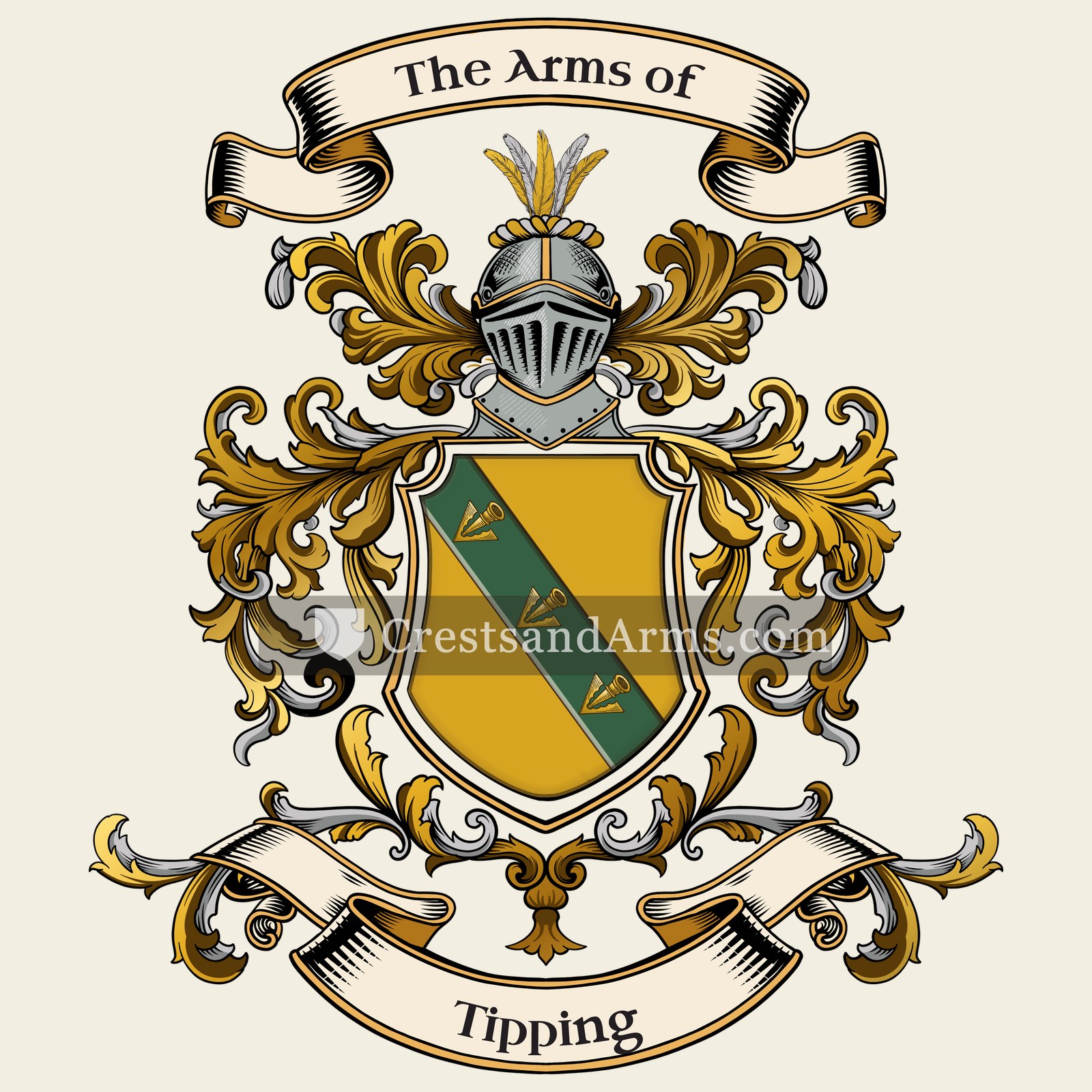


 chevronProtection, and faithful service completed
 lionCourage, strength and royalty
 axeThe execution of military duty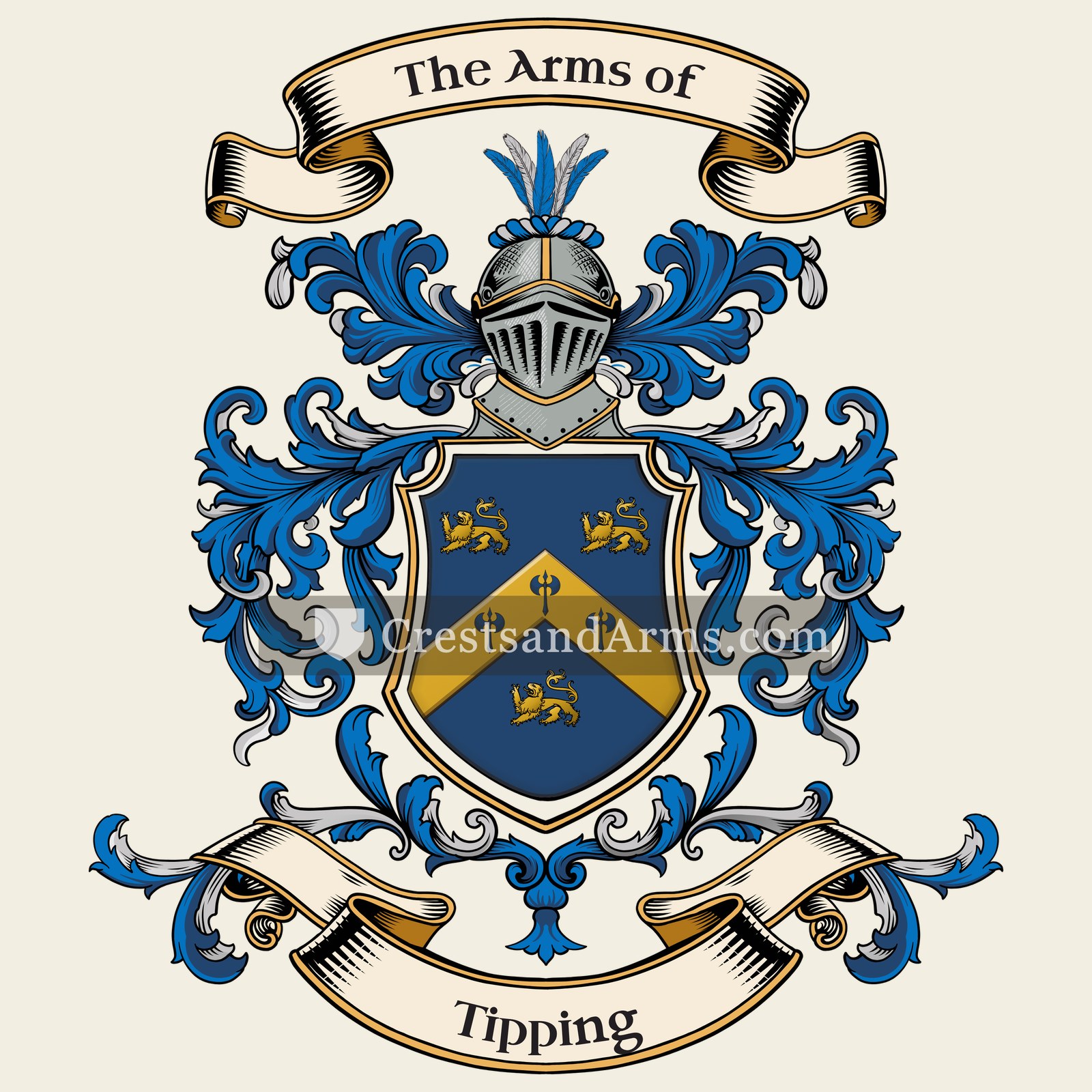

 cantonA mark of honour granted by the sovereign
 sceptreRoyal authority and justice
 dovePeace, love and the Holy Spirit