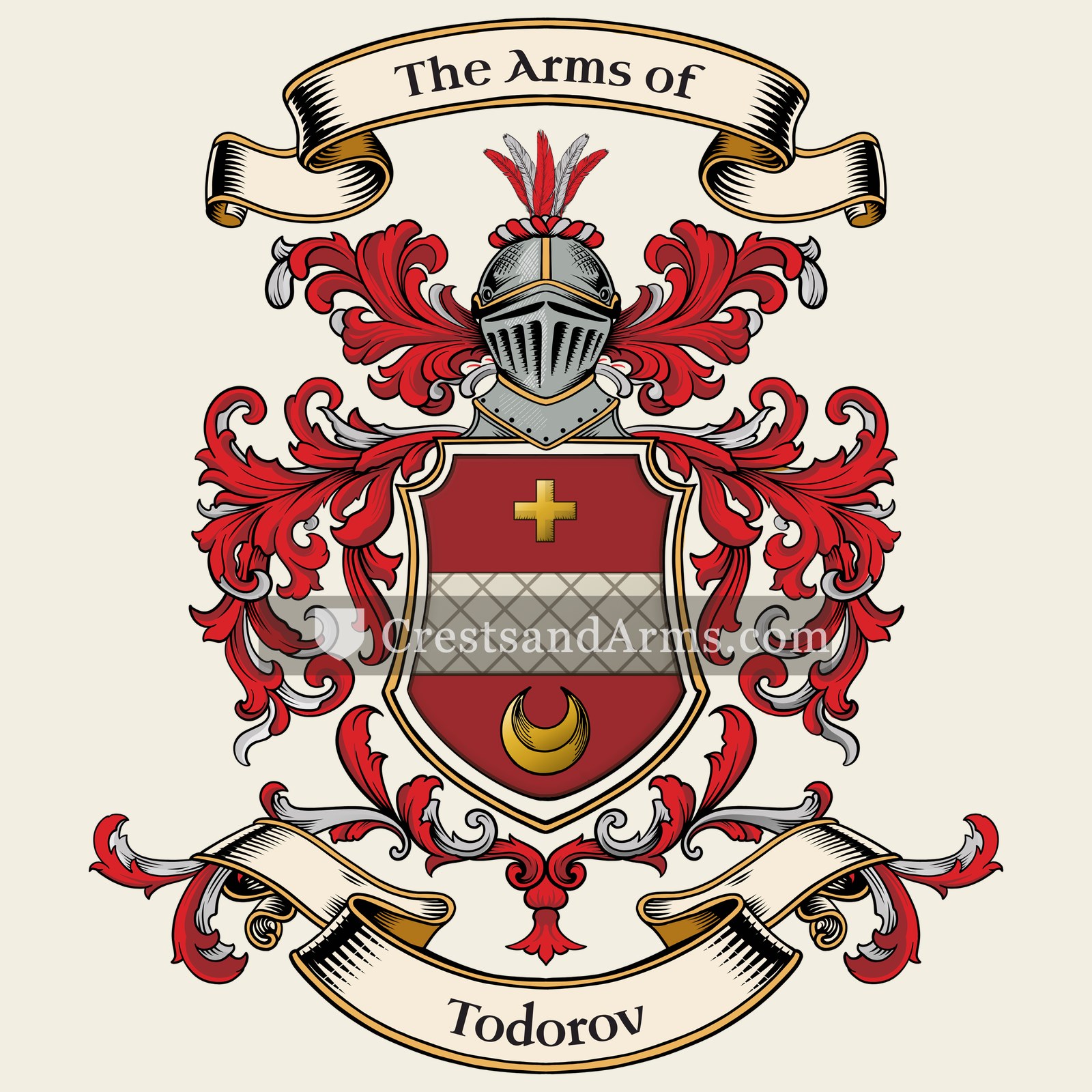
A record of documented arms, meaning and origin, researched for the Todorov family of Russia.
Reg. 9268 · Russian, T–V
Coat of Arms & Family Crest Details
Symbols on this shield
fessThe military belt, and readiness to serve
cross symbolChristian faith and service
crescentHonour by the sovereign, and the second son
Colours
Red (Gules)Means: Military strength
Silver (Argent)Means: Peace and sincerity
Gold (Or)Means: Generosity
Historical info
Source
J. B. Rietstap, Armorial Général, Gouda: G. B. van Goor Zonen, 1884–87
Blazon (the actual original written record)
“De gu. à la fasce d'arg., acc. en chef d'une croix de Lorraine d'or de trois traverses, la traverse inférieure posée en bande, et en p. d'un croiss. versé d'or. Cq. cour. C.: trois pl. d'aut., une de gu. entre deux d'arg. L.: à dextre d'arg. et de gu., à sen. d'or et de gu.”
Russiac. 1857
Digital archive packCoat of arms PNG, gold border print PDF, vector SVG and the certificate of authenticity. Sent to your email in minutes.
Map of Russia showing where the Todorov arms are recorded
The Todorov arms were recorded in Russia, c. 1857.
Arms such as these were typically recorded in Moscow.
Moscow held the Russian court, and rank there came from service rather than land. Families who served the Tsar were entered in the registers of nobility, and that entry is where their arms are recorded.
This is where the arms were entered in the register. Families often moved to other parts of the country, so the same name can turn up in more than one region.
The body that granted and recorded arms in Russia in this period.
Alexander II of Russia
Sovereign of the period
Alexander II of Russia
1855–1881
Reigning in Russia when the Todorov arms are first recorded.
How Arms Worked in Russia
Russian heraldry was strictly tied to the nobility and the state service system. Families proved their ancient status or earned new rank to receive an official grant from the Tsar. These symbols were then inherited by all legitimate children of the noble line. If a family lacked proof of their status, they were often excluded from the official records entirely.
Granting authority
The Herald Master's Office acted as the central state body that strictly regulated and verified all noble heraldic symbols.
How they got arms
Families typically received their arms through a formal state grant or by proving their noble status to the government authorities.
Where arms were recorded
All approved coats of arms were officially recorded in the General Armorial of the Noble Families of the Russian Empire starting in 1797.
The family's standing
Recorded among the armigerous families of Russia.
Origin & History of the Todorov Family in Russia
The surname Todorov is a patronymic name, which means it was originally formed by adding a suffix to a father’s given name. In this case, the name is derived from Todor, a common Slavic variation of the Greek name Theodore, meaning gift of God. By the mid-19th century, the family had established a presence in Moscow, a city that served as a major cultural and economic hub during the Russian Empire. Records from 1857 indicate that the family was already integrated into the urban life of the region during a time of significant social change. As the family settled in Moscow, they likely participated in the growing merchant or professional classes that defined the city’s expansion before the turn of the century. This history reflects the broader movement of families across Eastern Europe who adopted stable surnames to track their lineage and social standing in rapidly developing imperial centers.
Related Branches & Arms
Root word
Theodoros
Derived from Greek words meaning gift of God.
This name
TodorovA patronymic surname meaning son of Todor, a Slavic variation of Theodore.
also spelled
Todorov
Documented Sources
J. B. Rietstap, Armorial Général, Gouda: G. B. van Goor Zonen, 1884–87
Unbegaun, Boris Ottokar, Russian Surnames, 1972
Central State Archive of Moscow (Tsentral'nyy gosudarstvennyy arkhiv Moskvy), Fond 203 (Records of the Moscow Spiritual Consistory)
Digital archive packCoat of arms PNG, gold border print PDF, vector SVG and the certificate of authenticity. Sent to your email in minutes.


 fessThe military belt, and readiness to serve
 cross symbolChristian faith and service
 crescentHonour by the sovereign, and the second son
 fessThe military belt, and readiness to serve
 cross symbolChristian faith and service
 crescentHonour by the sovereign, and the second son