Map of Spain showing where the Tomac arms are recorded
The Tomac arms were recorded in Murcie, c. 1722.
This is where the arms were entered in the register. Families often moved to other parts of the country, so the same name can turn up in more than one region.
The body that granted and recorded arms in Spain in this period.
Philip V of Spain
Sovereign of the period
Philip V of Spain
1714–1724
Reigning in Spain when the Tomac arms are first recorded.
How Arms Worked in Spain
In Spain, a coat of arms was considered a form of property that belonged to the entire family line. These arms were passed down from a father to all his children equally. Younger branches of the family usually kept the original design without needing to add any special marks to distinguish their specific line.
Granting authority
The Cronista Rey de Armas was the official body that regulated and granted coats of arms throughout Spain.
How they got arms
Families often obtained their arms through royal grants or by proving their noble status to the official heraldic authority.
Where arms were recorded
Coats of arms were officially recorded in the registers of the Cronista Rey de Armas starting in 1496.
The family's standing
Recorded among the armigerous families of Spain.
Origin & History of the Tomac Family in Spain
The surname Tomac has deep roots in the region of Murcia, Spain, where records confirm the family was established by at least 1722. The name likely evolved from regional naming traditions that linked individuals to specific geographic locations or ancestral occupations common to the Iberian Peninsula during the eighteenth century. Families like the Tomacs often played vital roles in the local agricultural and civic life of Murcia, which was a bustling center for trade and farming at the time. As the family grew, they integrated into the social fabric of the community, contributing to the development of local parishes and regional governance. Over generations, the name became a marker of the family’s enduring presence in the area, reflecting a history of resilience and adaptation within the changing landscape of southeastern Spain.
Tomac Meaning & Related Branches
Root word
Thomas
Aramaic word meaning twin
This name
TomacA patronymic surname derived from the given name Thomas, signifying son of the twin.
also spelled
Thomass
Thomas
Documented Sources
J. B. Rietstap, Armorial Général, Gouda: G. B. van Goor Zonen, 1884–87
Archivo General de la Región de Murcia, Protocolos Notariales de Murcia, 1722
Archivo Diocesano de Murcia, Libros de Bautismos y Matrimonios de la Parroquia de San Bartolomé, 1722
Digital archive packCoat of arms PNG, gold border print PDF, vector SVG and the certificate of authenticity. Sent to your email in minutes.


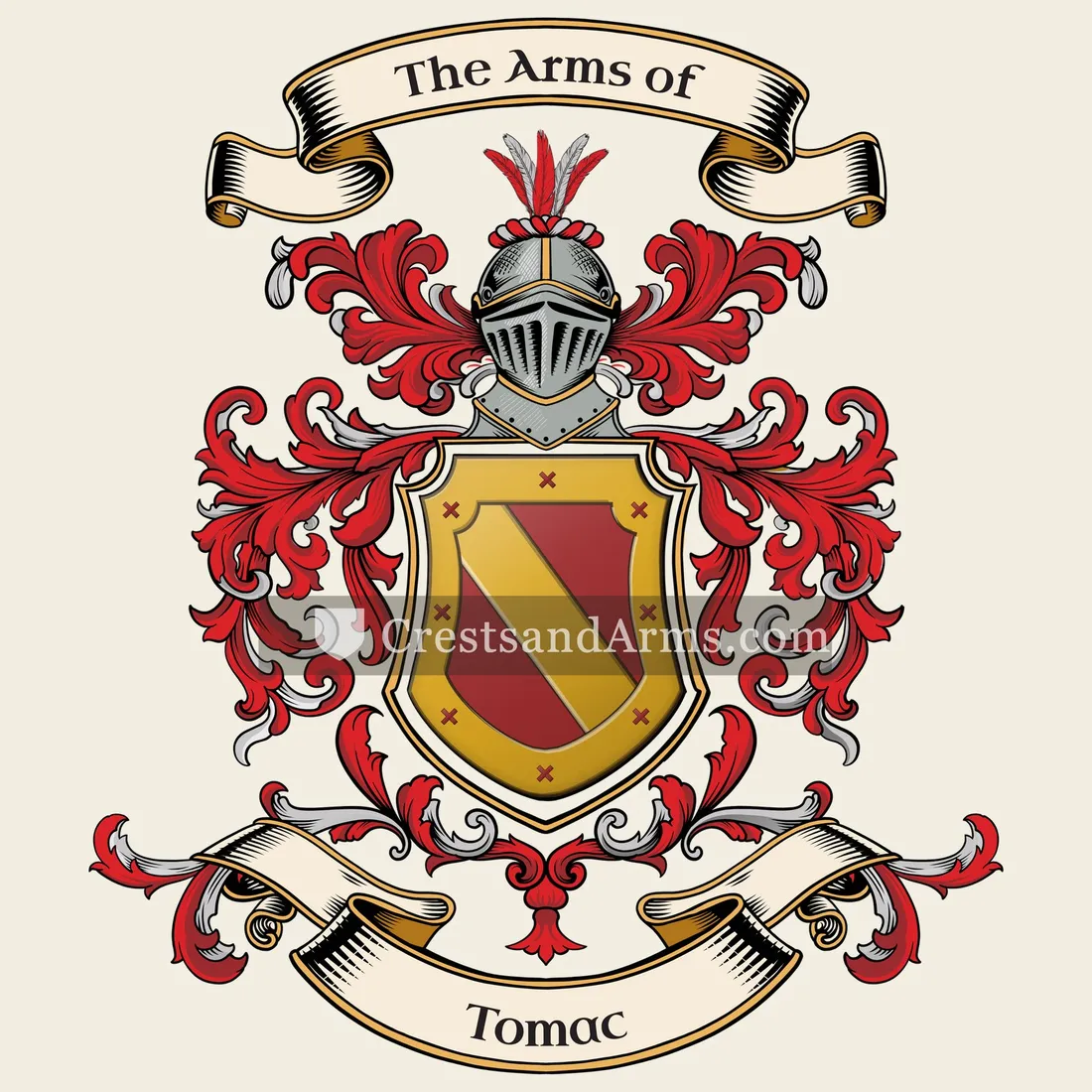
 bendDefence, and the scarf of a commander
 saltire coupedResolution, and the cross of St Andrew
 bendDefence, and the scarf of a commander
 saltire coupedResolution, and the cross of St Andrew