Map of England showing where the Tomescu arms are recorded
The Tomescu arms were recorded in Warwick, c. 1620.
Warwickshire lay in the middle of England, and its landed families were spread evenly across it rather than gathered in one corner. A great many held a single manor each, and each of those holdings brought its own claim to arms.
This is where the arms were entered in the register. Families often moved to other parts of the country, so the same name can turn up in more than one region.
The body that granted and recorded arms in England in this period.
James VI and I
Sovereign of the period
James VI and I
1603–1625
Reigning in England when the Tomescu arms are first recorded.
How Arms Worked in England
English heraldry allowed arms to be shared by all legitimate descendants of the original owner. These symbols were treated as personal property that moved through the generations to all children. While the eldest son kept the original design, other family members could use the same shield without needing to change it or register their own unique versions.
Granting authority
The College of Arms in London has regulated the use of coats of arms throughout England and Wales since 1484.
How they got arms
Families typically obtained their coats of arms through a formal grant from the Crown or by proving their ancient right to them.
Where arms were recorded
All official coats of arms are recorded in the registers kept at the College of Arms, which date back to the fifteenth century.
The family's standing
Recorded among the armigerous families of Warwick.
Origin & History of the Tomescu Family in England
The family name Tomescu originates from the Romanian region, where it functions as a patronymic surname derived from the name Toma, meaning Thomas. While the name is deeply rooted in Eastern European linguistic traditions, historical records indicate that members of the family were present in Warwick, England, as early as 1620. This suggests that early ancestors were part of a small wave of continental migrants who traveled to the English Midlands during the seventeenth century. These individuals likely integrated into the local trades and agricultural communities of the time. By settling in Warwick, the family became part of a diverse social landscape that was beginning to expand through international movement. Their presence in official English records from this period highlights how families often carried their cultural identities across borders while adapting to new environments.
Related Branches & Arms
Root word
Thomas
Aramaic name meaning twin.
This name
TomescuA Romanian patronymic surname indicating descent from a person named Thomas.
also spelled
Thomes
Toms
Thoms
Documented Sources
Sir Bernard Burke, The General Armory of England, Scotland, Ireland and Wales, London: Harrison & Sons, 1884
Warwickshire County Record Office, Quarter Sessions Records (1620)
Densusianu, Ovid, Histoire de la langue roumaine (1901)
Iordan, Iorgu, Dicționar al numelor de familie românești (1983)
Digital archive packCoat of arms PNG, gold border print PDF, vector SVG and the certificate of authenticity. Sent to your email in minutes.


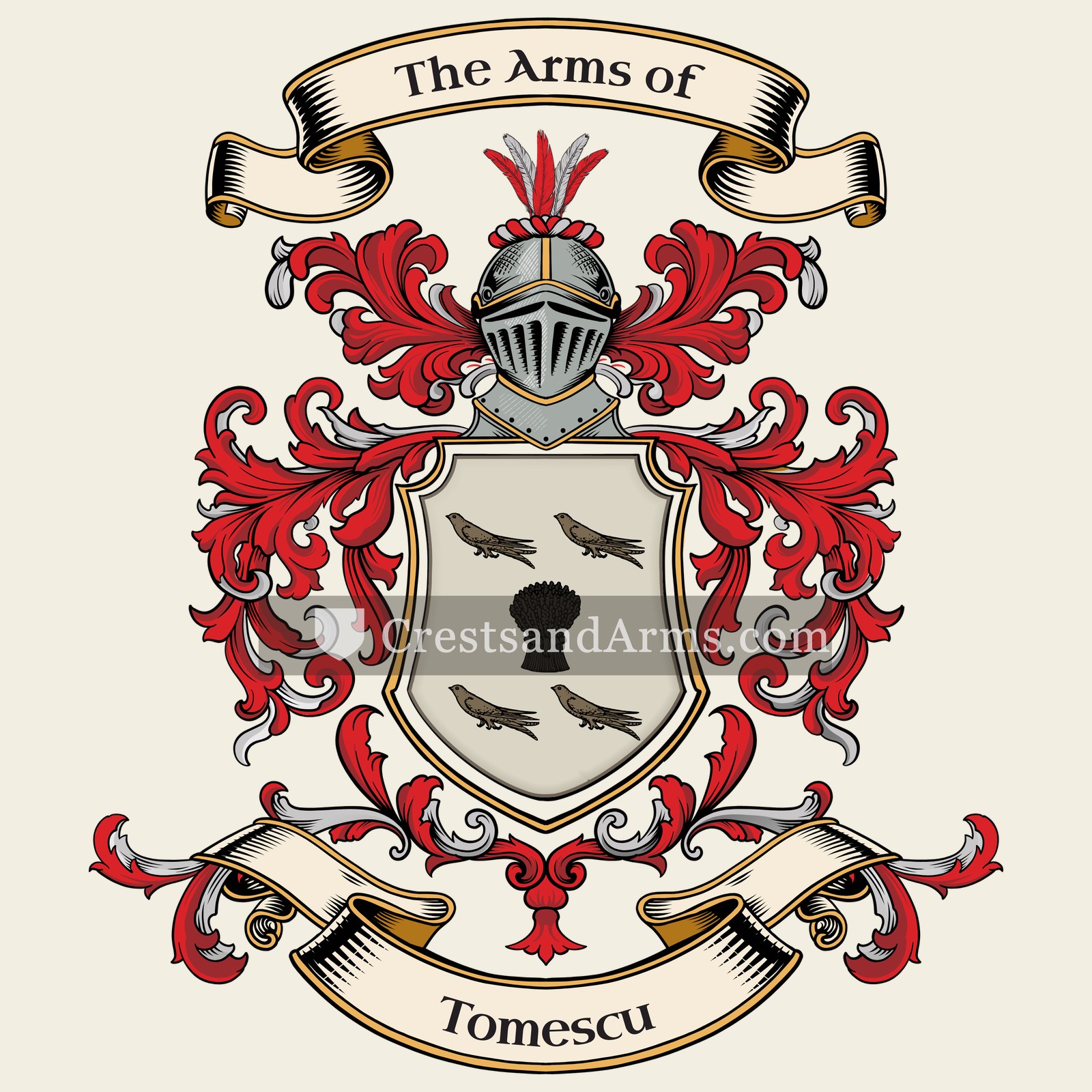
 martletA younger son, who must win his own land
 wheatsheafPlenty, and the harvest of one's own labour
 martletA younger son, who must win his own land
 wheatsheafPlenty, and the harvest of one's own labour