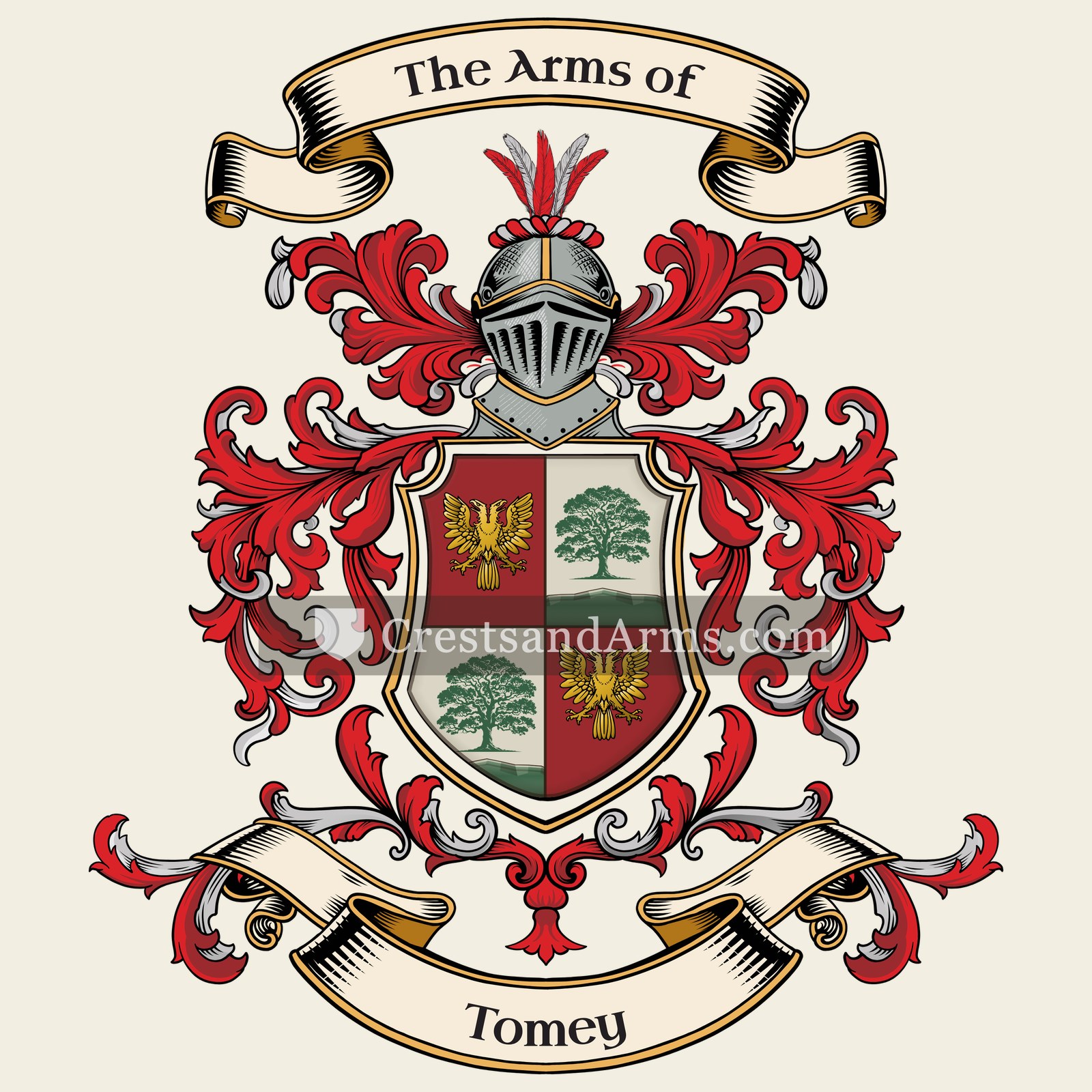
A record of documented arms, meaning and origin, researched for the Tomey family of France.
Reg. 7927 · French, T–V
Coat of Arms & Family Crest Details
Symbols on this shield
mountThe ground held, and steadfastness upon it
eagleNobility, strength and a keen mind
treeLife, endurance and deep roots
Colours
Red (Gules)Means: Military strength
Silver (Argent)Means: Peace and sincerity
Green (Vert)Means: Hope
Gold (Or)Means: Generosity
Historical info
Source
J. B. Rietstap, Armorial Général, Gouda: G. B. van Goor Zonen, 1884–87
Blazon (the actual original written record)
“Ec.: aux 1 et 4 de gu. à l'aigle d'or, celle du 1 cont.; aux 2 et 3 d'arg. à un arbre terrassé de sin. Deux cq. cour. C.: 1° l'aigle du 1; 1. d'or et de gu.; 2° un arbre de sin., entre deux prob. coupées alt. d'or et d'azur; l. d'arg. et de sin.”
Francec. 1725
Digital archive packCoat of arms PNG, gold border print PDF, vector SVG and the certificate of authenticity. Sent to your email in minutes.
Map of France showing where the Tomey arms are recorded
The Tomey arms were recorded in France, c. 1725.
Arms such as these were typically recorded in Bretagne.
More families held coats of arms in Bretagne than anywhere else in France. The land was divided into many small estates rather than a few large ones, so far more households counted as gentry, and each needed a shield of its own to be told apart.
This is where the arms were entered in the register. Families often moved to other parts of the country, so the same name can turn up in more than one region.
The body that granted and recorded arms in France in this period.
Louis XV of France
Sovereign of the period
Louis XV of France
1715–1774
Reigning in France when the Tomey arms are first recorded.
How Arms Worked in France
In France, a coat of arms was a mark of honor that passed down through the male line to all legitimate descendants. Families often used the same shield without changes to show their shared heritage. If a branch wanted to stand out, they could add a small mark to their shield to show their specific place in the family tree.
Granting authority
The Juge d'armes de France acted as the official authority that regulated and verified coats of arms across the country.
How they got arms
Families typically inherited their arms from ancestors, though they could also receive them through royal grants or by proving their noble status.
Where arms were recorded
Coats of arms were officially recorded in the Armorial Général de France, which began its main collection in the year 1696.
The family's standing
Recorded among the armigerous families of France.
Origin & History of the Tomey Family in France
The family name Tomey finds its historical roots in the rugged landscape of Bretagne, France, where records confirm members of the family were established by 1725. During the eighteenth century, this region was defined by a strong sense of local identity and a deep connection to the land. Families like the Tomeys were often integrated into the rural economy, likely working as skilled laborers or farmers who contributed to the unique cultural fabric of the province. Because Bretagne remained somewhat isolated from the central politics of Paris, families in this area often maintained long-standing traditions and local customs that were passed down through generations. The name itself likely evolved from regional linguistic patterns common to the western coast of France, reflecting the migration and settlement habits of the people living in the coastal parishes during that era.
Related Branches & Arms
Root word
Thomas
Aramaic name meaning twin.
This name
TomeyA patronymic surname derived from the given name Thomas, indicating a descendant of Thomas.
also spelled
Thomi
Tomy
Documented Sources
J. B. Rietstap, Armorial Général, Gouda: G. B. van Goor Zonen, 1884–87
Archives départementales du Finistère, Registres paroissiaux et d'état civil
Archives départementales d'Ille-et-Vilaine, Fonds de l'intendance de Bretagne
Croix, Alain, La Bretagne aux 16e et 17e siècles: la vie, la mort, la foi, 1984
Le Moyne de La Borderie, Arthur, Histoire de Bretagne, 1905
Digital archive packCoat of arms PNG, gold border print PDF, vector SVG and the certificate of authenticity. Sent to your email in minutes.


 mountThe ground held, and steadfastness upon it
 eagleNobility, strength and a keen mind
 treeLife, endurance and deep roots
 mountThe ground held, and steadfastness upon it
 eagleNobility, strength and a keen mind
 treeLife, endurance and deep roots