Map of Italy showing where the Torigian arms are recorded
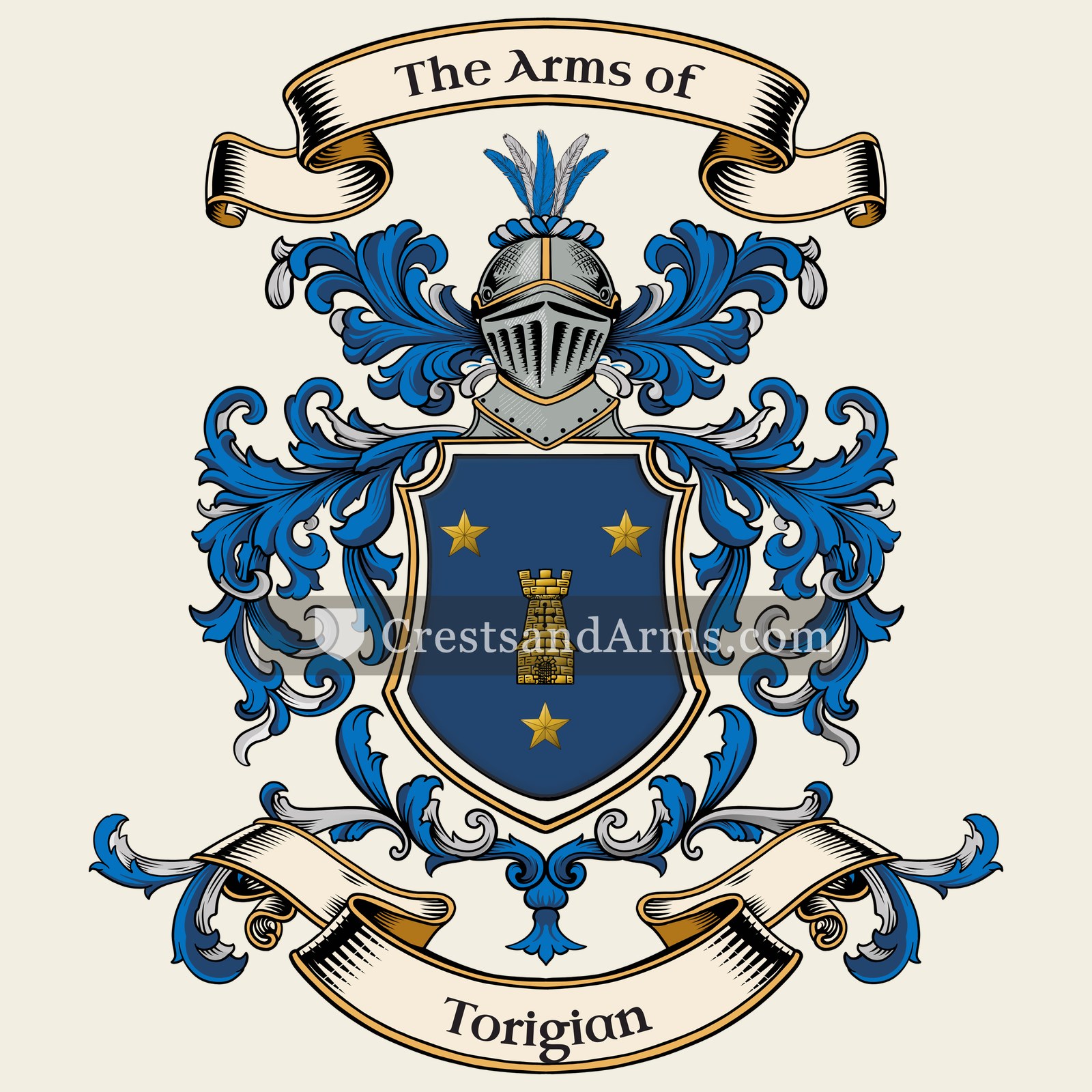
The Torigian arms were recorded in Florence, c. 1775.
This is where the arms were entered in the register. Families often moved to other parts of the country, so the same name can turn up in more than one region.
The body that granted and recorded arms in Italy in this period.
Alvise Giovanni Mocenigo
Sovereign of the period
Alvise Giovanni Mocenigo
1763–1778
Reigning in Italy when the Torigian arms are first recorded.
How Arms Worked in Italy
In the Italian states, coats of arms were often used by noble families to show their status and history. These symbols were passed down through the generations to all legitimate male descendants. Younger branches of a family usually kept the original design but sometimes added small changes to distinguish their specific line from the main branch.
Granting authority
Various local rulers and city governments controlled the use of coats of arms across the different Italian states.
How they got arms
Families often assumed their own arms or received them as official grants from local lords, popes, or city councils.
Where arms were recorded
Arms were recorded in local city archives or private family books rather than in one single national register.
The family's standing
Recorded among the armigerous families of Italy.
Origin & History of the Torigian Family in Italy
The Torigian family name carries a history rooted in the cultural crossroads of the Mediterranean. By 1775, records confirm that members of the family were established in Florence, a city renowned at the time for its vibrant trade and intellectual exchange. The name itself is believed to be a variation of the Armenian name Toros, which is derived from the Greek name Theodore, meaning gift of God. As the family moved through different regions, the spelling evolved to reflect the linguistic patterns of their new homes. Living in Florence during the late eighteenth century suggests that the family was likely involved in the city's active merchant class or artisanal guilds, which were the backbone of the local economy. This period of residence highlights the family's ability to integrate into diverse European societies while maintaining a distinct identity that connected them to their ancestral roots.
Related Branches & Arms
Root word
Torrigia
Derived from the Italian word for a small tower or turret.
This name
TorigianAn occupational or locative surname referring to someone who lived near or worked in a tower.
also spelled
Torrigiany
Torrijiani
Documented Sources
J. B. Rietstap, Armorial Général, Gouda: G. B. van Goor Zonen, 1884–87
Acharian, Hrachia. Hayots Anjnanunneri Bararan (Dictionary of Armenian Personal Names). 1942
Billioud, Jacques. Le Livre d'or du commerce de Marseille au XVIIIe siècle. 1951
Archivio di Stato di Firenze, Stato Civile della Restaurazione
Archivio di Stato di Firenze, Registri delle Arti e dei Mestieri
Digital archive packCoat of arms PNG, gold border print PDF, vector SVG and the certificate of authenticity. Sent to your email in minutes.


 towerGrandeur and solidity, and a stronghold defended
 mulletThe third son, and a divine quality from above
 towerGrandeur and solidity, and a stronghold defended
 mulletThe third son, and a divine quality from above