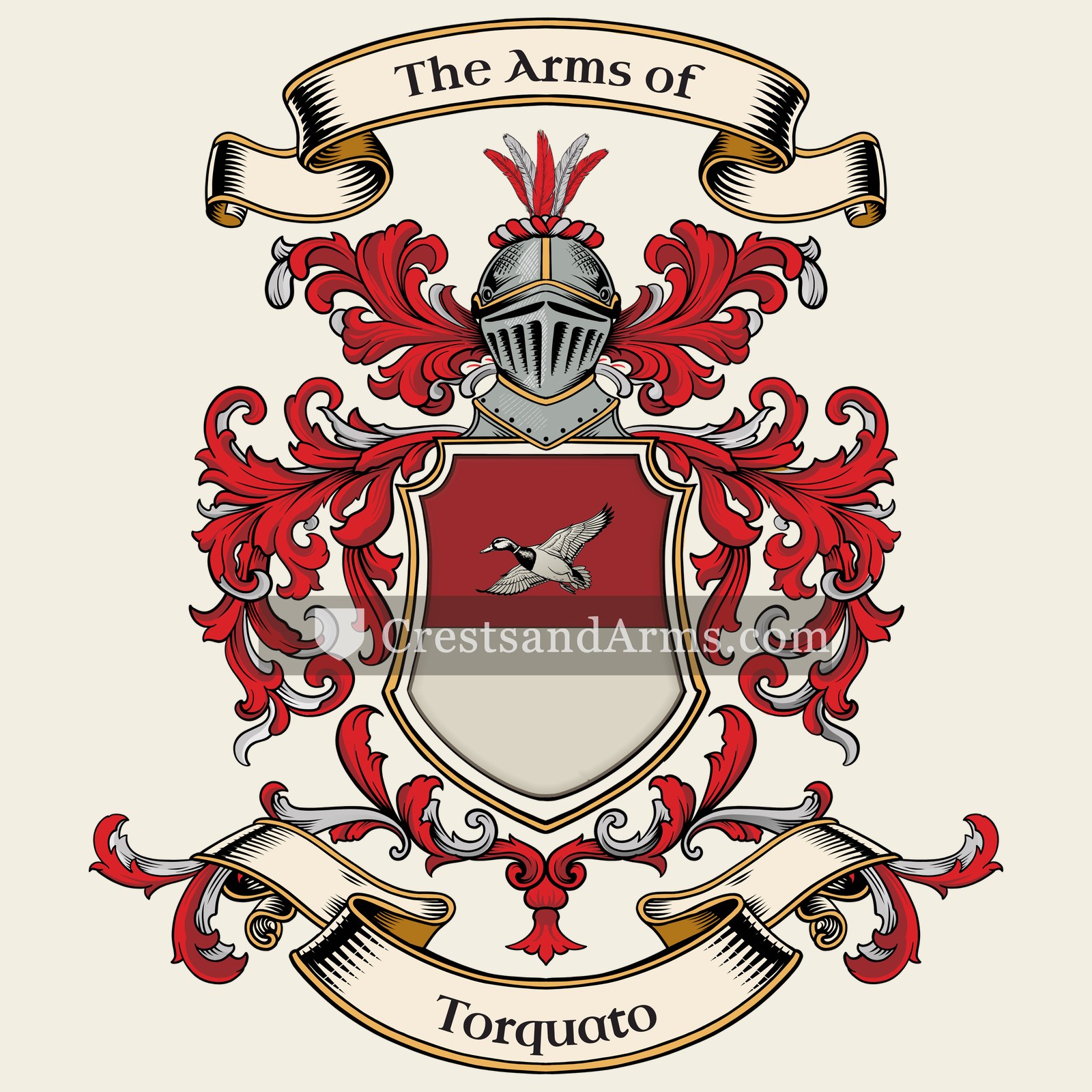
A record of documented arms, meaning and origin, researched for the Torquato family of Italy.
Reg. 9040 · Italian, T–V
Coat of Arms & Family Crest Details
Symbols on this shield
duckResourcefulness on land and water
Colours
Red (Gules)Means: Military strength
Silver (Argent)Means: Peace and sincerity
Historical info
Source
J. B. Rietstap, Armorial Général, Gouda: G. B. van Goor Zonen, 1884–87
Blazon (the actual original written record)
“Coupé: au 1 de gu. à une oie d'arg., bq. et m. d'or, cour. d'or, ceint d'un collier du même auquel est attaché une médaille aussi d'or; au 2 d'arg. et d'azur. Cq. cour. C.: l'oie, iss. L. d'arg. et de gu.”
DalmatiaSerbie · Dalmatia, c. 1775
Digital archive packCoat of arms PNG, gold border print PDF, vector SVG and the certificate of authenticity. Sent to your email in minutes.
Map of Italy showing where the Torquato arms are recorded
The Torquato arms were recorded in Dalmatia, c. 1775.
Dalmatia was a string of walled towns along the Adriatic coast, each with its own leading families. Sea trade made them wealthy, and the towns kept lists of the houses entitled to arms.
This is where the arms were entered in the register. Families often moved to other parts of the country, so the same name can turn up in more than one region.
The body that granted and recorded arms in Italy in this period.
Alvise Giovanni Mocenigo
Sovereign of the period
Alvise Giovanni Mocenigo
1763–1778
Reigning in Italy when the Torquato arms are first recorded.
How Arms Worked in Italy
In the Italian states, coats of arms were often used by noble families to show their status and history. These symbols were passed down through the generations to all legitimate male descendants. Younger branches of a family usually kept the original design but sometimes added small changes to distinguish their specific line from the main branch.
Granting authority
Various local rulers and city governments controlled the use of coats of arms across the different Italian states.
How they got arms
Families often assumed their own arms or received them as official grants from local lords, popes, or city councils.
Where arms were recorded
Arms were recorded in local city archives or private family books rather than in one single national register.
The family's standing
Recorded among the armigerous families of Dalmatia.
Origin & History of the Torquato Family in Italy
The surname Torquato finds its roots in the Latin word *torques*, which refers to a twisted metal collar or necklace worn as a mark of honor in ancient times. While the name originated in Italy, historical records confirm that members of the family established a notable presence in the Dalmatian region by 1775. During this period, Dalmatia served as a vital crossroads for trade and cultural exchange between the Venetian Republic and the surrounding Balkan territories. Families like the Torquatos often moved across the Adriatic Sea to pursue opportunities in maritime commerce or local administration. By settling in coastal cities, these individuals integrated into the unique social fabric of the region, which blended Mediterranean traditions with Slavic influences. This migration pattern highlights the family’s role in the long history of movement and connection that defined the Adriatic coastline during the eighteenth century.
Related Branches & Arms
Root word
Torquatus
Derived from the Latin word for a twisted metal neck collar.
This name
TorquatoRefers to one who wears a torc or a twisted necklace as a mark of distinction.
also spelled
Torquatovitch
Torquatowich
Documented Sources
J. B. Rietstap, Armorial Général, Gouda: G. B. van Goor Zonen, 1884–87
Fisković, Cvito. Dalmatinske studije. 1975
State Archives in Zadar (Državni arhiv u Zadru). Fond: Obiteljski arhiv (Family Archives), 1750–1800
Novak, Grga. Povijest Splita. 1965
Digital archive packCoat of arms PNG, gold border print PDF, vector SVG and the certificate of authenticity. Sent to your email in minutes.


 duckResourcefulness on land and water
 duckResourcefulness on land and water