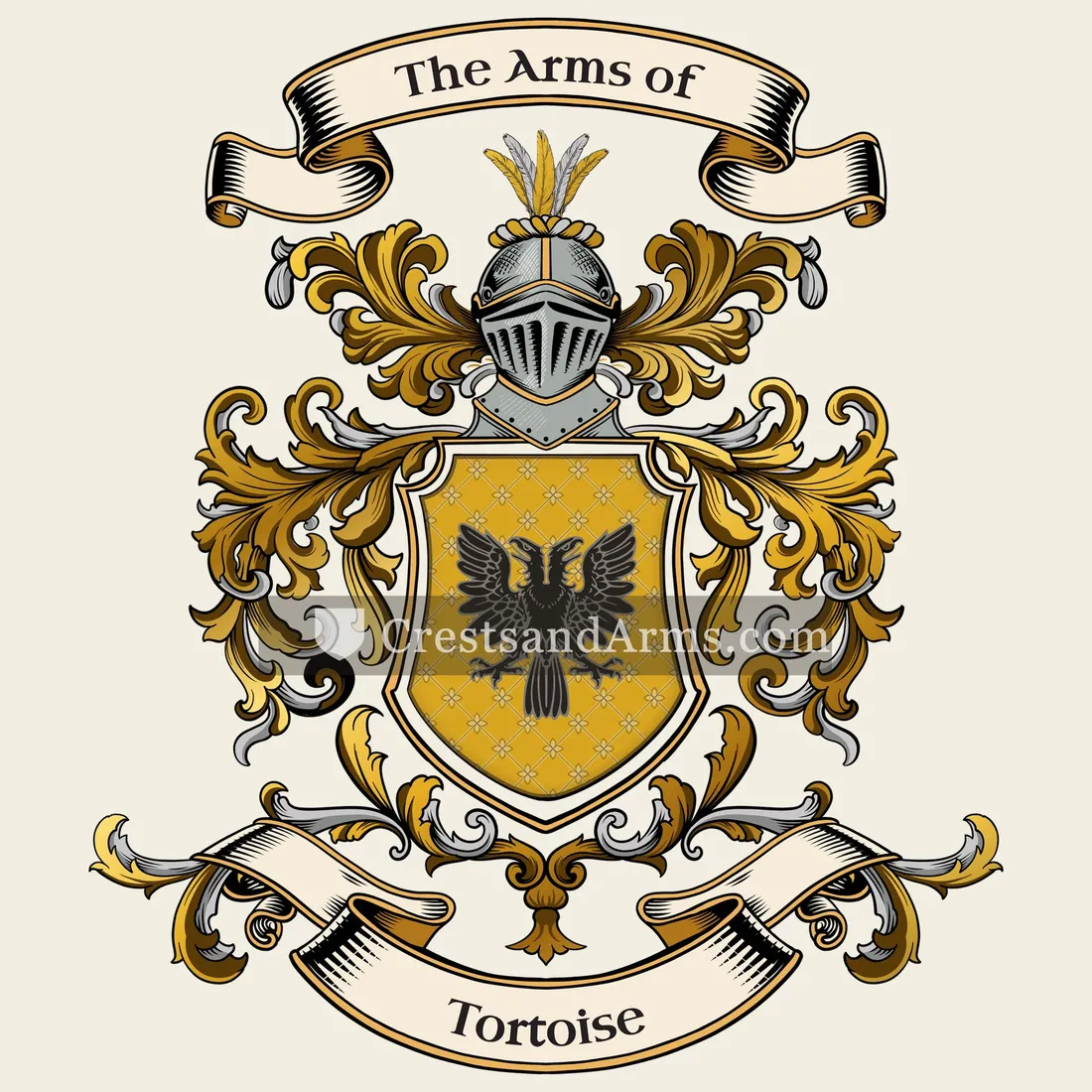
A record of documented arms, meaning and origin, researched for the Tortoise family of Italy.
Reg. 9562 · Italian, T–V
Meaning of the Tortoise family crest colors & symbols
Symbols on this shield
eagleNobility, strength and a keen mind
Colours
Gold (Or)Means: Generosity
Black (Sable)Means: Constancy
Historical info
Source
J. B. Rietstap, Armorial Général, Gouda: G. B. van Goor Zonen, 1884–87
Blazon (the actual original written record)
“D'or à l'aigle de sa., cour. d'or, portant sur sa poitrine un écusson circulaire d'azur, bordé d'arg. et ch. d'une tête et col d'homme de carn., posée de front.”
ItalyVicence, c. 1775
Digital archive packCoat of arms PNG, gold border print PDF, vector SVG and the certificate of authenticity. Sent to your email in minutes.
Map of Italy showing where the Tortoise arms are recorded
The Tortoise arms were recorded in Vicence, c. 1775.
This is where the arms were entered in the register. Families often moved to other parts of the country, so the same name can turn up in more than one region.
The body that granted and recorded arms in Italy in this period.
Alvise Giovanni Mocenigo
Sovereign of the period
Alvise Giovanni Mocenigo
1763–1778
Reigning in Italy when the Tortoise arms are first recorded.
How Arms Worked in Italy
In the Italian states, coats of arms were often used by noble families to show their status and history. These symbols were passed down through the generations to all legitimate male descendants. Younger branches of a family usually kept the original design but sometimes added small changes to distinguish their specific line from the main branch.
Granting authority
Various local rulers and city governments controlled the use of coats of arms across the different Italian states.
How they got arms
Families often assumed their own arms or received them as official grants from local lords, popes, or city councils.
Where arms were recorded
Arms were recorded in local city archives or private family books rather than in one single national register.
The family's standing
Recorded among the armigerous families of Italy.
Origin & History of the Tortoise Family in Italy
The family name Tortoise, often appearing in Italian records as Tortosa, carries a history deeply rooted in the cultural landscape of the Veneto region. By the year 1775, members of the family were firmly established in the city of Vicenza, a period when the area was a thriving center of trade and craftsmanship under the influence of the Republic of Venice. The name itself likely originated as a descriptive nickname, a common practice in medieval Italy used to distinguish individuals based on their physical traits, personality, or a notable association with a specific place. In the context of 18th-century Vicenza, families with such names were often part of the industrious middle class, contributing to the local economy through agriculture, commerce, or specialized trades. As the family grew, they became woven into the social fabric of the city, leaving behind traces in parish registers and municipal tax documents that reflect their steady presence in the region for generations.
Tortoise Meaning & Related Branches
Root word
Testudo
Latin term for a tortoise or a protective military shield formation.
This name
TortoiseAn occupational or descriptive surname referring to someone slow-moving or protected by a shell.
also spelled
Tortose
Tortossa
Tortos
Documented Sources
J. B. Rietstap, Armorial Général, Gouda: G. B. van Goor Zonen, 1884–87
De Felice, Emidio. Dizionario dei cognomi italiani. 1978
Mantese, Giovanni. Memorie storiche della Chiesa vicentina. 1954
Archivio di Stato di Vicenza, Stato civile della Restaurazione
Archivio Storico Comunale di Vicenza, Anagrafi e registri di popolazione
Digital archive packCoat of arms PNG, gold border print PDF, vector SVG and the certificate of authenticity. Sent to your email in minutes.


 eagleNobility, strength and a keen mind
 eagleNobility, strength and a keen mind