Map of Netherlands showing where the Tours arms are recorded
The Tours arms were recorded in Netherlands, c. 1815.
Arms such as these were typically recorded in Friesland.
Friesland was low, wet country on the northern coast of the Netherlands, farmed by families who had held the same land for centuries. Free landholders were unusually common there, and a free landholder could carry arms.
This is where the arms were entered in the register. Families often moved to other parts of the country, so the same name can turn up in more than one region.
Region
Friesland
First recorded
1815
Granting Authority for the Tours Arms
Hoge Raad van Adel
Photograph made by me · CC BY-SA 3.0
The body that granted and recorded arms in Netherlands in this period.
William I of the Netherlands
Sovereign of the period
William I of the Netherlands
1815–1840
Reigning in Netherlands when the Tours arms are first recorded.
How Arms Worked in Netherlands
In the Netherlands, coats of arms were often used by noble families and those who held specific public offices. These arms were passed down through the generations to legitimate descendants. Younger branches of a family usually kept the original design without needing to add special marks. This system ensured that the family identity remained clear and consistent over many years.
Granting authority
The Hoge Raad van Adel is the official body that regulates and manages noble titles and coats of arms in the Netherlands.
How they got arms
Families typically obtained their coats of arms through official royal grants or by proving their long-standing historical use of the symbols.
Where arms were recorded
Coats of arms are officially recorded in the registers held by the Hoge Raad van Adel, which began its work in 1814.
The family's standing
Recorded among the armigerous families of Netherlands.
Origin & History of the Tours Family in Netherlands
The family name Tours has deep roots in the northern region of the Netherlands, particularly within the province of Friesland. By the early 19th century, records confirm that members of the family were well-established residents of this area. During this time, the Netherlands was transitioning into a unified kingdom following the Napoleonic Wars, a period that required citizens to formally register their surnames for official census and tax purposes. The name likely functioned as a locative surname, which was a common naming practice in the Low Countries where families were often identified by the specific town or landscape feature near their home. As the family lived in Friesland, they were part of a distinct cultural group known for its unique language and strong traditions of local independence. Over the decades, the family integrated into the social and economic life of the region, moving from rural settings into the growing towns as the Dutch economy modernized throughout the 1800s.
Meaning of the Tours family crest colors & symbols
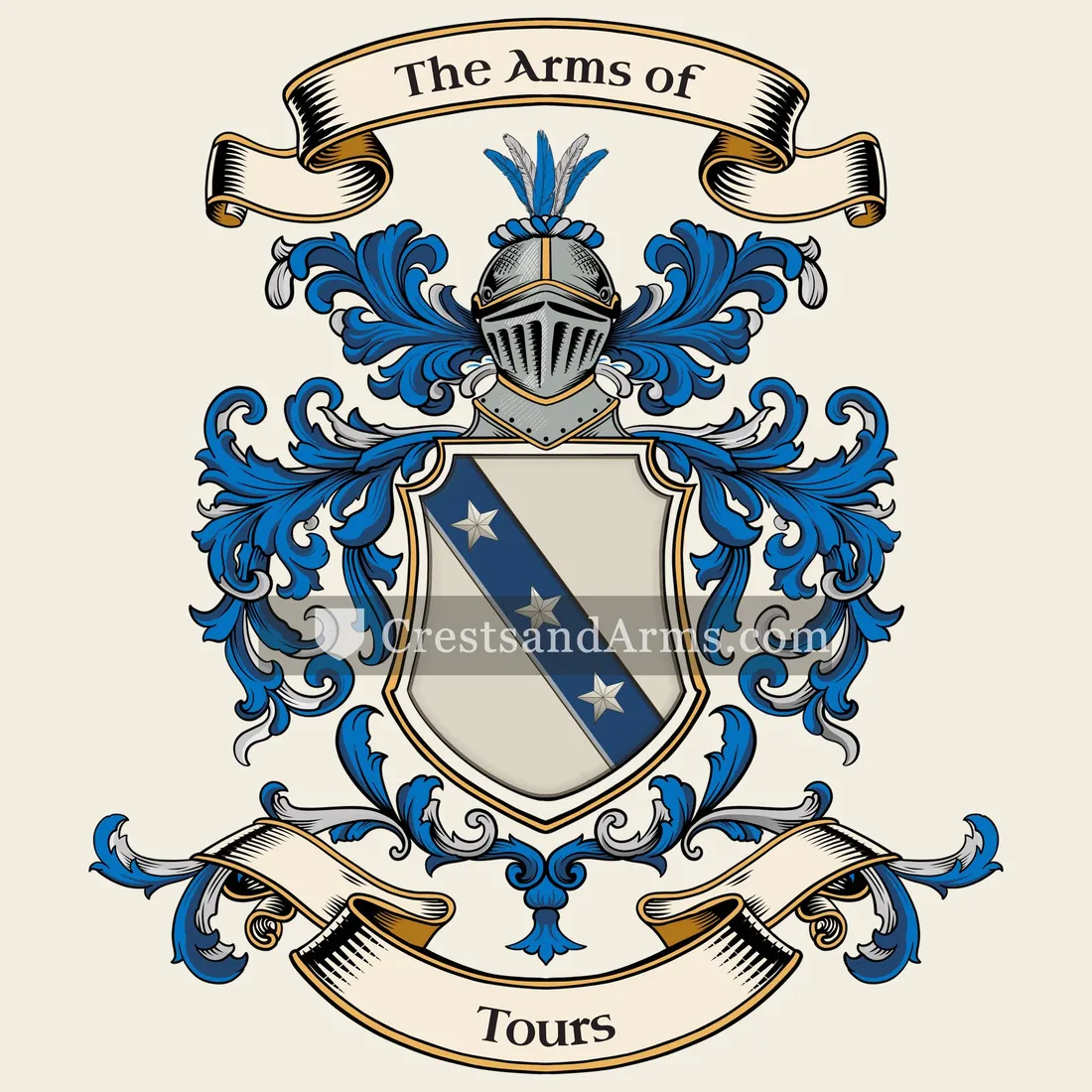
Symbols on this shield
bendDefence, and the scarf of a commander
mulletThe third son, and a divine quality from above
Colours
Silver (Argent)Means: Peace and sincerity
Blue (Azure)Means: Loyalty and truth
Historical info
Source
Sir Bernard Burke, The General Armory of England, Scotland, Ireland and Wales, London: Harrison & Sons, 1884
Blazon (the actual original written record)
“Ar. on a bend az. three mullets of the first”
EdinburghInverleith · Edinburgh, c. 1748
Digital archive packCoat of arms PNG, gold border print PDF, vector SVG and the certificate of authenticity. Sent to your email in minutes.
Map of Scotland showing where the Tours arms are recorded
The Tours arms were recorded in Edinburgh, c. 1748.
Edinburgh was the seat of Scotland's government, its courts and its heralds. Families with business there settled nearby, and being close to where arms were recorded is exactly why so many of them appear.
This is where the arms were entered in the register. Families often moved to other parts of the country, so the same name can turn up in more than one region.
The body that granted and recorded arms in Scotland in this period.
George II of Great Britain
Sovereign of the period
George II of Great Britain
1727–1760
Reigning in Netherlands when the Tours arms are first recorded.
How Arms Worked in Scotland
Scottish heraldry is unique because it treats a coat of arms as a piece of personal property protected by law. Only one person can own a specific design at any given time. When a family grows, the head keeps the original shield while other relatives must apply for their own distinct version with slight changes to prove their specific identity.
Granting authority
The Court of the Lord Lyon acts as the official body that regulates and controls all heraldic matters throughout Scotland.
How they got arms
Individuals obtain a legal right to their arms through a formal petition process that confirms their identity and family connection.
Where arms were recorded
All valid coats of arms are officially entered into the Public Register of All Arms and Bearings starting from 1672.
The family's standing
Recorded among the armigerous families of Edinburgh.
Origin & History of the Tours Family in Scotland
The surname Tours has deep roots in the historical landscape of Scotland, particularly within the bustling urban environment of Edinburgh. By the mid-eighteenth century, the family was already established as a recognizable part of the city’s social fabric, with records confirming their presence in the capital by 1748. The name itself is often associated with a locational origin, suggesting that early ancestors may have migrated from regions in France or other parts of Europe before settling into the Scottish Lowlands. During this era, families like the Tours were often involved in the growing trade and professional networks that defined Edinburgh as a center of commerce and enlightenment. As the city expanded during the eighteenth century, members of the family likely navigated the shifting social structures of a nation undergoing rapid industrial and intellectual change. Their early documented presence serves as a window into the lives of ordinary citizens who contributed to the development of Scottish urban history.
Tours Meaning & Related Branches
Root word
Tur
Old Germanic element meaning giant or a tower-like structure.
This name
ToursRefers to a person living near a tower or originating from the city of Tours.
also spelled
Tour
Tourse
Toursy
Toor
Toures
Related arms
Tourvariant spelling
Burnettrecorded with Tours, same area
Rocheadrecorded with Tours, same area
Documented Sources
J. B. Rietstap, Armorial Général, Gouda: G. B. van Goor Zonen, 1884–87
Tresoar: Frysk Histoarysk en Letterkundich Sintrum, Bevolkingsregisters van Friesland (1811-1900)
Centraal Bureau voor Genealogie, Nederland's Patriciaat (1910-2023)
Meertens Instituut, Nederlandse Familienamenbank (2024)
Digital archive packCoat of arms PNG, gold border print PDF, vector SVG and the certificate of authenticity. Sent to your email in minutes.


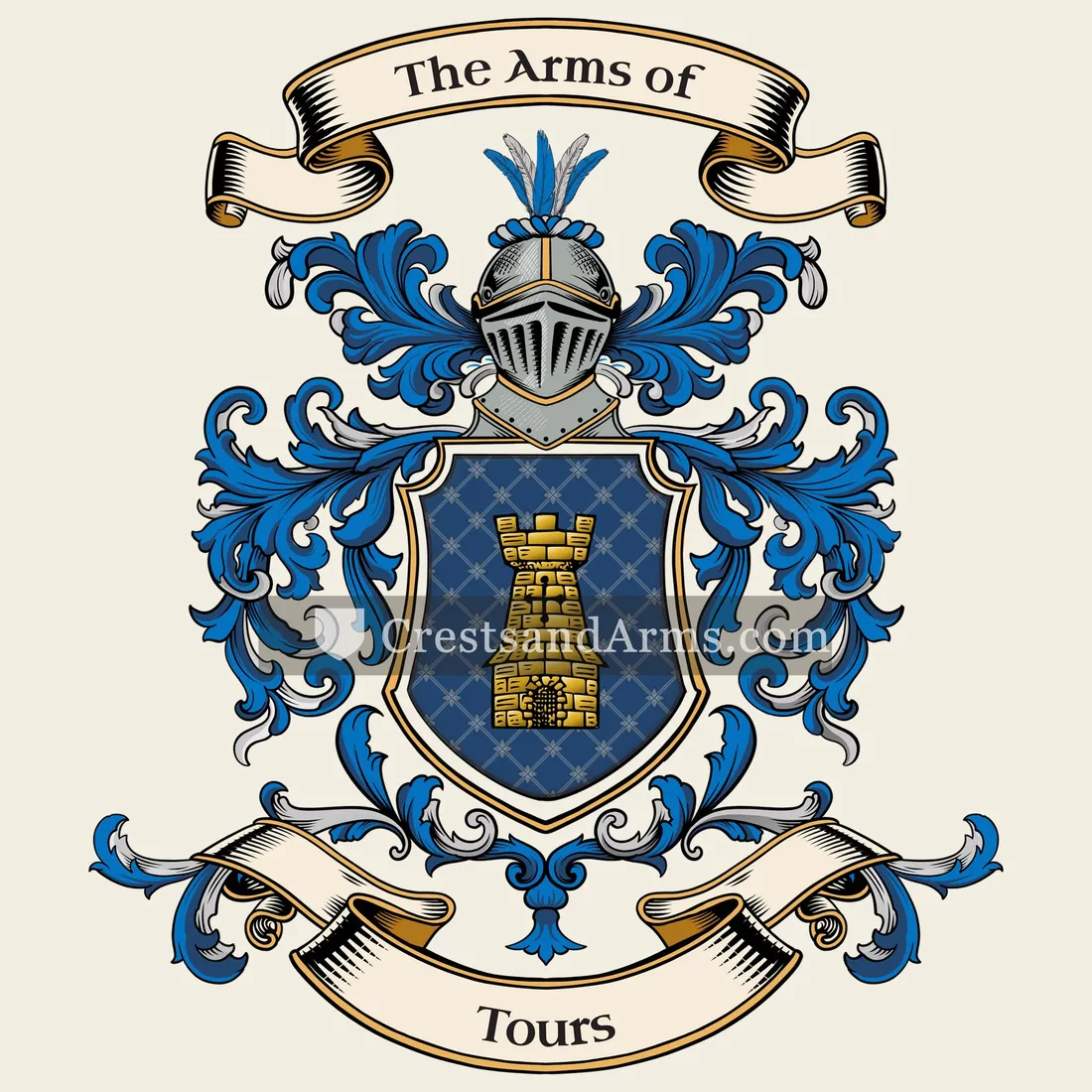
 towerGrandeur and solidity, and a stronghold defended
 towerGrandeur and solidity, and a stronghold defended


 bendDefence, and the scarf of a commander
 mulletThe third son, and a divine quality from above