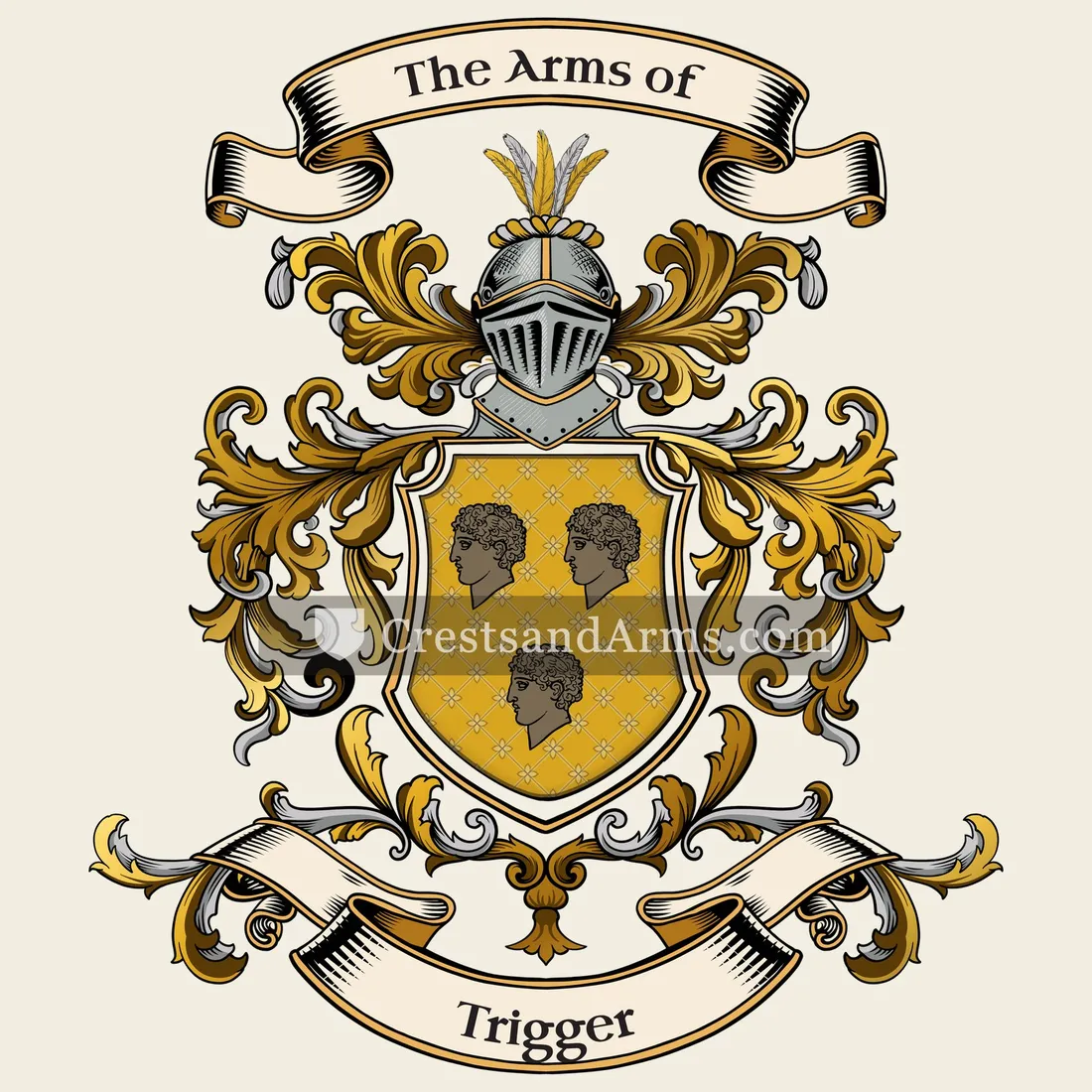
A record of documented arms, meaning and origin, researched for the Trigger family lines. Documented in 2 countries.
Reg. 3563 · German, T–V
Meaning of the Trigger family crest colors & symbols
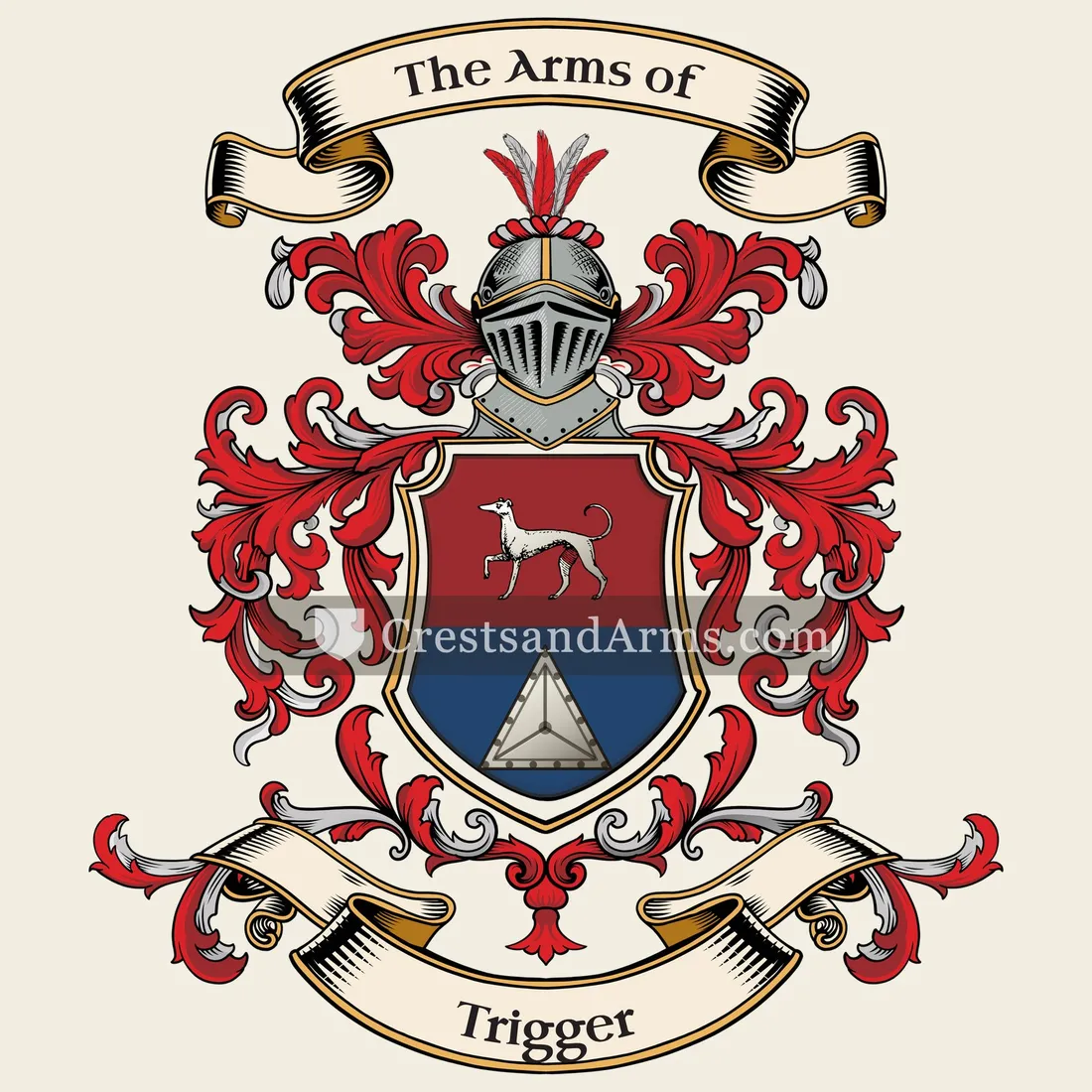
Symbols on this shield
greyhoundCourage, vigilance and loyalty
triangleThe Trinity, and stability
Colours
Red (Gules)Means: Military strength
Blue (Azure)Means: Loyalty and truth
Silver (Argent)Means: Peace and sincerity
Historical info
Source
J. B. Rietstap, Armorial Général, Gouda: G. B. van Goor Zonen, 1884–87
Blazon (the actual original written record)
“Coupé au 1 de gu. à un lévrier courant d'arg., coll. et bouclé d'or; au 2 d'azur à un triangle renv. d'arg., vidé d'azur et bordé de gu. C.: le lévrier, iss. L. d'arg. et de gu.”
Germanyc. 1765
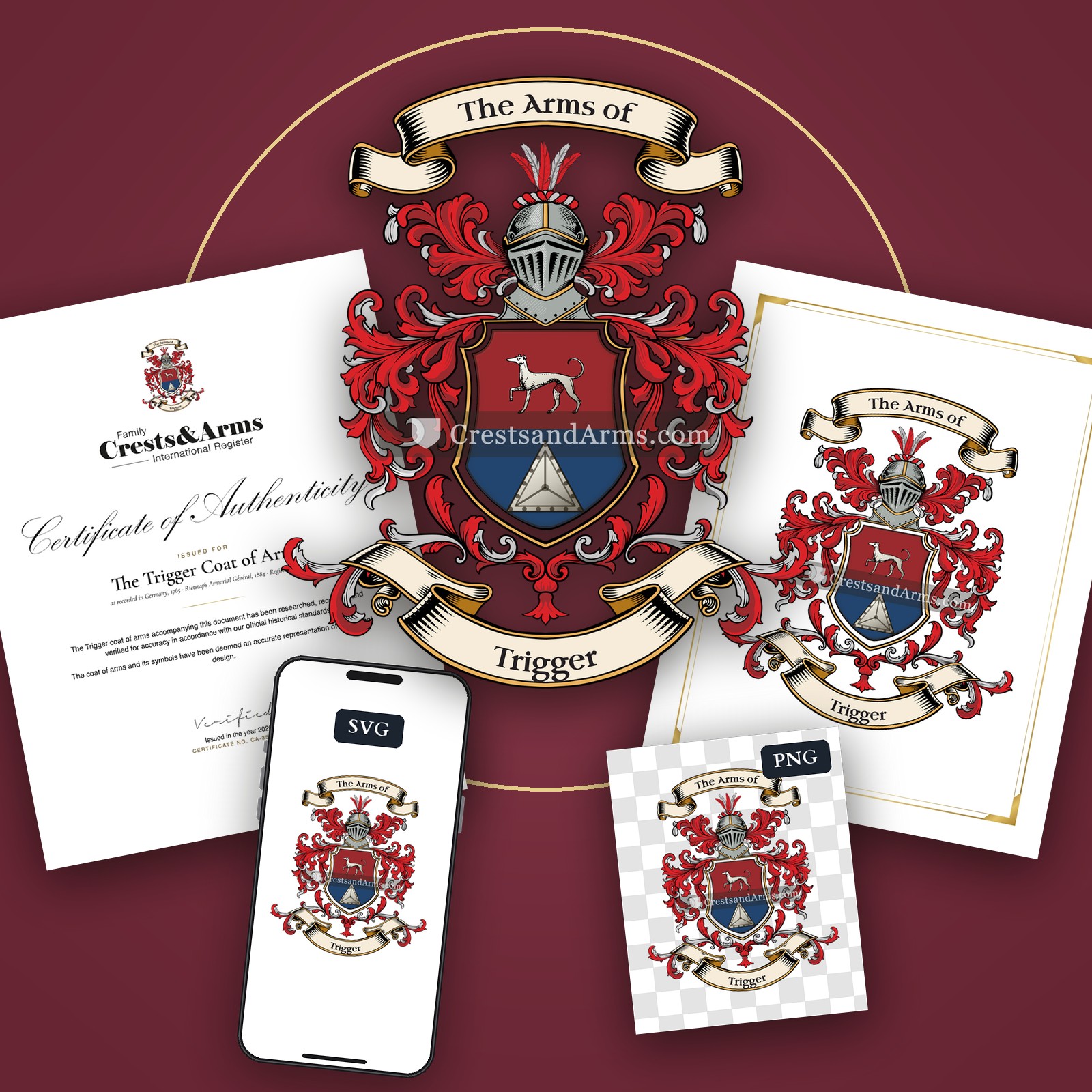
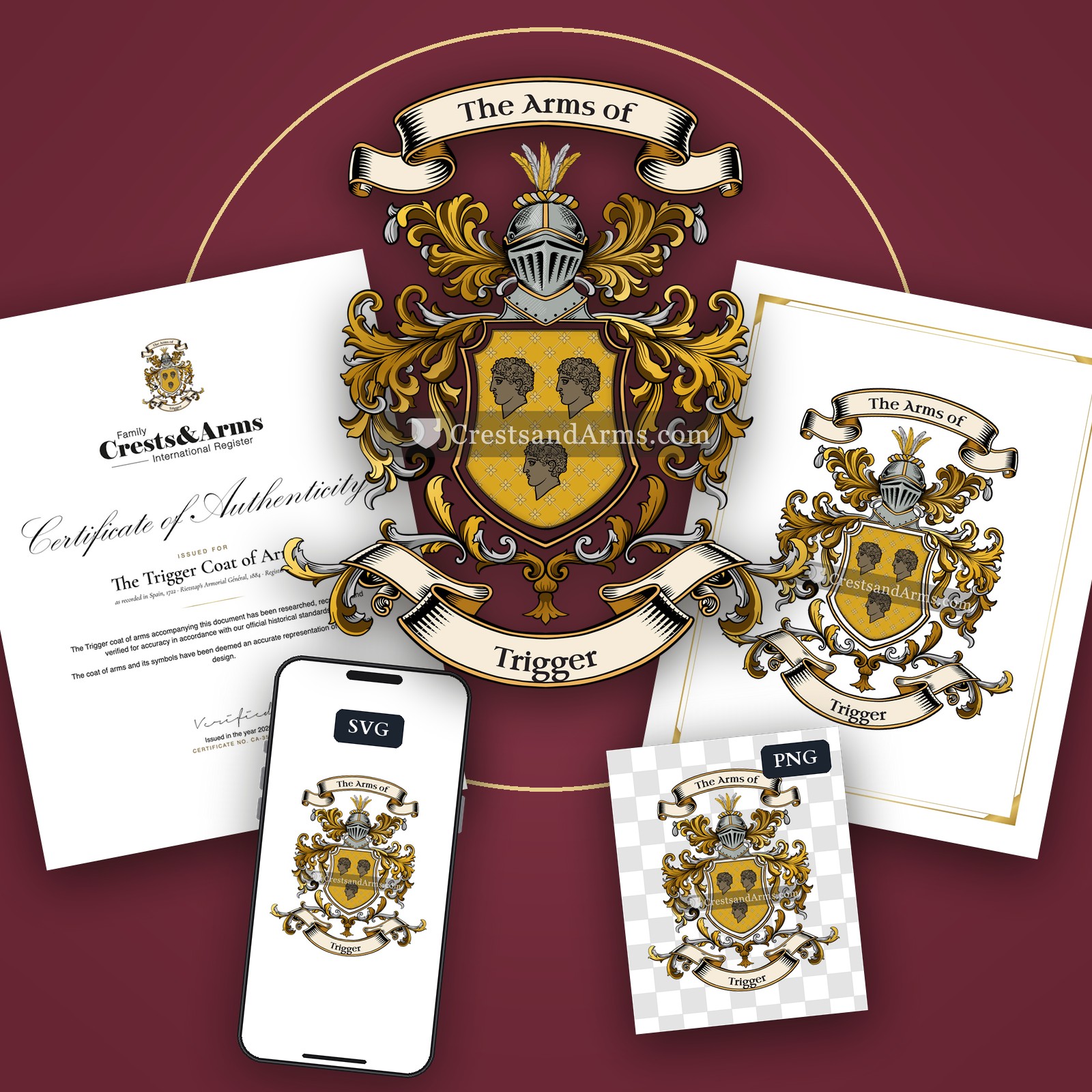
Digital archive packCoat of arms PNG, gold border print PDF, vector SVG and the certificate of authenticity. Sent to your email in minutes.
Map of Germany showing where the Trigger arms are recorded
The Trigger arms were recorded in Germany, c. 1765.
Arms such as these were typically recorded in Bavaria.
Bavaria was a country of old landed families and walled market towns. Estates passed down the same line for centuries, and both the landowners and the leading townsmen kept arms, which is why so many Bavarian names sit in the registers.
This is where the arms were entered in the register. Families often moved to other parts of the country, so the same name can turn up in more than one region.
The body that granted and recorded arms in Germany in this period.
Francis I, Holy Roman Emperor
Sovereign of the period
Francis I, Holy Roman Emperor
1745–1765
Reigning in Germany when the Trigger arms are first recorded.
How Arms Worked in Germany
In the Holy Roman Empire, coats of arms were often granted to individuals by the Emperor or his representatives. These arms were then passed down through the generations to all legitimate descendants of the original holder. Younger branches of a family usually kept the same shield design without needing to change it, as the arms belonged to the entire lineage.
Granting authority
The Holy Roman Emperor held the sole power to grant new coats of arms throughout his vast imperial territories.
How they got arms
Families typically obtained their coats of arms through a formal imperial grant or by proving their noble status to the authorities.
Where arms were recorded
These grants were officially recorded in the Imperial Chancery registers, which began keeping formal records of such honors during the Middle Ages.
The family's standing
Recorded among the armigerous families of Germany.
Origin & History of the Trigger Family in Germany
The family name Trigger finds its roots in the southern German region of Bavaria, where records confirm the presence of family members as early as 1765. The name likely originated as a descriptive term or a nickname based on the local Middle High German dialect. In this historical context, names often evolved from specific occupations, personal traits, or the geographic features of a person’s home village. Living in the rural landscapes of Bavaria, early ancestors were likely involved in agricultural life or local trade within the Holy Roman Empire. As the family grew, they became part of the social fabric of their local parishes, where birth, marriage, and death records were meticulously kept by church officials. These early generations helped establish the name within the region, setting the foundation for the family’s long-standing connection to the Bavarian countryside.
Meaning of the Trigger family crest colors & symbols
Symbols on this shield
savages head affrontyAn enemy overcome
Colours
Gold (Or)Means: Generosity
Historical info
Source
J. B. Rietstap, Armorial Général, Gouda: G. B. van Goor Zonen, 1884–87
Blazon (the actual original written record)
“D'or à trois têtes de More, tort. d'arg.”
Spainc. 1722
Digital archive packCoat of arms PNG, gold border print PDF, vector SVG and the certificate of authenticity. Sent to your email in minutes.
Map of Spain showing where the Trigger arms are recorded
The Trigger arms were recorded in Spain, c. 1722.
Arms such as these were typically recorded in Castile.
Castile was the heart of Spain and the source of most of its noble families. Land won in the long wars against the Moors was granted out to fighting men, and a man granted land was granted arms along with it.
This is where the arms were entered in the register. Families often moved to other parts of the country, so the same name can turn up in more than one region.
The body that granted and recorded arms in Spain in this period.
Philip V of Spain
Sovereign of the period
Philip V of Spain
1714–1724
Reigning in Germany when the Trigger arms are first recorded.
How Arms Worked in Spain
In Spain, a coat of arms was considered a form of property that belonged to the entire family line. These arms were passed down from a father to all his children equally. Younger branches of the family usually kept the original design without needing to add any special marks to distinguish their specific line.
Granting authority
The Cronista Rey de Armas was the official body that regulated and granted coats of arms throughout Spain.
How they got arms
Families often obtained their arms through royal grants or by proving their noble status to the official heraldic authority.
Where arms were recorded
Coats of arms were officially recorded in the registers of the Cronista Rey de Armas starting in 1496.
The family's standing
Recorded among the armigerous families of Spain.
Origin & History of the Trigger Family in Spain
The family name Trigger, while often associated with northern European roots, established a documented presence in the heart of the Kingdom of Castile by 1722. During this period, the region was undergoing significant administrative shifts under the Bourbon monarchy, which encouraged the movement of families across the central plateau. Ancestors bearing this name likely integrated into the local agrarian or merchant classes that defined the Castilian economy of the eighteenth century. Because the name appears in regional census records and parish registers from this era, it suggests that these early members were settled citizens who participated in the social and religious life of their communities. Their presence in Castile highlights how families often migrated across borders to seek new opportunities in the changing landscape of early modern Spain.
Trigger Meaning & Related Branches
Root word
Trüger
Derived from the Middle High German word for a deceiver or fraud.
This name
TriggerAn occupational or descriptive surname historically used to identify a deceptive person or a trickster.
also spelled
Tragere
Tragar
Tragg
Documented Sources
J. B. Rietstap, Armorial Général, Gouda: G. B. van Goor Zonen, 1884–87


 greyhoundCourage, vigilance and loyalty
 triangleThe Trinity, and stability
 greyhoundCourage, vigilance and loyalty
 triangleThe Trinity, and stability


 savages head affrontyAn enemy overcome