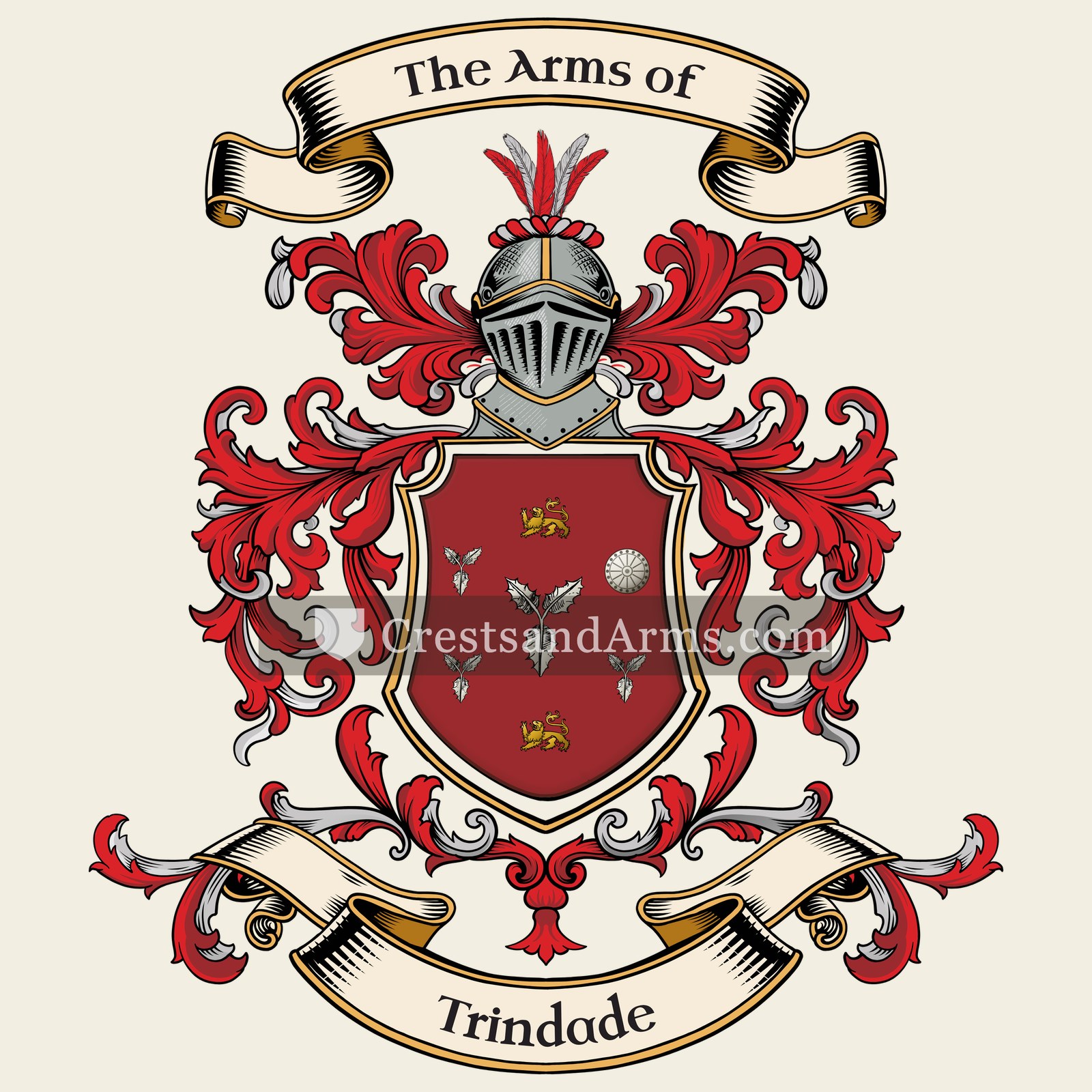
A record of documented arms, meaning and origin, researched for the Trindade family of Netherlands.
Reg. 5500 · Dutch, T–V
Coat of Arms & Family Crest Details
Symbols on this shield
hollyTruth, and protection through winter
roundelA coin, and one who has been to the crusades
lionCourage, strength and royalty
Colours
Red (Gules)Means: Military strength
Silver (Argent)Means: Peace and sincerity
Gold (Or)Means: Generosity
Historical info
Source
J. B. Rietstap, Armorial Général, Gouda: G. B. van Goor Zonen, 1884–87
Blazon (the actual original written record)
“De gu. à quatre feuilles de houx d'arg. en saut., aboutées dans une boule d'arg., et deux lions d'or; ainsi posés: en chef les feuilles de houx et un lion, et en p. l'autre lion.”
UtrechtUtrecht, c. 1815
Digital archive packCoat of arms PNG, gold border print PDF, vector SVG and the certificate of authenticity. Sent to your email in minutes.
Map of Netherlands showing where the Trindade arms are recorded
The Trindade arms were recorded in Utrecht, c. 1815.
Utrecht was an old church town with rich farming country around it. Both the church and the land produced families of standing, and families of standing kept arms to seal their documents with.
This is where the arms were entered in the register. Families often moved to other parts of the country, so the same name can turn up in more than one region.
Region
Utrecht
First recorded
1815
Granting Authority for the Trindade Arms
Hoge Raad van Adel
Photograph made by me · CC BY-SA 3.0
The body that granted and recorded arms in Netherlands in this period.
William I of the Netherlands
Sovereign of the period
William I of the Netherlands
1815–1840
Reigning in Netherlands when the Trindade arms are first recorded.
How Arms Worked in Netherlands
In the Netherlands, coats of arms were often used by noble families and those who held specific public offices. These arms were passed down through the generations to legitimate descendants. Younger branches of a family usually kept the original design without needing to add special marks. This system ensured that the family identity remained clear and consistent over many years.
Granting authority
The Hoge Raad van Adel is the official body that regulates and manages noble titles and coats of arms in the Netherlands.
How they got arms
Families typically obtained their coats of arms through official royal grants or by proving their long-standing historical use of the symbols.
Where arms were recorded
Coats of arms are officially recorded in the registers held by the Hoge Raad van Adel, which began its work in 1814.
The family's standing
Recorded among the armigerous families of Utrecht.
Origin & History of the Trindade Family in Netherlands
The surname Trindade originates from the Portuguese word for the Holy Trinity, a name often bestowed upon families to honor religious devotion or to mark a child born during the feast of Pentecost. While the name is deeply rooted in the Iberian Peninsula, historical records confirm that members of the family had established a presence in Utrecht by 1815. During this period, the Netherlands served as a significant hub for European trade and diplomacy, attracting families from across the continent who sought new opportunities in the wake of the Napoleonic Wars. The presence of the Trindade family in Utrecht suggests they were likely part of a mobile class of merchants or professionals who moved between major European cities. By settling in the Netherlands, these early family members integrated into a distinct cultural landscape while maintaining a name that reflects a long tradition of religious heritage.
Related Branches & Arms
Root word
Trinitas
Latin term referring to the state of being three or threefold.
This name
TrindadeRefers to the Holy Trinity in Christian theology, often given to children born on Trinity Sunday.
also spelled
Trynde
Trindee
Trindet
Documented Sources
J. B. Rietstap, Armorial Général, Gouda: G. B. van Goor Zonen, 1884–87
Het Utrechts Archief, Burgerlijke Stand van de gemeente Utrecht (1811-1902)
Antenor Nascentes, Dicionário Etimológico da Língua Portuguesa, 1932
José Pedro Machado, Dicionário Onomástico Etimológico da Língua Portuguesa, 1981
Digital archive packCoat of arms PNG, gold border print PDF, vector SVG and the certificate of authenticity. Sent to your email in minutes.


 hollyTruth, and protection through winter
 roundelA coin, and one who has been to the crusades
 lionCourage, strength and royalty
 hollyTruth, and protection through winter
 roundelA coin, and one who has been to the crusades
 lionCourage, strength and royalty