Map of France showing where the Tripolone arms are recorded
The Tripolone arms were recorded in Lorraine, c. 1572.
Lorraine sat on the border between France and the German lands, and border country bred soldiers. Families here held small estates and served in arms, and a fighting man was exactly the sort who carried a shield of his own.
This is where the arms were entered in the register. Families often moved to other parts of the country, so the same name can turn up in more than one region.
The body that granted and recorded arms in France in this period.
Charles IX of France
Sovereign of the period
Charles IX of France
1560–1574
Reigning in France when the Tripolone arms are first recorded.
How Arms Worked in France
In France, a coat of arms was a mark of honor that passed down through the male line to all legitimate descendants. Families often used the same shield without changes to show their shared heritage. If a branch wanted to stand out, they could add a small mark to their shield to show their specific place in the family tree.
Granting authority
The Juge d'armes de France acted as the official authority that regulated and verified coats of arms across the country.
How they got arms
Families typically inherited their arms from ancestors, though they could also receive them through royal grants or by proving their noble status.
Where arms were recorded
Coats of arms were officially recorded in the Armorial Général de France, which began its main collection in the year 1696.
The family's standing
Recorded among the armigerous families of Lorraine.
Origin & History of the Tripolone Family in France
The history of the Tripolone family is deeply rooted in the complex landscape of sixteenth-century Europe, with documented evidence placing early members in the region of Lorraine by 1572. During this era, Lorraine served as a vital crossroads between French and Germanic cultures, often experiencing significant political and social shifts due to religious tensions and regional conflicts. Families living in this area were frequently involved in the agricultural and craft-based economies that defined village life. The name itself likely evolved from local linguistic patterns, reflecting the specific dialects spoken in the borderlands during the late Renaissance. As these early ancestors navigated the challenges of life in Lorraine, they contributed to the resilient social fabric of a region that was constantly changing under the influence of neighboring powers.
Tripolone Meaning & Related Branches
Root word
Tripa
Latin term referring to the intestines or belly.
This name
TripoloneA nickname for a person with a large belly or a gluttonous individual.
also spelled
Tryplot
Triplott
Triplote
Triplo
Documented Sources
J. B. Rietstap, Armorial Général, Gouda: G. B. van Goor Zonen, 1884–87
Archives départementales de Meurthe-et-Moselle, Série B (Cours et juridictions)
Cabourdin, Guy, Histoire de la Lorraine, 1991
Schneider, Jean, La ville de Metz aux XIIIe et XIVe siècles, 1950
Digital archive packCoat of arms PNG, gold border print PDF, vector SVG and the certificate of authenticity. Sent to your email in minutes.


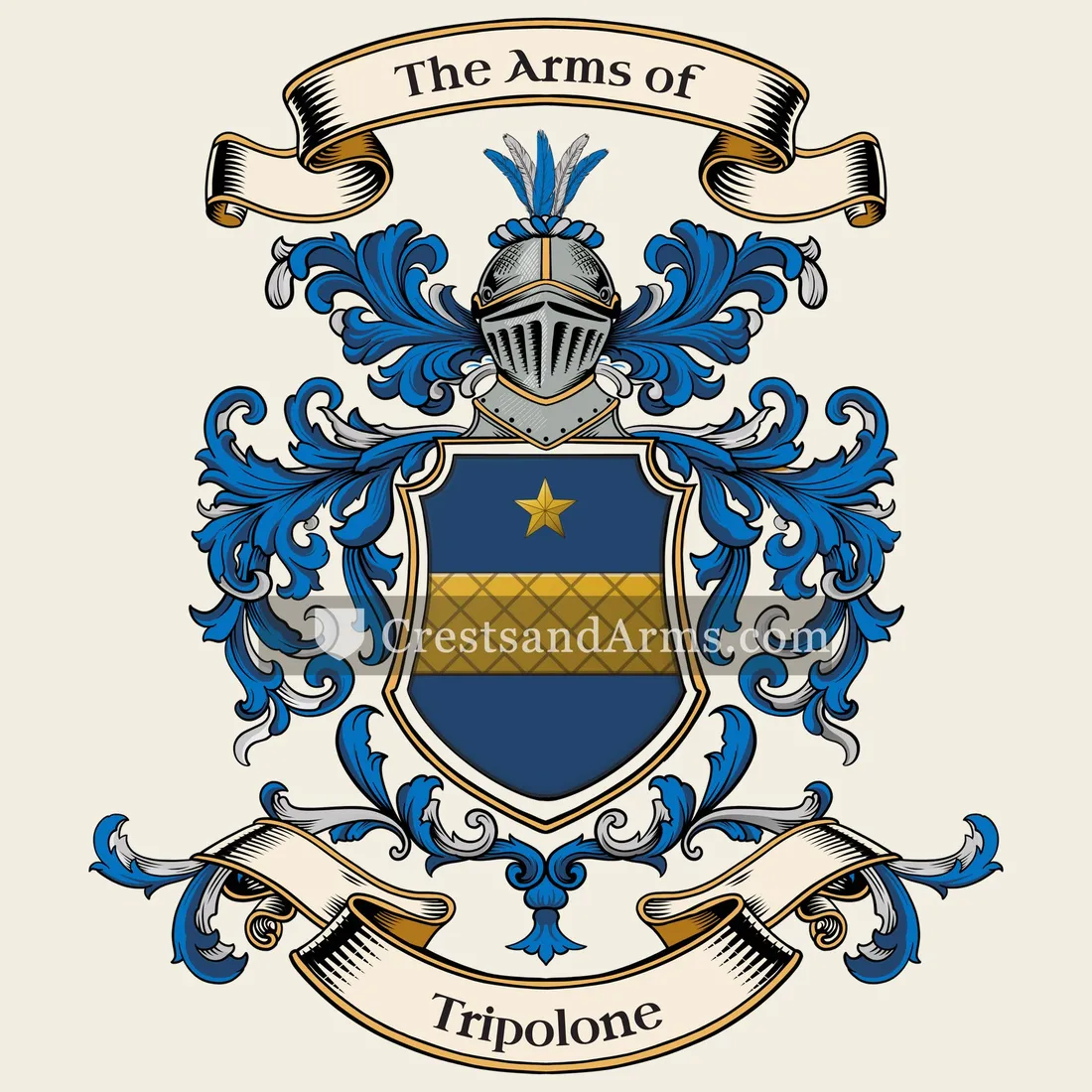
 fessThe military belt, and readiness to serve
 mulletThe third son, and a divine quality from above
 fessThe military belt, and readiness to serve
 mulletThe third son, and a divine quality from above