A record of documented arms, meaning and origin, researched for the Trott family lines. Documented in 2 countries.
Reg. 5690 · German, T–V
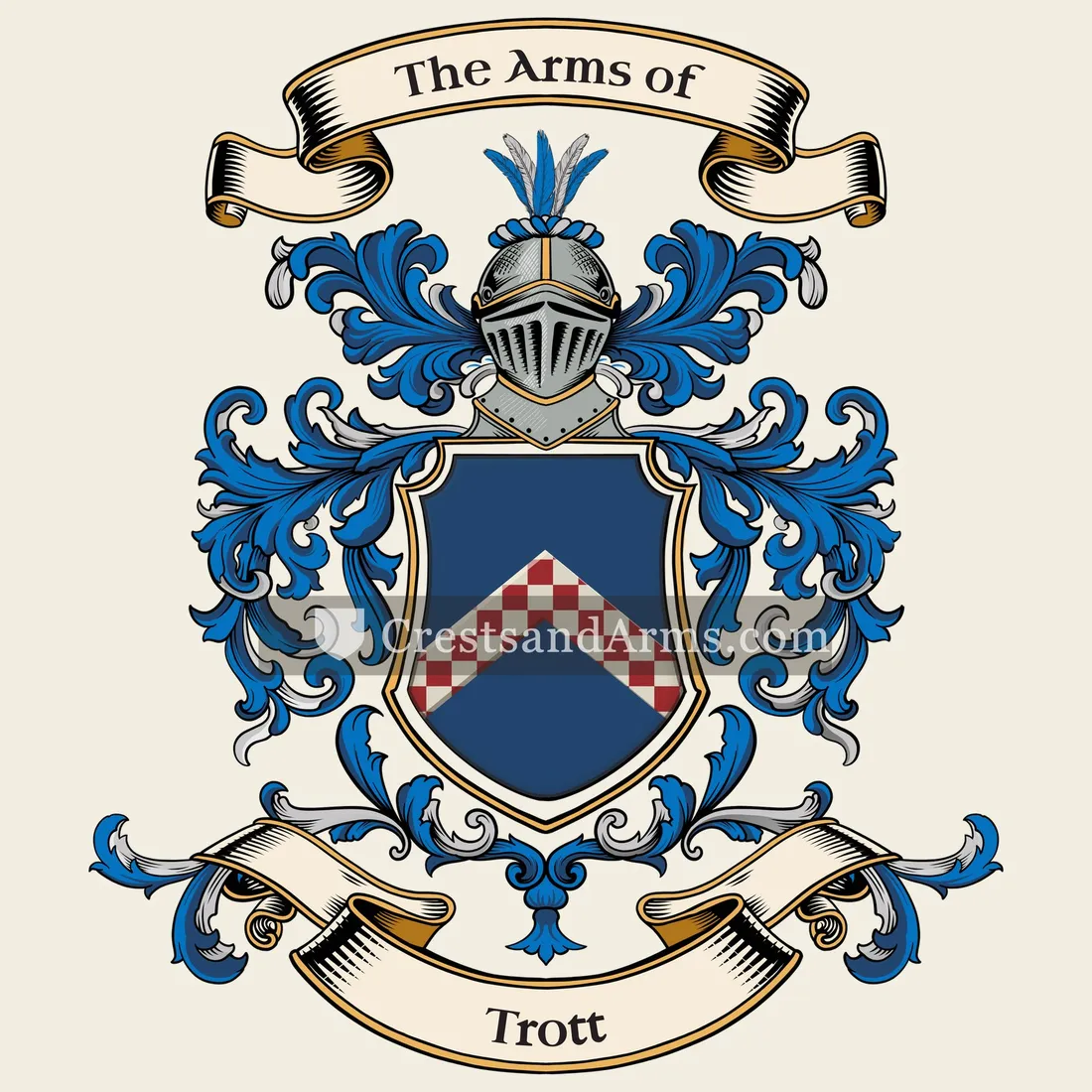
Meaning of the Trott family crest colors & symbols
Symbols on this shield
chevronProtection, and faithful service completed
chequyConstancy, and the counting-board
Colours
Blue (Azure)Means: Loyalty and truth
Silver (Argent)Means: Peace and sincerity
Historical info
Source
J. B. Rietstap, Armorial Général, Gouda: G. B. van Goor Zonen, 1884–87
Blazon (the actual original written record)
“D'azur au chev. échiq. de gu. et d'arg. C.: un vol de sa., les plumes ext. de gu., semé de feuilles de tilleul d'arg., les tiges en haut. L. d'arg. et d'azur.”
HesseHesse, c. 1765
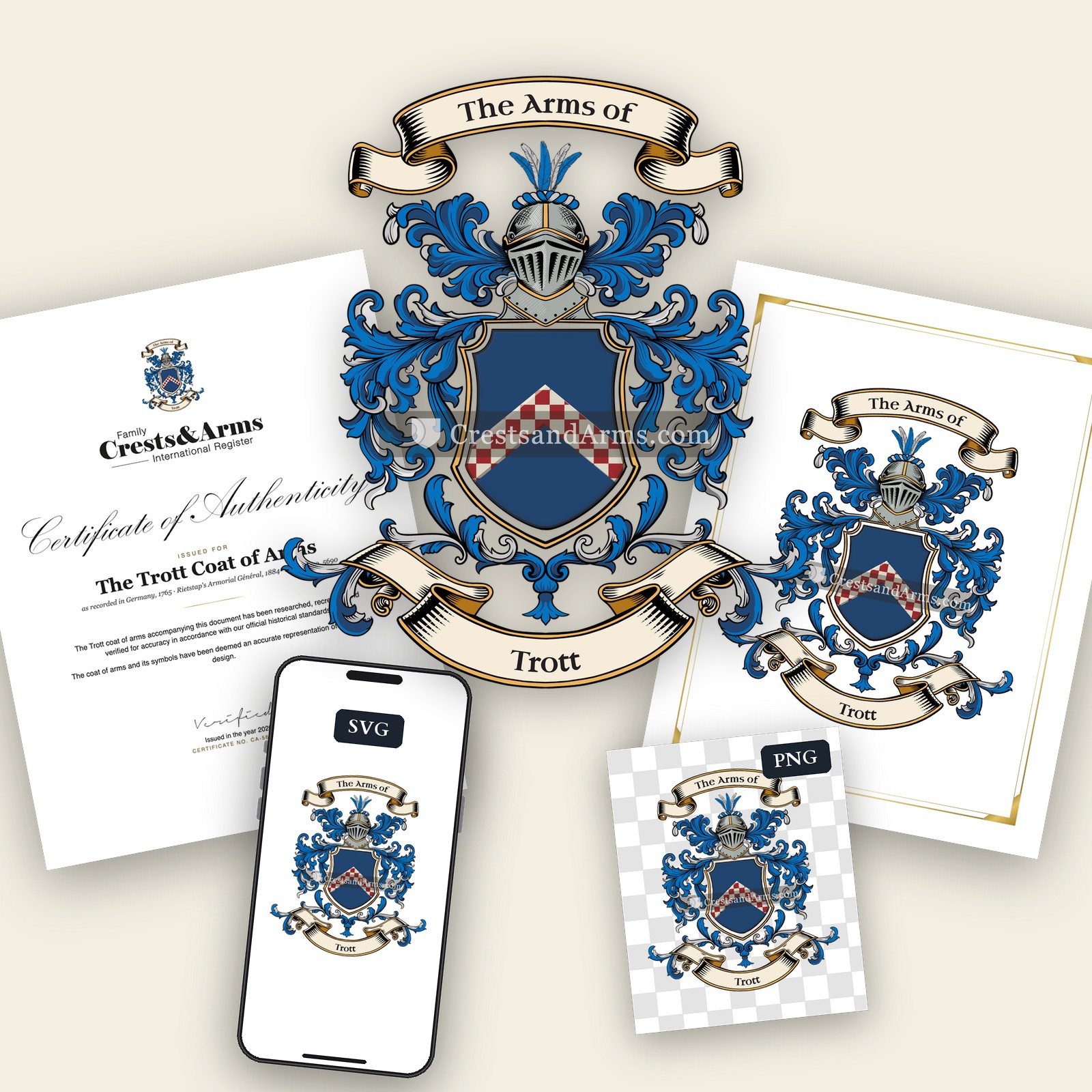
Digital archive packCoat of arms PNG, gold border print PDF, vector SVG and the certificate of authenticity. Sent to your email in minutes.
Map of Germany showing where the Trott arms are recorded
The Trott arms were recorded in Hesse, c. 1765.
Hesse was central German country, divided among a large number of small landowners and prosperous towns. So many separate households held ground there that the region produced an unusual number of coats of arms.
This is where the arms were entered in the register. Families often moved to other parts of the country, so the same name can turn up in more than one region.
The body that granted and recorded arms in Germany in this period.
Francis I, Holy Roman Emperor
Sovereign of the period
Francis I, Holy Roman Emperor
1745–1765
Reigning in Germany when the Trott arms are first recorded.
How Arms Worked in Germany
In the Holy Roman Empire, coats of arms were often granted to individuals by the Emperor or his representatives. These arms were then passed down through the generations to all legitimate descendants of the original holder. Younger branches of a family usually kept the same shield design without needing to change it, as the arms belonged to the entire lineage.
Granting authority
The Holy Roman Emperor held the sole power to grant new coats of arms throughout his vast imperial territories.
How they got arms
Families typically obtained their coats of arms through a formal imperial grant or by proving their noble status to the authorities.
Where arms were recorded
These grants were officially recorded in the Imperial Chancery registers, which began keeping formal records of such honors during the Middle Ages.
The family's standing
Recorded among the armigerous families of Hesse.
Origin & History of the Trott Family in Germany
The family name Trott has deep roots in the German region of Hesse, where members of the family were well-established by the mid-eighteenth century. The name itself is thought to have originated as a descriptive nickname, likely referring to a person’s distinctive gait or a quick, trotting pace. During the 1700s, the Trott family in Hesse was often associated with the local landed gentry and civil service, playing a role in the administrative and social life of the region. Many families with this name lived in rural areas where they managed land or served in local government positions. As the family grew, they became integrated into the fabric of Hessian society, maintaining a presence that spanned generations. This history reflects the broader movement of families in central Germany who built their lives around regional identity and local community service during the Enlightenment era.
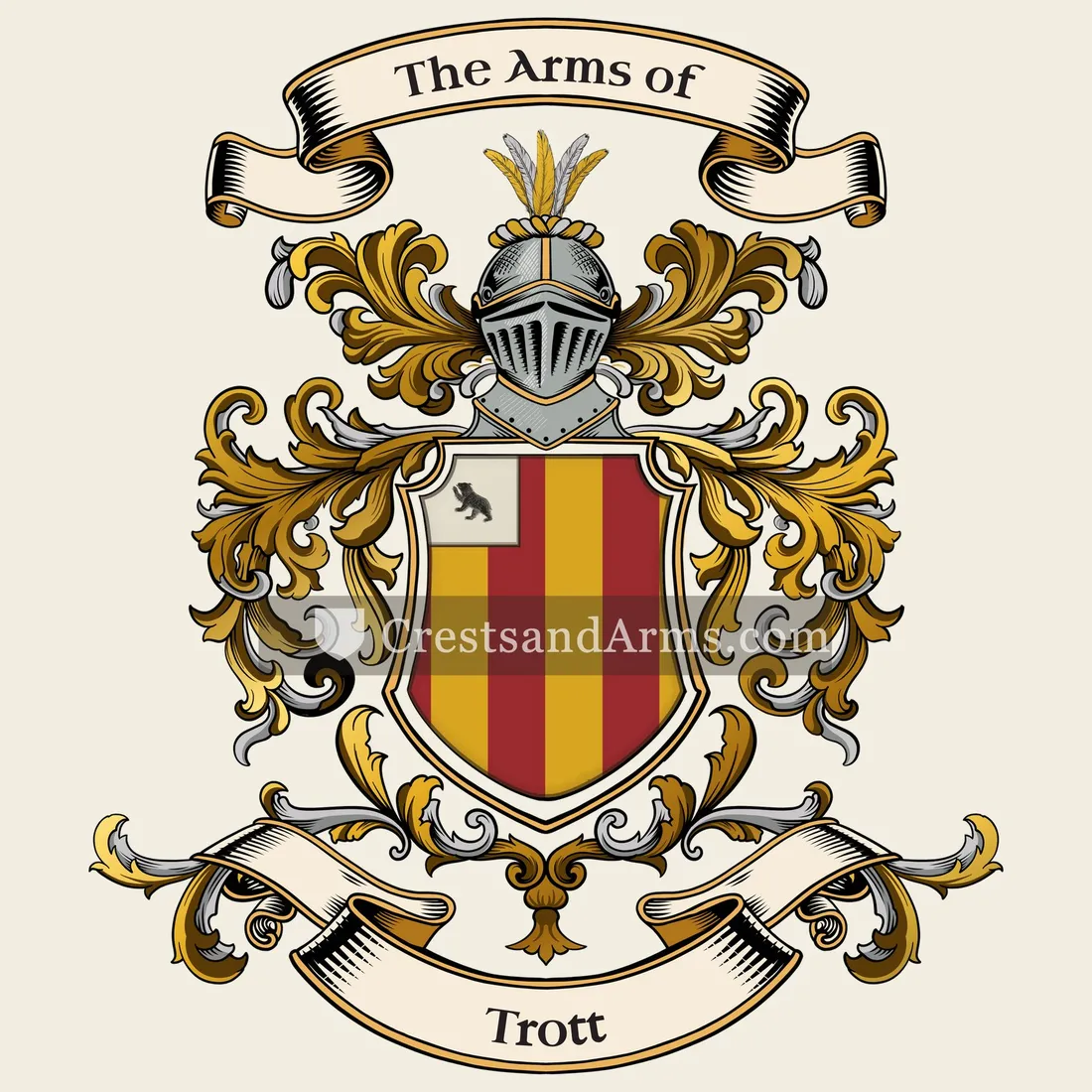
Meaning of the Trott family crest colors & symbols
Symbols on this shield
cantonA mark of honour granted by the sovereign
bearStrength, cunning and protection of kin
Colours
Gold (Or)Means: Generosity
Silver (Argent)Means: Peace and sincerity
Black (Sable)Means: Constancy
Red (Gules)Means: Military strength
Historical info
Source
Sir Bernard Burke, The General Armory of England, Scotland, Ireland and Wales, London: Harrison & Sons, 1884
Blazon (the actual original written record)
“Paly of six or and gu. on a canton ar. a bear salient sa”
EnglandLondon, c. 1574
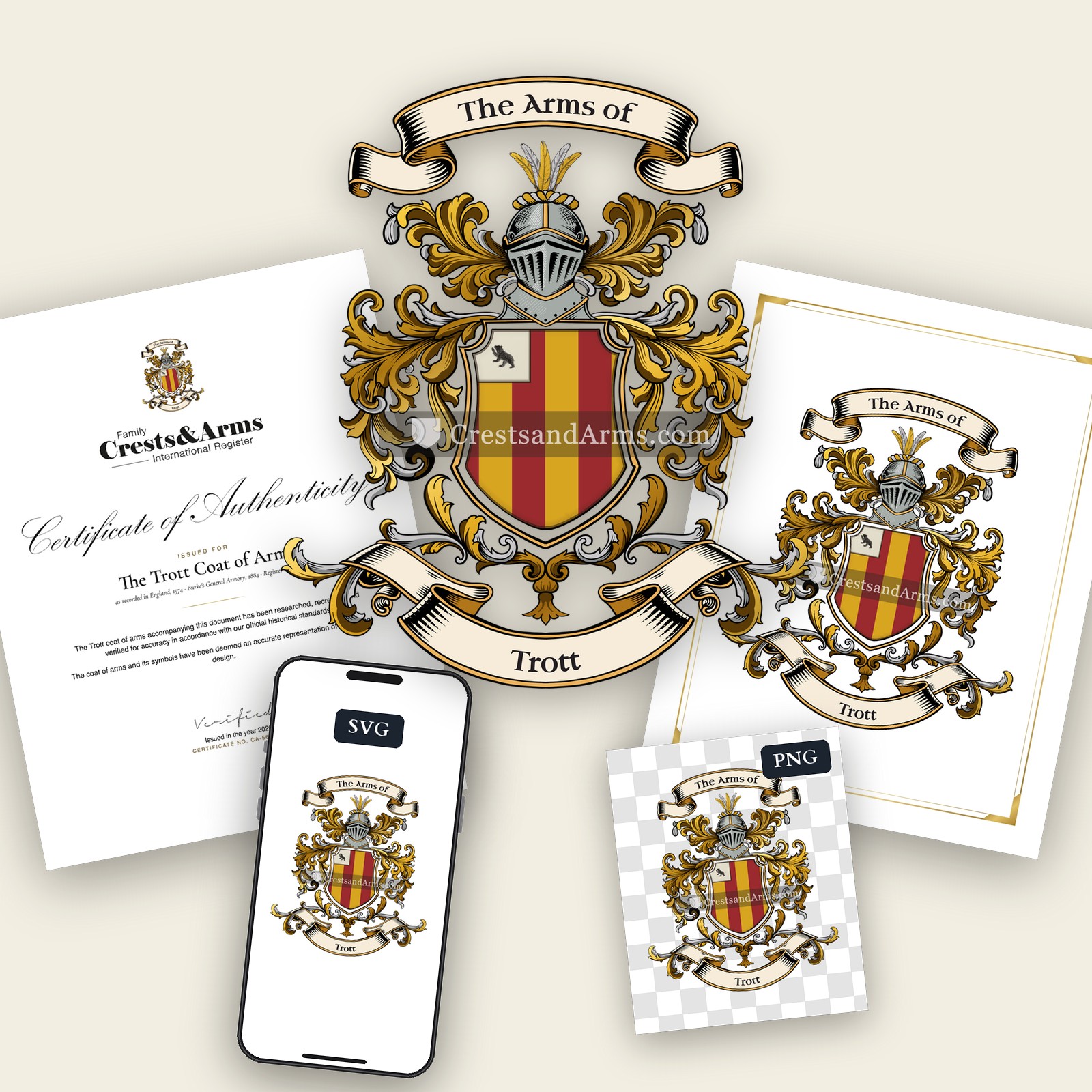
Digital archive packCoat of arms PNG, gold border print PDF, vector SVG and the certificate of authenticity. Sent to your email in minutes.
Map of England showing where the Trott arms are recorded
The Trott arms were recorded in London, c. 1574.
This is where the arms were entered in the register. Families often moved to other parts of the country, so the same name can turn up in more than one region.
The body that granted and recorded arms in England in this period.
Elizabeth I of England
Sovereign of the period
Elizabeth I of England
1558–1603
Reigning in Germany when the Trott arms are first recorded.
How Arms Worked in England
English heraldry allowed arms to be shared by all legitimate descendants of the original owner. These symbols were treated as personal property that moved through the generations to all children. While the eldest son kept the original design, other family members could use the same shield without needing to change it or register their own unique versions.
Granting authority
The College of Arms in London has regulated the use of coats of arms throughout England and Wales since 1484.
How they got arms
Families typically obtained their coats of arms through a formal grant from the Crown or by proving their ancient right to them.
Where arms were recorded
All official coats of arms are recorded in the registers kept at the College of Arms, which date back to the fifteenth century.
The family's standing
Recorded among the armigerous families of England.
Origin & History of the Trott Family in England
The surname Trott emerged in England during the Middle Ages as a descriptive name, likely originating from the Old French word "trot," which was used to describe a person who walked with a quick or brisk pace. By the time the name appeared in London records in 1574, the family had already established itself within the bustling social and economic life of the city. During this era, London was a rapidly growing hub of trade and commerce, and families like the Trotts often participated in the city’s influential merchant guilds. These early members were part of a rising middle class that helped shape the capital’s development during the reign of Elizabeth I. As the family name spread beyond the city walls, it became tied to the local history of various English parishes, reflecting the broader movement of people across the country during the sixteenth century.
Trott Meaning & Related Branches
Root word
trot
A Middle High German term referring to a quick or brisk gait.
This name
TrottAn occupational nickname for a messenger or a person who walked with a fast, hurried pace.
also spelled
Trot
Trote
Troth
Related arms
Downrecorded with Trott, same area
Documented Sources
J. B. Rietstap, Armorial Général, Gouda: G. B. van Goor Zonen, 1884–87
Hessisches Staatsarchiv Marburg, Bestand 340 (von Trott zu Solz)
Kneschke, Ernst Heinrich, Neues allgemeines deutsches Adels-Lexicon, 1870
Stolzenberg, Ingeborg, Die Familie von Trott zu Solz, 1972
Digital archive packCoat of arms PNG, gold border print PDF, vector SVG and the certificate of authenticity. Sent to your email in minutes.


 chevronProtection, and faithful service completed
 chequyConstancy, and the counting-board
 chevronProtection, and faithful service completed
 chequyConstancy, and the counting-board


 cantonA mark of honour granted by the sovereign
 bearStrength, cunning and protection of kin