A record of documented arms, meaning and origin, researched for the Trottier family lines. Documented in 2 countries.
Reg. 9829 · English, T–V
Coat of Arms & Family Crest Details
Symbols on this shield
chiefAuthority, wisdom and dominion
cantonA mark of honour granted by the sovereign
chevronProtection, and faithful service completed
chequyConstancy, and the counting-board
crescentHonour by the sovereign, and the second son
mulletThe third son, and a divine quality from above
fleur de lisPurity, light, and the sixth son
Colours
Silver (Argent)Means: Peace and sincerity
Blue (Azure)Means: Loyalty and truth
Black (Sable)Means: Constancy
Red (Gules)Means: Military strength
Historical info
Source
Sir Bernard Burke, The General Armory of England, Scotland, Ireland and Wales, London: Harrison & Sons, 1884
Blazon (the actual original written record)
“Quarterly, 1st and 4th, ar. a crescent gu. on a chief indented az. three mullets pierced of the field, a canton ar. for distinction, for Trotter; 2nd and 3rd, az. a chev. chequy ar. and sa. betw. three fleurs-de-lis of the second, for Brown”
SurreyHorton Manor · Surrey, c. 1868
Digital archive packCoat of arms PNG, gold border print PDF, vector SVG and the certificate of authenticity. Sent to your email in minutes.
Map of England showing where the Trottier arms are recorded
The Trottier arms were recorded in Surrey, c. 1868.
Surrey sat just south of London and filled up with families who had made money in the City. Buying an estate there was the usual next step, and an estate was the usual reason to take arms.
This is where the arms were entered in the register. Families often moved to other parts of the country, so the same name can turn up in more than one region.
The body that granted and recorded arms in England in this period.
Victoria
Sovereign of the period
Victoria
1837–1901
Reigning in England when the Trottier arms are first recorded.
How Arms Worked in England
English heraldry allowed arms to be shared by all legitimate descendants of the original owner. These symbols were treated as personal property that moved through the generations to all children. While the eldest son kept the original design, other family members could use the same shield without needing to change it or register their own unique versions.
Granting authority
The College of Arms in London has regulated the use of coats of arms throughout England and Wales since 1484.
How they got arms
Families typically obtained their coats of arms through a formal grant from the Crown or by proving their ancient right to them.
Where arms were recorded
All official coats of arms are recorded in the registers kept at the College of Arms, which date back to the fifteenth century.
The family's standing
Recorded among the armigerous families of Surrey.
Origin & History of the Trottier Family in England
The name Trottier is traditionally associated with French origins, but its presence in England provides a unique look at how families migrated and settled during the nineteenth century. By 1868, records confirm that members of the Trottier family were established in the county of Surrey. During this period, Surrey was undergoing significant changes due to the expansion of the railway system, which allowed people to move more easily between the countryside and the growing city of London. Families like the Trottiers often settled in these areas to take advantage of new economic opportunities in trade or professional services. While the name remained relatively rare in England compared to its prevalence in North America and France, these early residents contributed to the diverse social fabric of the region during the Victorian era. Their presence in Surrey suggests a family history defined by mobility and the pursuit of new beginnings in a rapidly industrializing society.
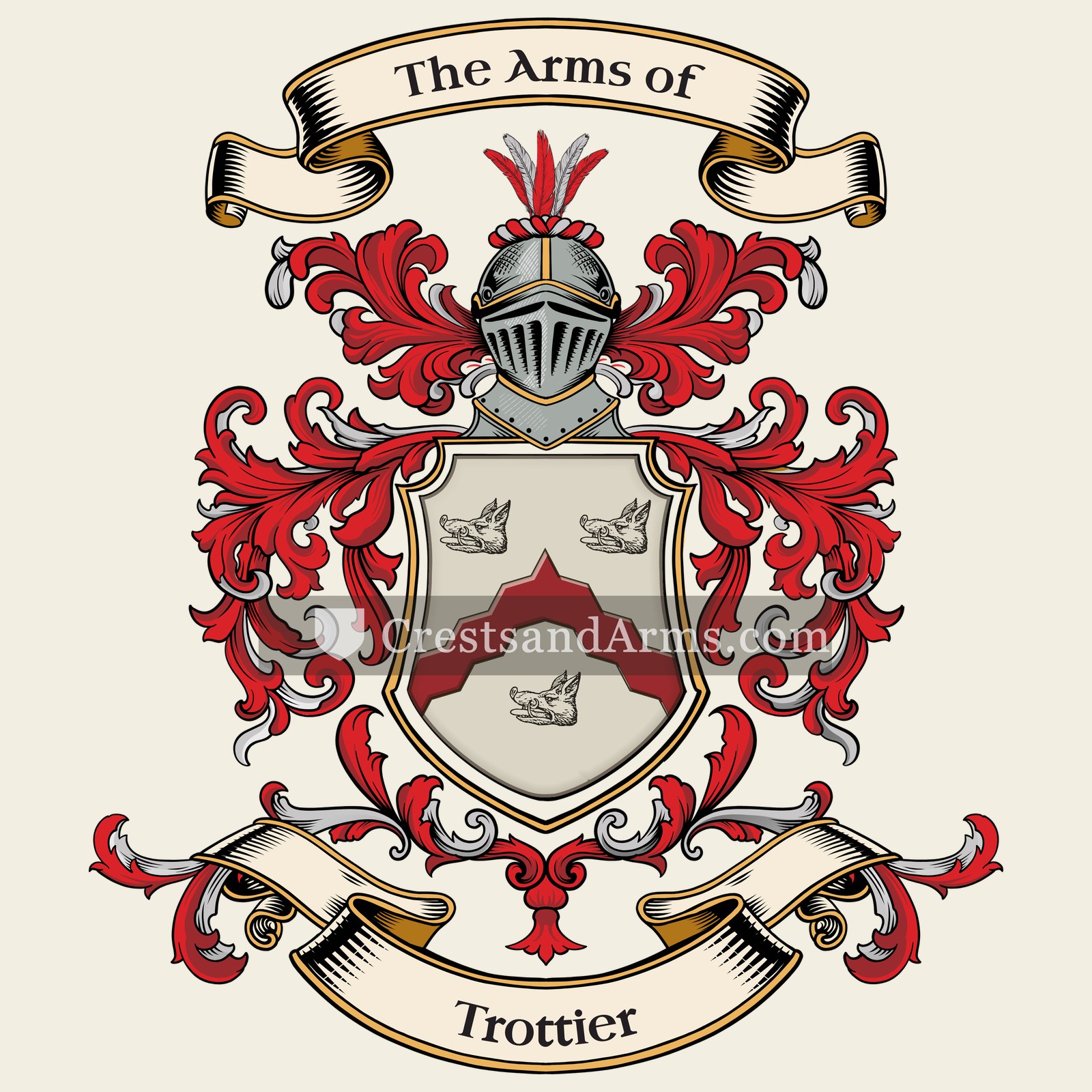
Coat of Arms & Family Crest Details
Symbols on this shield
chevronProtection, and faithful service completed
boars headA fierce fighter who battles to the end
Colours
Silver (Argent)Means: Peace and sincerity
Red (Gules)Means: Military strength
Black (Sable)Means: Constancy
Historical info
Source
Sir Bernard Burke, The General Armory of England, Scotland, Ireland and Wales, London: Harrison & Sons, 1884
Blazon (the actual original written record)
“Ar. a chev. indented gu. betw. three boars' heads couped sa”
Scotlandc. 1672
Digital archive packCoat of arms PNG, gold border print PDF, vector SVG and the certificate of authenticity. Sent to your email in minutes.
Map of Scotland showing where the Trottier arms are recorded
The Trottier arms were recorded in Scotland, c. 1672.
Arms such as these were typically recorded in Edinburgh.
Edinburgh was the seat of Scotland's government, its courts and its heralds. Families with business there settled nearby, and being close to where arms were recorded is exactly why so many of them appear.
This is where the arms were entered in the register. Families often moved to other parts of the country, so the same name can turn up in more than one region.
The body that granted and recorded arms in Scotland in this period.
Charles II of England
Sovereign of the period
Charles II of England
1660–1685
Reigning in England when the Trottier arms are first recorded.
How Arms Worked in Scotland
Scottish heraldry is unique because it treats a coat of arms as a piece of personal property protected by law. Only one person can own a specific design at any given time. When a family grows, the head keeps the original shield while other relatives must apply for their own distinct version with slight changes to prove their specific identity.
Granting authority
The Court of the Lord Lyon acts as the official body that regulates and controls all heraldic matters throughout Scotland.
How they got arms
Individuals obtain a legal right to their arms through a formal petition process that confirms their identity and family connection.
Where arms were recorded
All valid coats of arms are officially entered into the Public Register of All Arms and Bearings starting from 1672.
The family's standing
Recorded among the armigerous families of Scotland.
Origin & History of the Trottier Family in Scotland
The Trottier family name carries a distinct history that links its early members to the bustling urban environment of seventeenth-century Edinburgh. By 1672, records confirm that individuals bearing this surname were established within the city, a period marked by significant social and economic shifts in the Scottish capital. During this era, Edinburgh served as a central hub for trade and administration, drawing families into the city to participate in the growing professional and merchant classes. While the name itself is often associated with French origins, its presence in Scotland suggests a history of migration and integration into the local community. These early Trottiers likely navigated the complex social structures of the Restoration period, contributing to the development of the city as they settled into their new surroundings. Their presence in the official registers of the time highlights how families moved across borders to build new lives during a transformative century in Scottish history.
Trottier Meaning & Related Branches
Root word
trot
Old French word for a quick or brisk pace.
This name
TrottierA nickname for a fast walker or a messenger who traveled quickly.
also spelled
Trottar
Trottor
Documented Sources
Sir Bernard Burke, The General Armory of England, Scotland, Ireland and Wales, London: Harrison & Sons, 1884
General Register Office, England and Wales Civil Registration Births Index, 1868
Surrey History Centre, Surrey Electoral Registers, 1868
Digital archive packCoat of arms PNG, gold border print PDF, vector SVG and the certificate of authenticity. Sent to your email in minutes.


 chiefAuthority, wisdom and dominion
 cantonA mark of honour granted by the sovereign
 chevronProtection, and faithful service completed
 chequyConstancy, and the counting-board
 crescentHonour by the sovereign, and the second son
 mulletThe third son, and a divine quality from above
 fleur de lisPurity, light, and the sixth son
 chiefAuthority, wisdom and dominion
 cantonA mark of honour granted by the sovereign
 chevronProtection, and faithful service completed
 chequyConstancy, and the counting-board
 crescentHonour by the sovereign, and the second son
 mulletThe third son, and a divine quality from above
 fleur de lisPurity, light, and the sixth son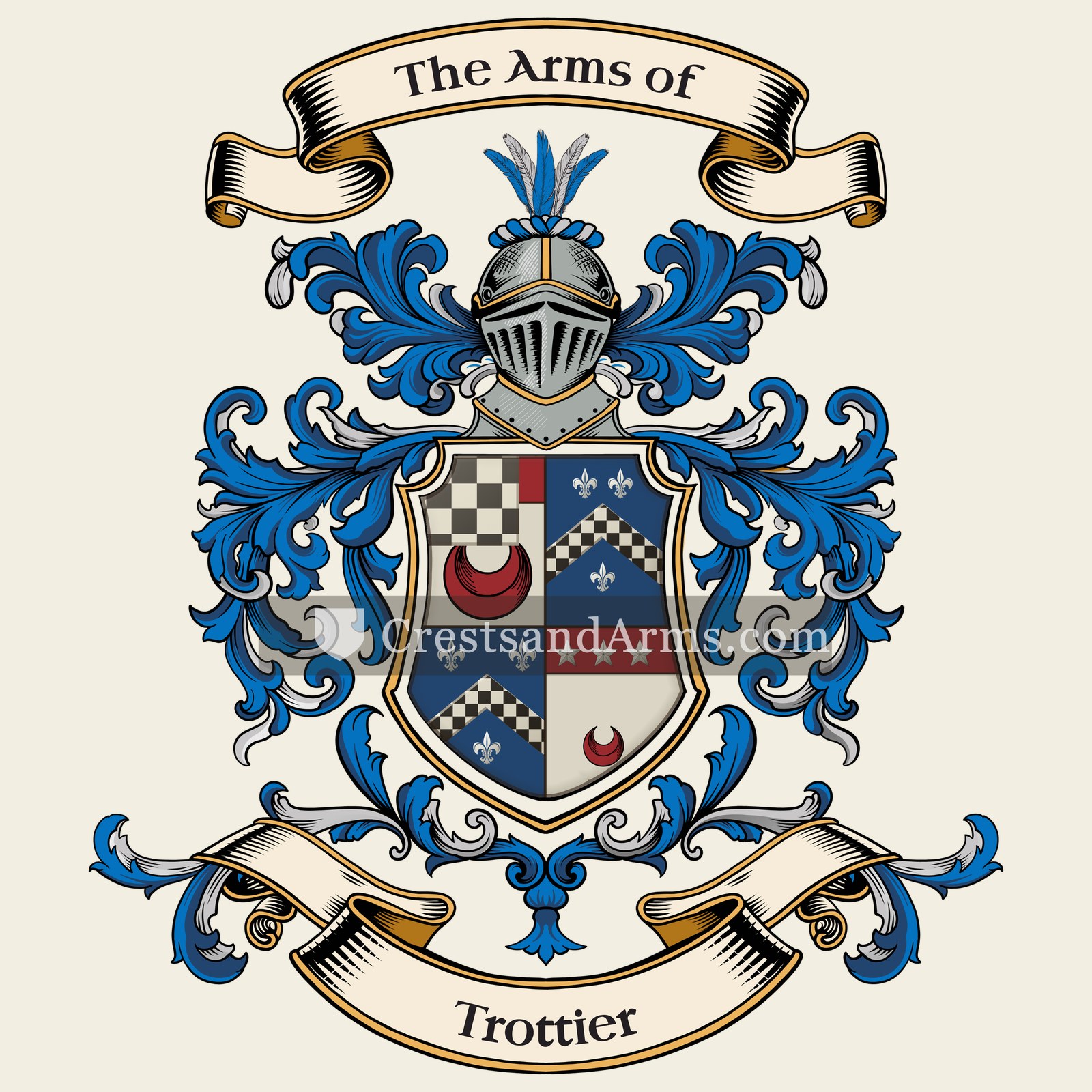


 boars headA fierce fighter who battles to the end