Map of France showing where the Tryon arms are recorded
The Tryon arms were recorded in Perigord, c. 1663.
Perigord was wooded upland country in south-western France, thick with small castles. Its gentry were numerous and mostly poor, and even a modest holding justified a shield of one's own.
This is where the arms were entered in the register. Families often moved to other parts of the country, so the same name can turn up in more than one region.
The body that granted and recorded arms in France in this period.
Louis XIV of France
Sovereign of the period
Louis XIV of France
1643–1715
Reigning in France when the Tryon arms are first recorded.
How Arms Worked in France
In France, a coat of arms was a mark of honor that passed down through the male line to all legitimate descendants. Families often used the same shield without changes to show their shared heritage. If a branch wanted to stand out, they could add a small mark to their shield to show their specific place in the family tree.
Granting authority
The Juge d'armes de France acted as the official authority that regulated and verified coats of arms across the country.
How they got arms
Families typically inherited their arms from ancestors, though they could also receive them through royal grants or by proving their noble status.
Where arms were recorded
Coats of arms were officially recorded in the Armorial Général de France, which began its main collection in the year 1696.
The family's standing
Recorded among the armigerous families of Perigord.
Origin & History of the Tryon Family in France
The roots of the Tryon family in France are deeply connected to the historical region of Périgord, where members of the family were documented as early as 1663. During this period, the area was characterized by a complex social landscape defined by local land ownership and the influence of the provincial nobility. Families like the Tryons often held positions of local importance, managing estates and participating in the administrative life of their parishes. Life in seventeenth-century Périgord required families to navigate the shifting political climate of the French monarchy while maintaining their ancestral ties to the land. As the family established their presence in the region, they became part of the long-standing traditions of rural French society, where identity was closely tied to one’s specific village and local community.
Meaning of the Tryon family crest colors & symbols
Symbols on this shield
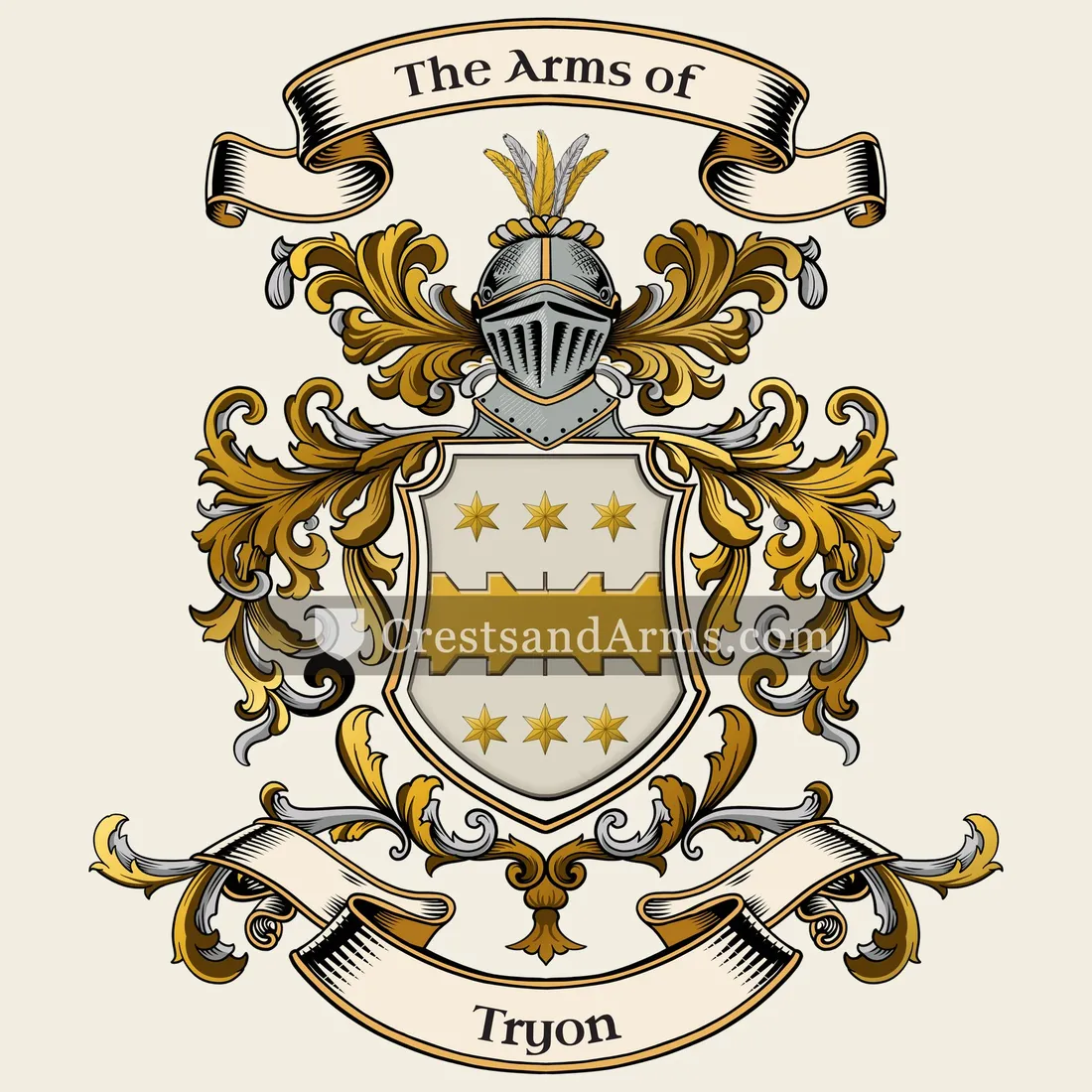
fessThe military belt, and readiness to serve
starThe celestial goddess, and nobility
Colours
Silver (Argent)Means: Peace and sincerity
Gold (Or)Means: Generosity
Historical info
Source
Sir Bernard Burke, The General Armory of England, Scotland, Ireland and Wales, London: Harrison & Sons, 1884
Blazon (the actual original written record)
“Ar. a fess embattled betw. six estoiles or”
EssexLayer Marney · Essex, c. 1615
Digital archive packCoat of arms PNG, gold border print PDF, vector SVG and the certificate of authenticity. Sent to your email in minutes.
Map of England showing where the Tryon arms are recorded
The Tryon arms were recorded in Essex, c. 1615.
Essex lay close enough to London for City money to buy land there. Merchants who prospered moved out to estates within a day's ride, and a new landowner almost always wanted arms to go with the ground.
This is where the arms were entered in the register. Families often moved to other parts of the country, so the same name can turn up in more than one region.
The body that granted and recorded arms in England in this period.
James VI and I
Sovereign of the period
James VI and I
1603–1625
Reigning in France when the Tryon arms are first recorded.
How Arms Worked in England
English heraldry allowed arms to be shared by all legitimate descendants of the original owner. These symbols were treated as personal property that moved through the generations to all children. While the eldest son kept the original design, other family members could use the same shield without needing to change it or register their own unique versions.
Granting authority
The College of Arms in London has regulated the use of coats of arms throughout England and Wales since 1484.
How they got arms
Families typically obtained their coats of arms through a formal grant from the Crown or by proving their ancient right to them.
Where arms were recorded
All official coats of arms are recorded in the registers kept at the College of Arms, which date back to the fifteenth century.
The family's standing
Recorded among the armigerous families of Essex.
Origin & History of the Tryon Family in England
The surname Tryon has deep roots in the English county of Essex, where members of the family were firmly established by the early 17th century. Historical records confirm their presence in this region by 1615, suggesting that the family played a part in the local life of the area during the Stuart period. The name itself is often linked to the Old French term "trion," which historically referred to a type of coin or a specific measurement, though it likely evolved into a family name as a descriptive nickname or a reference to a specific trade. By settling in Essex, the early Tryons became part of a landscape defined by agriculture and proximity to London, which allowed families of that era to grow their influence through land ownership and local commerce. As the family expanded throughout the 1600s, they integrated into the social fabric of southeastern England, leaving behind a legacy that is still tied to the historical records of the region.
Tryon Meaning & Related Branches
Root word
Tiron
Latin term referring to a novice soldier or a young recruit.
This name
TryonA habitational name derived from a place in France or a nickname for a new recruit.
also spelled
Trion
Trione
Documented Sources
J. B. Rietstap, Armorial Général, Gouda: G. B. van Goor Zonen, 1884–87
Archives départementales de la Dordogne, Série E (Familles et seigneuries)
Galy, Élie, Dictionnaire des familles du Périgord, 1875
Peyronnet, Jean-Pierre, Histoire du Périgord, 1988
Digital archive packCoat of arms PNG, gold border print PDF, vector SVG and the certificate of authenticity. Sent to your email in minutes.


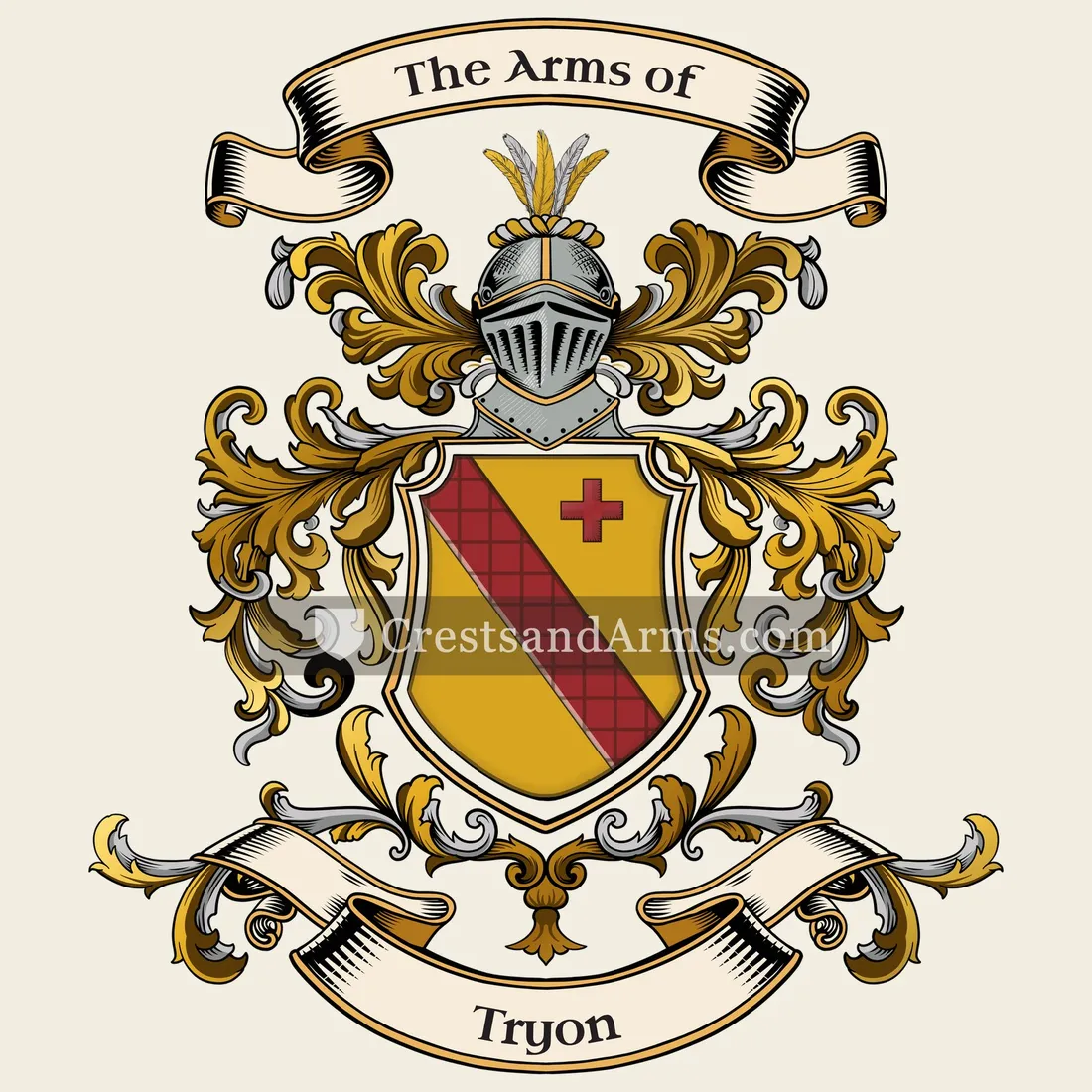
 bendDefence, and the scarf of a commander
 cross symbolChristian faith and service
 bendDefence, and the scarf of a commander
 cross symbolChristian faith and service


 fessThe military belt, and readiness to serve
 starThe celestial goddess, and nobility