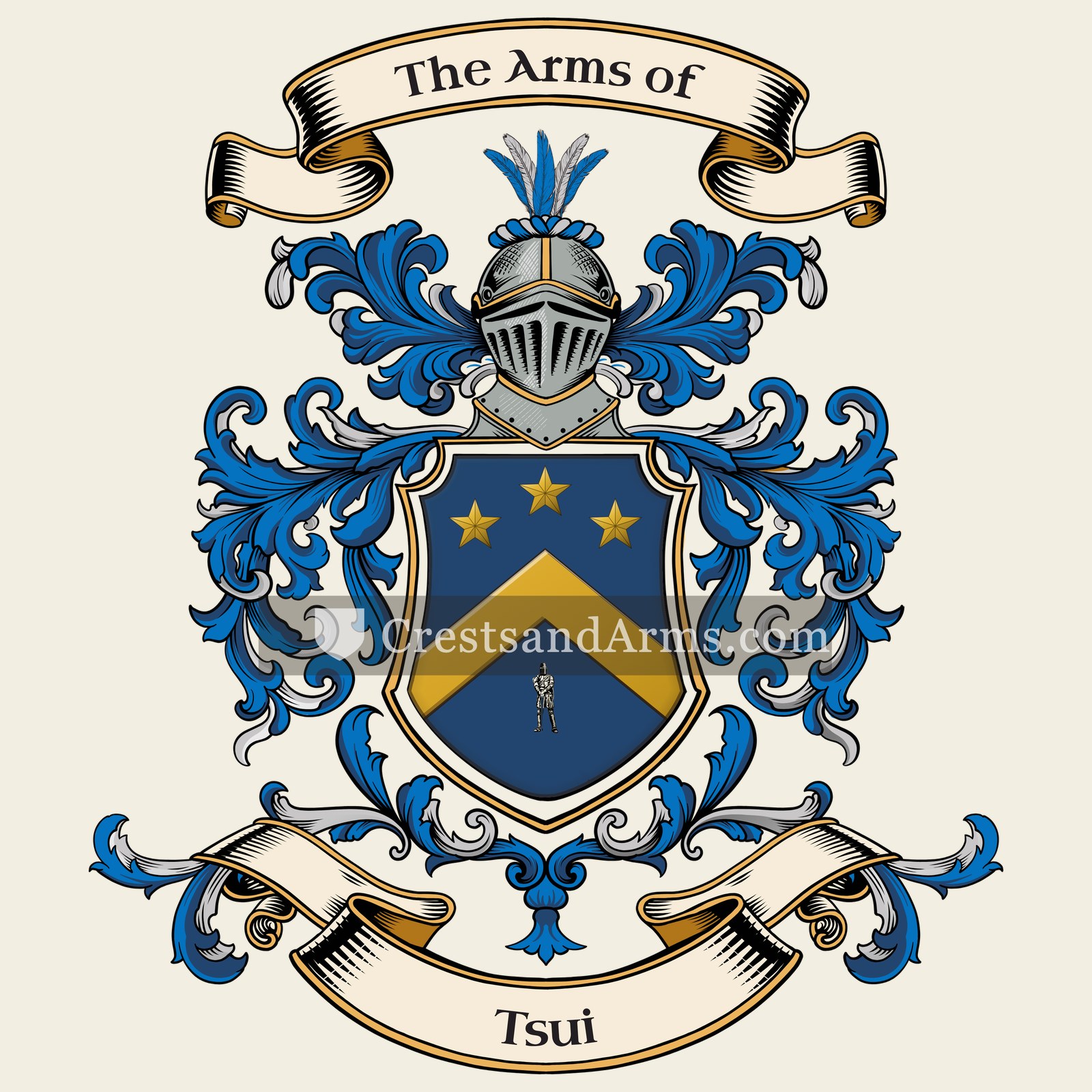
A record of documented arms, meaning and origin, researched for the Tsui family of Italy.
Reg. 6097 · Italian, T–V
Coat of Arms & Family Crest Details
Symbols on this shield
chevronProtection, and faithful service completed
mulletThe third son, and a divine quality from above
knightChivalry and service in arms
Colours
Blue (Azure)Means: Loyalty and truth
Gold (Or)Means: Generosity
Historical info
Source
J. B. Rietstap, Armorial Général, Gouda: G. B. van Goor Zonen, 1884–87
Blazon (the actual original written record)
“D'azur au chev. d'or, acc. en chef de trois étoiles (8) mal-ordonnées du même et en p. d'un buste d'homme de carn., posé de profil, la tête environnée d'une couronne de laurier de sin., hab. de gu., bout. d'or.”
ItalyMilan, c. 1775
Digital archive packCoat of arms PNG, gold border print PDF, vector SVG and the certificate of authenticity. Sent to your email in minutes.
Map of Italy showing where the Tsui arms are recorded
The Tsui arms were recorded in Milan, c. 1775.
This is where the arms were entered in the register. Families often moved to other parts of the country, so the same name can turn up in more than one region.
The body that granted and recorded arms in Italy in this period.
Alvise Giovanni Mocenigo
Sovereign of the period
Alvise Giovanni Mocenigo
1763–1778
Reigning in Italy when the Tsui arms are first recorded.
How Arms Worked in Italy
In the Italian states, coats of arms were often used by noble families to show their status and history. These symbols were passed down through the generations to all legitimate male descendants. Younger branches of a family usually kept the original design but sometimes added small changes to distinguish their specific line from the main branch.
Granting authority
Various local rulers and city governments controlled the use of coats of arms across the different Italian states.
How they got arms
Families often assumed their own arms or received them as official grants from local lords, popes, or city councils.
Where arms were recorded
Arms were recorded in local city archives or private family books rather than in one single national register.
The family's standing
Recorded among the armigerous families of Italy.
Origin & History of the Tsui Family in Italy
The history of the Tsui family name is deeply rooted in the cultural shifts of the late eighteenth century, particularly within the vibrant urban landscape of Milan. By 1775, records indicate that members of the family were already established residents of the city, participating in the social and economic life of Northern Italy during a period of significant transition under the Habsburg monarchy. While the name itself carries distinct linguistic origins often associated with East Asian roots, its presence in Milan suggests a unique narrative of migration, trade, or diplomatic service that brought the family to the heart of Lombardy. These early ancestors likely navigated the complex administrative systems of the time, leaving behind traces in local parish registers and municipal documents that highlight their integration into the local community. Through these records, we see a family that successfully adapted to a new environment while maintaining the legacy of their ancestral identity in a rapidly changing European society.
Related Branches & Arms
Root word
Cuius
Latin term referring to someone belonging to or of whom
This name
TsuiAn Italian surname derived from the Latin possessive pronoun indicating origin or belonging
also spelled
Tosy
Documented Sources
J. B. Rietstap, Armorial Général, Gouda: G. B. van Goor Zonen, 1884–87
Archivio di Stato di Milano, Stato delle Anime (Parish census records for the city of Milan, 1775)
Cattaneo, Carlo, Memorie storiche di Milano, 1845
Romani, Roberto, Sensibilità e storia. Dinamiche sociali nella Lombardia del Settecento, 1996
Digital archive packCoat of arms PNG, gold border print PDF, vector SVG and the certificate of authenticity. Sent to your email in minutes.


 chevronProtection, and faithful service completed
 mulletThe third son, and a divine quality from above
 knightChivalry and service in arms
 chevronProtection, and faithful service completed
 mulletThe third son, and a divine quality from above
 knightChivalry and service in arms