A record of documented arms, meaning and origin, researched for the Tutor family lines. Documented in 3 countries.
Reg. 4992 · Britain, T–V
Coat of Arms & Family Crest Details
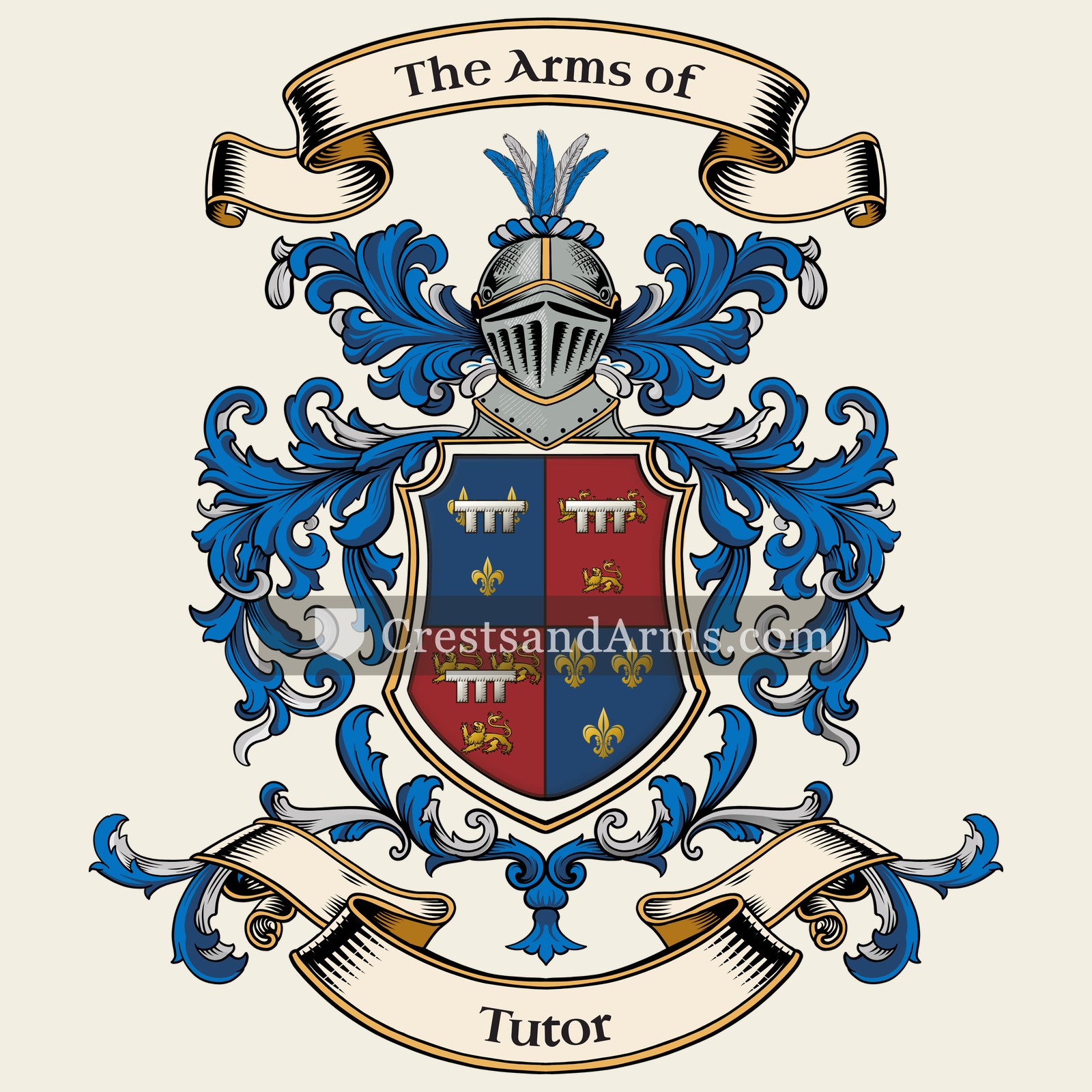
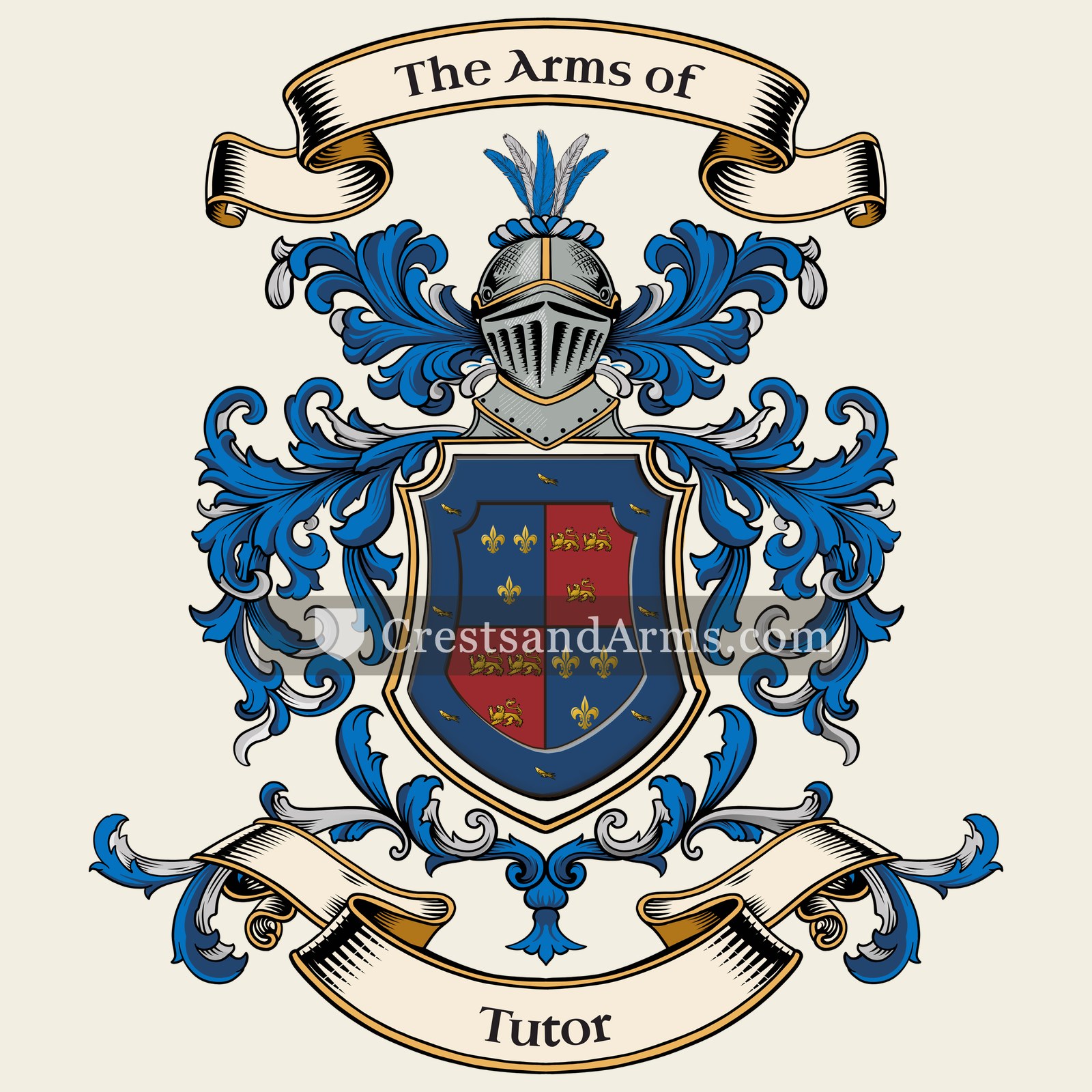
Symbols on this shield
martletA younger son, who must win his own land
fleur de lisPurity, light, and the sixth son
lionCourage, strength and royalty
Colours
Blue (Azure)Means: Loyalty and truth
Red (Gules)Means: Military strength
Gold (Or)Means: Generosity
Historical info
Source
J. B. Rietstap, Armorial Général, Gouda: G. B. van Goor Zonen, 1884–87
Blazon (the actual original written record)
“Ec., d'azur à trois fleurs-de-lis d'or, et de gu. à trois léopards d'or, l'un sur l'autre. L'écu entouré d'une bord. d'azur, ch. de huit martinets d'or. C.: un léopard d'or, orné d'un collier d'azur ch. de trois martinets d'or, et posé sur un chapeau de tournoi de gu., retr. d'herm.”
Britainc. 1452
Digital archive packCoat of arms PNG, gold border print PDF, vector SVG and the certificate of authenticity. Sent to your email in minutes.
Map of Britain showing where the Tutor arms are recorded
The Tutor arms were recorded in Britain, c. 1452.
Arms such as these were typically recorded in Kent.
Kent sits between London and the short crossing to Europe, and the trade passing through made it wealthy. Merchant families bought land with that money, and it was landowners who took coats of arms.
This is where the arms were entered in the register. Families often moved to other parts of the country, so the same name can turn up in more than one region.
The body that granted and recorded arms in Britain in this period.
Henry VI of England
Sovereign of the period
Henry VI of England
1422–1461
Reigning in Britain when the Tutor arms are first recorded.
How Arms Worked in Britain
English heraldry allowed arms to be shared by all legitimate descendants of the original owner. These symbols were treated as personal property that moved through the generations to all children. While the eldest son kept the original design, other family members could use the same shield without needing to change it or register their own unique versions.
Granting authority
The College of Arms in London has regulated the use of coats of arms throughout England and Wales since 1484.
How they got arms
Families typically obtained their coats of arms through a formal grant from the Crown or by proving their ancient right to them.
Where arms were recorded
All official coats of arms are recorded in the registers kept at the College of Arms, which date back to the fifteenth century.
The family's standing
Recorded among the armigerous families of Britain.
Origin & History of the Tutor Family in Britain
The family name Tutor has roots that stretch back to the medieval period in England, with documented evidence placing members of the family in the county of Kent as early as 1452. During the fifteenth century, surnames were often derived from a person’s occupation, a physical trait, or their location. The name Tutor is widely believed to be an occupational surname, likely referring to a private teacher or a guardian who managed the affairs of a young person. In the social structure of late medieval Kent, which was a hub for trade and agriculture, families with this name were part of the growing class of commoners who were beginning to establish stable, localized identities. As the family settled into the rural landscape of southeastern England, they lived through a time of great social change, including the transition from the feudal system to a more mobile society. By remaining in the region for generations, the early Tutors became part of the local fabric of Kentish life, contributing to the agricultural and social development of their communities long before the surname became widely dispersed across the country.
Coat of Arms & Family Crest Details
Symbols on this shield
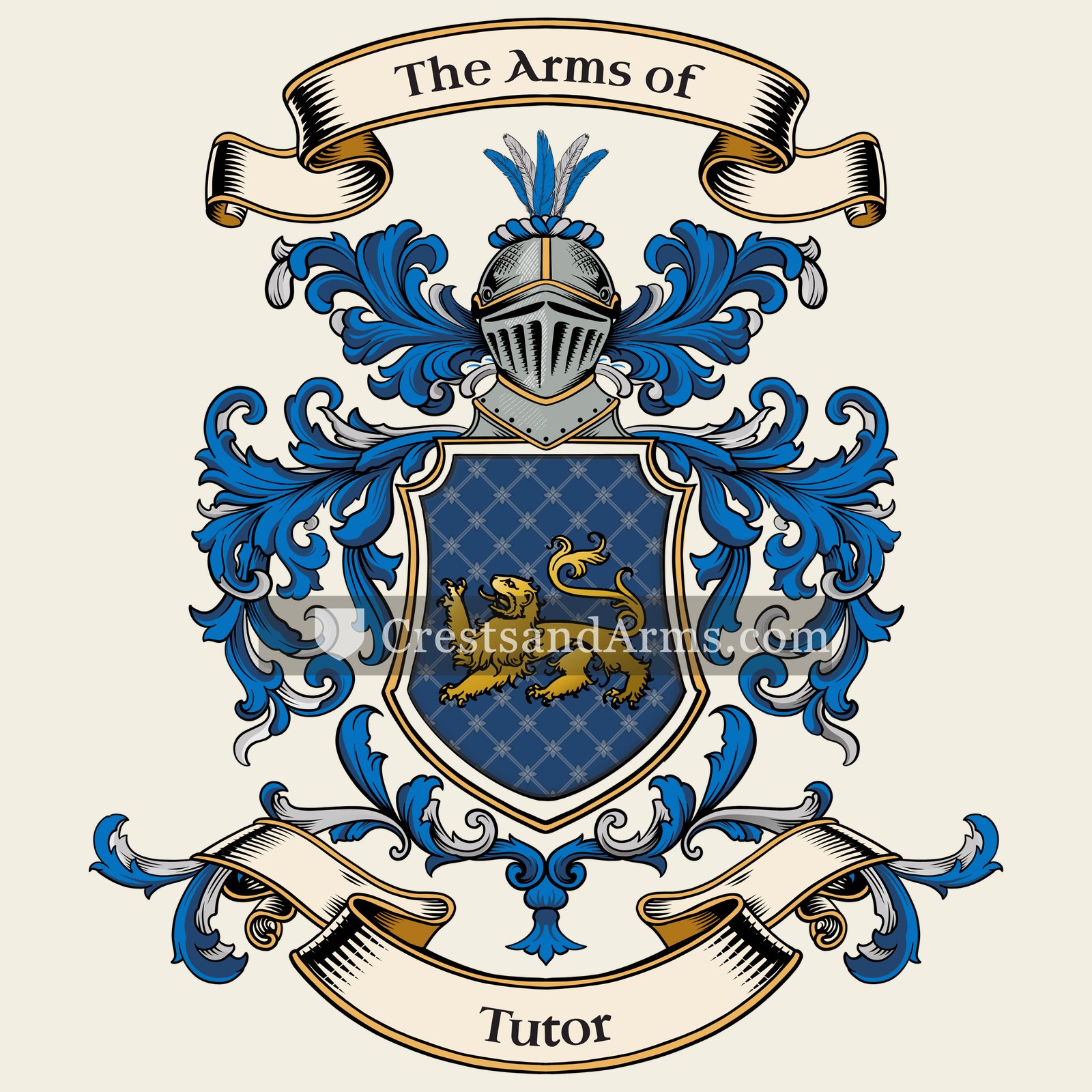
lionCourage, strength and royalty
Colours
Blue (Azure)Means: Loyalty and truth
Gold (Or)Means: Generosity
Historical info
Source
Sir Bernard Burke, The General Armory of England, Scotland, Ireland and Wales, London: Harrison & Sons, 1884
Blazon (the actual original written record)
“Az. a lion ramp. or”
Englandc. 1620
Digital archive packCoat of arms PNG, gold border print PDF, vector SVG and the certificate of authenticity. Sent to your email in minutes.
Map of England showing where the Tutor arms are recorded
The Tutor arms were recorded in England, c. 1620.
Arms such as these were typically recorded in York.
Yorkshire is the largest of the English counties, and it held more gentry families than any other. Land there was split among a great many households rather than a few, so a great many of them carried arms.
This is where the arms were entered in the register. Families often moved to other parts of the country, so the same name can turn up in more than one region.
The body that granted and recorded arms in England in this period.
James VI and I
Sovereign of the period
James VI and I
1603–1625
Reigning in Britain when the Tutor arms are first recorded.
How Arms Worked in England
English heraldry allowed arms to be shared by all legitimate descendants of the original owner. These symbols were treated as personal property that moved through the generations to all children. While the eldest son kept the original design, other family members could use the same shield without needing to change it or register their own unique versions.
Granting authority
The College of Arms in London has regulated the use of coats of arms throughout England and Wales since 1484.
How they got arms
Families typically obtained their coats of arms through a formal grant from the Crown or by proving their ancient right to them.
Where arms were recorded
All official coats of arms are recorded in the registers kept at the College of Arms, which date back to the fifteenth century.
The family's standing
Recorded among the armigerous families of England.
Origin & History of the Tutor Family in England
The surname Tutor emerged in England as a descriptive name, likely originating from the Latin word *tutor*, which means a guardian or a protector. During the medieval period, surnames were often adopted to reflect a person’s occupation, status, or role within their local community. By the early 17th century, the family had established a notable presence in the city of York. Records from 1620 confirm that members of the Tutor family were living and working in this historic northern hub, which served as a major center for trade and administration. At this time, York was a bustling city where families often built their lives around the crafts and guild systems that defined English urban life. While the name may have begun as a title for someone who watched over others or managed an estate, it eventually became a permanent family identifier that was passed down through generations of residents in Northern England.
Coat of Arms & Family Crest Details
Symbols on this shield
labelThe eldest son, during his father's life
fleur de lisPurity, light, and the sixth son
lionCourage, strength and royalty
Colours
Blue (Azure)Means: Loyalty and truth
Red (Gules)Means: Military strength
Silver (Argent)Means: Peace and sincerity
Gold (Or)Means: Generosity
Historical info
Source
Sir Bernard Burke, The General Armory of England, Scotland, Ireland and Wales, London: Harrison & Sons, 1884
Blazon (the actual original written record)
“Quarterly, France and England, a label of three points ar”
WalesArthur, c. 1566
Digital archive packCoat of arms PNG, gold border print PDF, vector SVG and the certificate of authenticity. Sent to your email in minutes.
Map of Wales showing where the Tutor arms are recorded
The Tutor arms were recorded in Arthur, c. 1566.
Arms such as these were typically recorded in Denbigh.
Denbighshire was north Welsh country of hills and small estates. Land was held by a great many families rather than a few, and each holding brought its own claim to a coat of arms.
This is where the arms were entered in the register. Families often moved to other parts of the country, so the same name can turn up in more than one region.
The body that granted and recorded arms in Wales in this period.
Elizabeth I of England
Sovereign of the period
Elizabeth I of England
1558–1603
Reigning in Britain when the Tutor arms are first recorded.
How Arms Worked in Wales
English heraldry allowed arms to be shared by all legitimate descendants of the original owner. These symbols were treated as personal property that moved through the generations to all children. While the eldest son kept the original design, other family members could use the same shield without needing to change it or register their own unique versions.
Granting authority
The College of Arms in London has regulated the use of coats of arms throughout England and Wales since 1484.
How they got arms
Families typically obtained their coats of arms through a formal grant from the Crown or by proving their ancient right to them.
Where arms were recorded
All official coats of arms are recorded in the registers kept at the College of Arms, which date back to the fifteenth century.
The family's standing
Recorded among the armigerous families of Wales.
Origin & History of the Tutor Family in Wales
The family name Tutor has deep roots in the rugged landscape of North Wales, particularly within the historic county of Denbighshire. By the year 1566, records confirm that members of the family were firmly established in the town of Denbigh, a region known for its complex social structures and shifting political loyalties during the Tudor period. The name likely evolved from local linguistic traditions, serving as a descriptive marker for individuals who held specific roles or lived in particular settlements within the Welsh Marches. During this era, the transition from traditional Welsh patronymic naming systems to fixed hereditary surnames was becoming more common, and the Tutor family was part of this significant cultural shift. Their presence in Denbigh suggests they were integrated into the local community, likely participating in the agricultural and trade networks that defined life in the sixteenth-century Welsh countryside.
Tutor Meaning & Related Branches
Root word
tutor
Latin for a guardian, protector, or watcher.
This name
TutorAn occupational surname for a private teacher, guardian, or legal protector.
also spelled
Tudyr
Tudder
Documented Sources
J. B. Rietstap, Armorial Général, Gouda: G. B. van Goor Zonen, 1884–87
Reaney, P.H., A Dictionary of English Surnames, 1991
Kent Archives, Canterbury Cathedral Archives: Records of the Dean and Chapter, 1452
Digital archive packCoat of arms PNG, gold border print PDF, vector SVG and the certificate of authenticity. Sent to your email in minutes.


 martletA younger son, who must win his own land
 fleur de lisPurity, light, and the sixth son
 lionCourage, strength and royalty
 martletA younger son, who must win his own land
 fleur de lisPurity, light, and the sixth son
 lionCourage, strength and royalty



 labelThe eldest son, during his father's life