A record of documented arms, meaning and origin, researched for the Tylor family lines. Documented in 3 countries.
Reg. 8047 · English, T–V
Coat of Arms & Family Crest Details
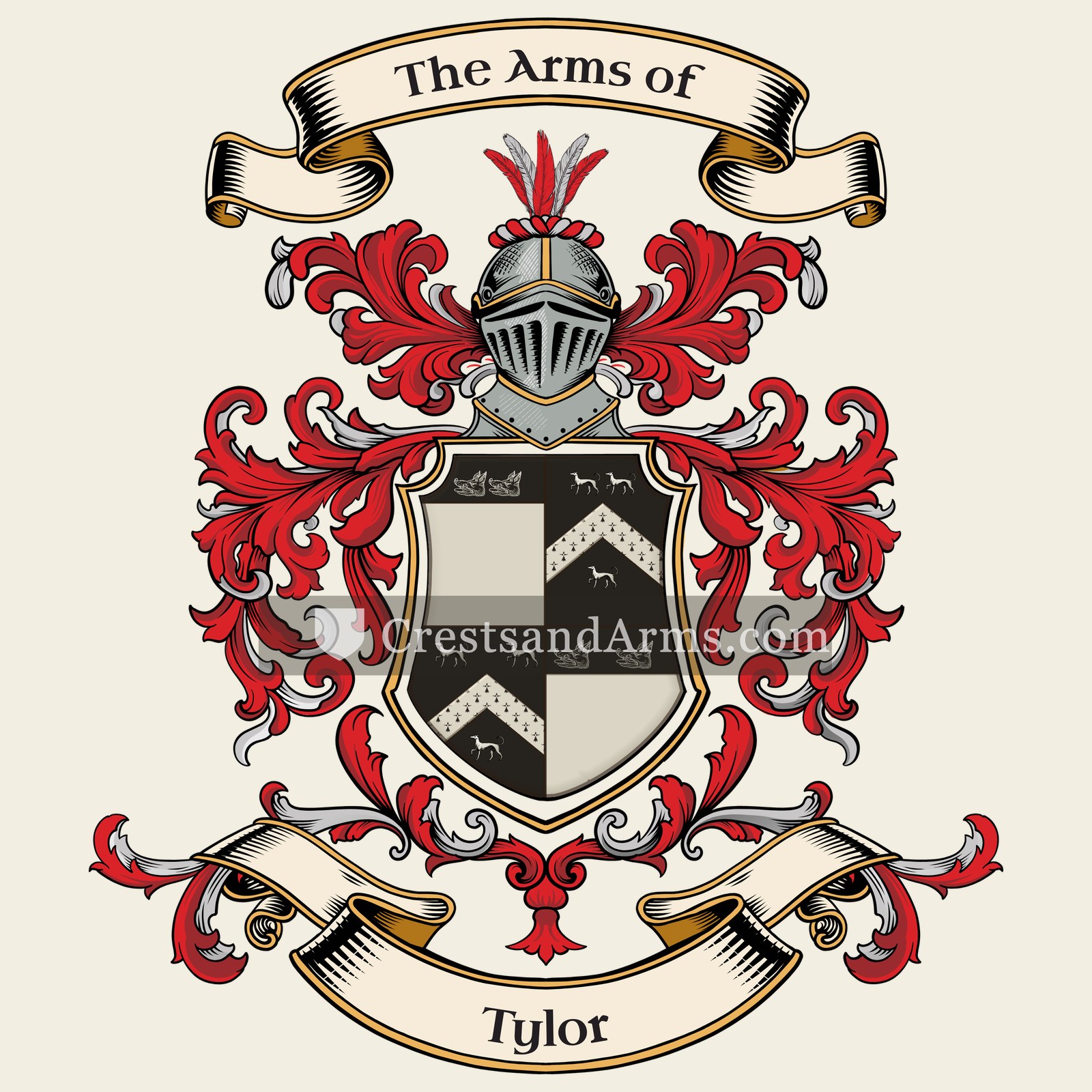
Symbols on this shield
chiefAuthority, wisdom and dominion
chevronProtection, and faithful service completed
boars headA fierce fighter who battles to the end
greyhoundCourage, vigilance and loyalty
Colours
Silver (Argent)Means: Peace and sincerity
Black (Sable)Means: Constancy
ErmineMeans: Dignity
Historical info
Source
Sir Bernard Burke, The General Armory of England, Scotland, Ireland and Wales, London: Harrison & Sons, 1884
Blazon (the actual original written record)
“Quarterly, 1st and 4th, ar. on a chief sa. two boars' heads couped of the first, for TAYLOR; 2nd and 3rd, sa. a chev. erm. betw. three greyhounds pass. ar., for ADAM”
KentTurnham · Kent, c. 1587
Digital archive packCoat of arms PNG, gold border print PDF, vector SVG and the certificate of authenticity. Sent to your email in minutes.
Map of England showing where the Tylor arms are recorded
The Tylor arms were recorded in Kent, c. 1587.
Kent sits between London and the short crossing to Europe, and the trade passing through made it wealthy. Merchant families bought land with that money, and it was landowners who took coats of arms.
This is where the arms were entered in the register. Families often moved to other parts of the country, so the same name can turn up in more than one region.
The body that granted and recorded arms in England in this period.
Elizabeth I of England
Sovereign of the period
Elizabeth I of England
1558–1603
Reigning in England when the Tylor arms are first recorded.
How Arms Worked in England
English heraldry allowed arms to be shared by all legitimate descendants of the original owner. These symbols were treated as personal property that moved through the generations to all children. While the eldest son kept the original design, other family members could use the same shield without needing to change it or register their own unique versions.
Granting authority
The College of Arms in London has regulated the use of coats of arms throughout England and Wales since 1484.
How they got arms
Families typically obtained their coats of arms through a formal grant from the Crown or by proving their ancient right to them.
Where arms were recorded
All official coats of arms are recorded in the registers kept at the College of Arms, which date back to the fifteenth century.
The family's standing
Recorded among the armigerous families of Kent.
Origin & History of the Tylor Family in England
The family name Tylor is an occupational surname that emerged in medieval England to describe people who worked as roofers. These individuals were essential to local communities because they installed clay tiles on houses and public buildings. By the late sixteenth century, the family had established a notable presence in the county of Kent. Records confirm that members of the Tylor family were living in this region by 1587. During this era, Kent was a hub of agricultural and trade activity, which provided steady work for skilled craftsmen like tilers. As the name passed from one generation to the next, it evolved from a simple job description into a permanent family identifier. This transition reflects a time when surnames became necessary to distinguish between people living in growing English villages.
Coat of Arms & Family Crest Details
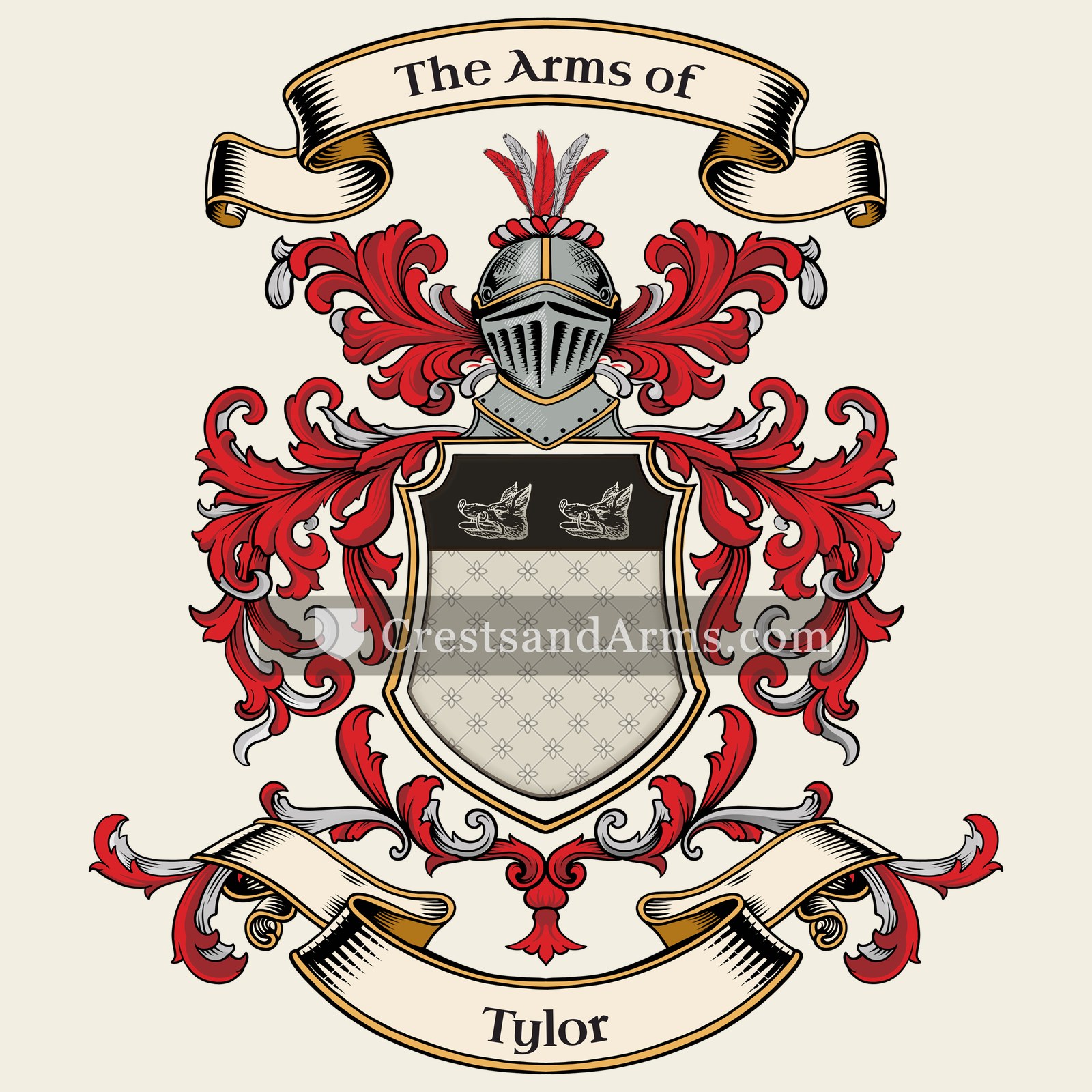
Symbols on this shield
chiefAuthority, wisdom and dominion
boars headA fierce fighter who battles to the end
Colours
Silver (Argent)Means: Peace and sincerity
Black (Sable)Means: Constancy
Historical info
Source
Sir Bernard Burke, The General Armory of England, Scotland, Ireland and Wales, London: Harrison & Sons, 1884
Blazon (the actual original written record)
“Ar. on a chief sa. two boars' heads couped fessways of the first, langued gu”
CavanBallyhaise · Cavan, c. 1636
Digital archive packCoat of arms PNG, gold border print PDF, vector SVG and the certificate of authenticity. Sent to your email in minutes.
Map of Ireland showing where the Tylor arms are recorded
The Tylor arms were recorded in Cavan, c. 1636.
Cavan was drumlin and lake country on the edge of Ulster, planted in the seventeenth century. The new landowners took formal grants, and formal grants were recorded with arms.
This is where the arms were entered in the register. Families often moved to other parts of the country, so the same name can turn up in more than one region.
The body that granted and recorded arms in Ireland in this period.
Charles I of England
Sovereign of the period
Charles I of England
1625–1649
Reigning in England when the Tylor arms are first recorded.
How Arms Worked in Ireland
The Ulster King of Arms granted coats of arms to individuals who proved their social standing and good character. These symbols were typically inherited by all legitimate descendants of the original holder. If a family branch wanted a unique look, they could apply for a specific change to their design through the office to ensure their identity remained distinct.
Granting authority
The Ulster King of Arms acted as the official body that regulated and issued all coats of arms throughout Ireland.
How they got arms
Families obtained their arms through formal grants issued by the office after proving their eligibility and paying the required fees.
Where arms were recorded
All official grants were recorded in the registers held by the Ulster King of Arms starting from the year 1552.
The family's standing
Recorded among the armigerous families of Cavan.
Origin & History of the Tylor Family in Ireland
The surname Tylor, often spelled as Taylor, holds a distinct place in the history of County Cavan, where records confirm the family’s presence as early as 1636. During this period, the region was undergoing significant social and land-based shifts due to the Plantation of Ulster, which encouraged families from Britain to settle in the Irish midlands. The Tylors were likely among those who moved to Cavan to take up roles in trade, administration, or farming as the local economy reorganized under new governance. Because the name is occupational in origin, it suggests that early ancestors were skilled craftsmen who worked with textiles or clothing. Over the following decades, these families became deeply integrated into the local community, adapting to the rural landscape of Cavan while maintaining their distinct family identity through generations of change.
Related Branches & Arms
Root word
tegere
Latin verb meaning to cover or protect.
This name
TylorAn occupational surname for a person who covered roofs with tiles or slate.
also spelled
Tayler
Tailor
Taylour
Documented Sources
Sir Bernard Burke, The General Armory of England, Scotland, Ireland and Wales, London: Harrison & Sons, 1884
Bardsley, Charles Wareing, A Dictionary of English and Welsh Surnames, 1901
Reaney, P.H., A Dictionary of British Surnames, 1958
Kent Archives, Archdeaconry Court of Canterbury Probate Records, 1587
Digital archive packCoat of arms PNG, gold border print PDF, vector SVG and the certificate of authenticity. Sent to your email in minutes.


 chiefAuthority, wisdom and dominion
 chevronProtection, and faithful service completed
 boars headA fierce fighter who battles to the end
 greyhoundCourage, vigilance and loyalty
 chiefAuthority, wisdom and dominion
 chevronProtection, and faithful service completed
 boars headA fierce fighter who battles to the end
 greyhoundCourage, vigilance and loyalty