Map of Ireland showing where the Tyrrell arms are recorded
The Tyrrell arms were recorded in Dublin, c. 1595.
Dublin was the seat of government in Ireland and the place where grants were sought and recorded. Families with business at the castle or the courts settled nearby, and settling there put their arms on record.
This is where the arms were entered in the register. Families often moved to other parts of the country, so the same name can turn up in more than one region.
The body that granted and recorded arms in Ireland in this period.
Elizabeth I of England
Sovereign of the period
Elizabeth I of England
1558–1603
Reigning in Ireland when the Tyrrell arms are first recorded.
How Arms Worked in Ireland
The Ulster King of Arms granted coats of arms to individuals who proved their social standing and good character. These symbols were typically inherited by all legitimate descendants of the original holder. If a family branch wanted a unique look, they could apply for a specific change to their design through the office to ensure their identity remained distinct.
Granting authority
The Ulster King of Arms acted as the official body that regulated and issued all coats of arms throughout Ireland.
How they got arms
Families obtained their arms through formal grants issued by the office after proving their eligibility and paying the required fees.
Where arms were recorded
All official grants were recorded in the registers held by the Ulster King of Arms starting from the year 1552.
The family's standing
Recorded among the armigerous families of Dublin.
Origin & History of the Tyrrell Family in Ireland
The Tyrrell family name has deep roots in Ireland that stretch back long before the turn of the seventeenth century. While the name originated in Normandy, members of the family arrived in Ireland during the Anglo-Norman invasions and quickly integrated into the local landscape. By 1595, historical records confirm that the Tyrrells were well-established figures in Dublin, where they held significant social and political influence. Over the generations, the family expanded their reach across the island, particularly in areas like Westmeath, where they became prominent landowners. Their transition from newcomers to established members of Irish society reflects the complex history of migration and settlement that shaped the country during the late medieval and early modern periods.
Coat of Arms & Family Crest Details
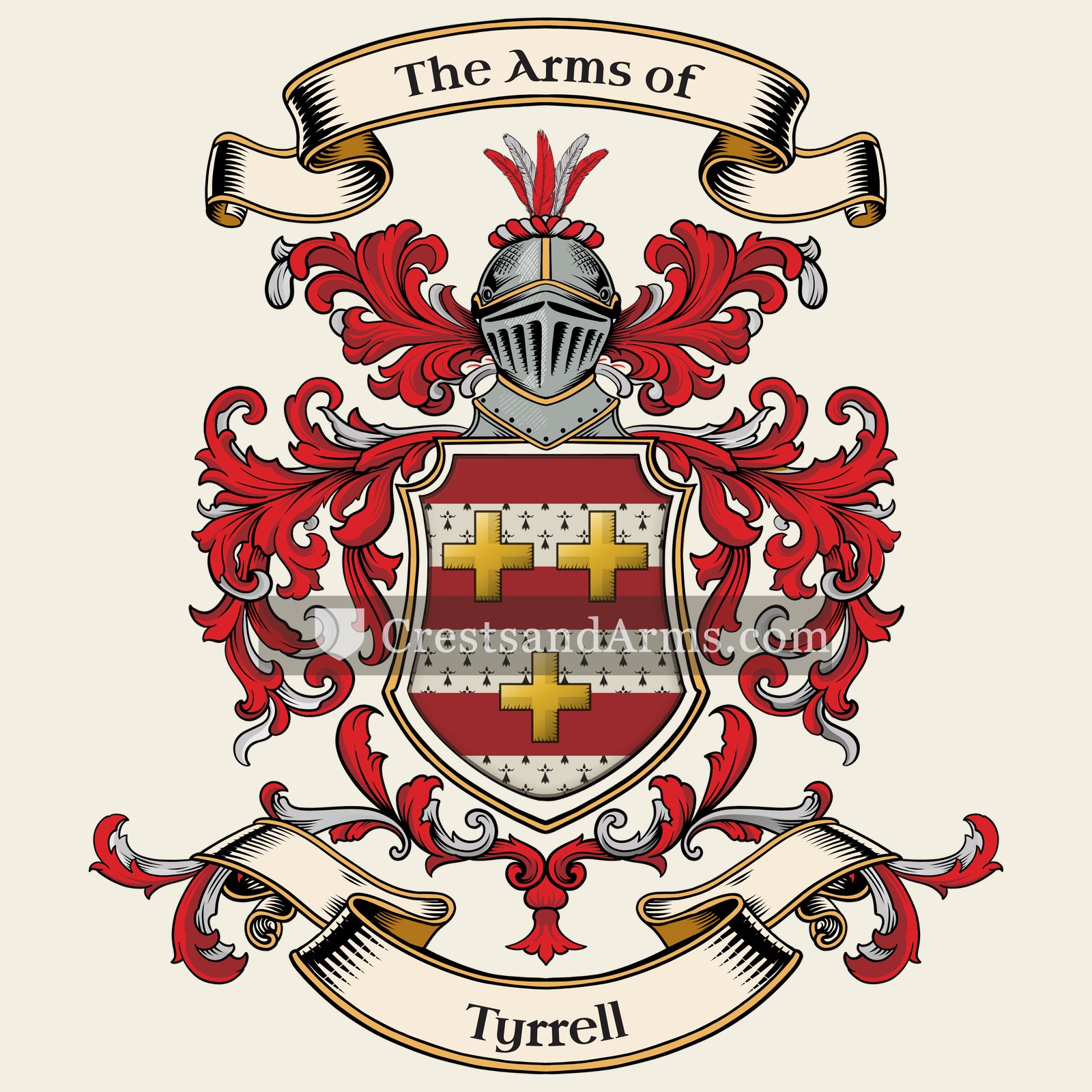
Symbols on this shield
cross symbolChristian faith and service
Colours
Red (Gules)Means: Military strength
Gold (Or)Means: Generosity
Historical info
Source
Sir Bernard Burke, The General Armory of England, Scotland, Ireland and Wales, London: Harrison & Sons, 1884
Blazon (the actual original written record)
“Gu. three bars erm. and nine crosses pattée, three, three, and three or”
Englandc. 1620
Digital archive packCoat of arms PNG, gold border print PDF, vector SVG and the certificate of authenticity. Sent to your email in minutes.
Map of England showing where the Tyrrell arms are recorded
The Tyrrell arms were recorded in England, c. 1620.
Arms such as these were typically recorded in York.
Yorkshire is the largest of the English counties, and it held more gentry families than any other. Land there was split among a great many households rather than a few, so a great many of them carried arms.
This is where the arms were entered in the register. Families often moved to other parts of the country, so the same name can turn up in more than one region.
The body that granted and recorded arms in England in this period.
James VI and I
Sovereign of the period
James VI and I
1603–1625
Reigning in Ireland when the Tyrrell arms are first recorded.
How Arms Worked in England
English heraldry allowed arms to be shared by all legitimate descendants of the original owner. These symbols were treated as personal property that moved through the generations to all children. While the eldest son kept the original design, other family members could use the same shield without needing to change it or register their own unique versions.
Granting authority
The College of Arms in London has regulated the use of coats of arms throughout England and Wales since 1484.
How they got arms
Families typically obtained their coats of arms through a formal grant from the Crown or by proving their ancient right to them.
Where arms were recorded
All official coats of arms are recorded in the registers kept at the College of Arms, which date back to the fifteenth century.
The family's standing
Recorded among the armigerous families of England.
Origin & History of the Tyrrell Family in England
The surname Tyrrell has deep roots in the English landscape, with its origins tied to the Old French nickname *tirel*, which translates to "puller" or "stubborn." This name likely described a person with a headstrong or persistent nature. While the family name became prominent in various regions, historical records confirm that members of the Tyrrell family were well-established in the city of York by 1620. During this period, York served as a vital northern hub for trade and administration, and families like the Tyrrells often played active roles in the local merchant classes or civic life. As the name spread across England, it evolved from a descriptive nickname into a permanent family identifier that linked generations of people to their specific local communities and occupations.
Coat of Arms & Family Crest Details
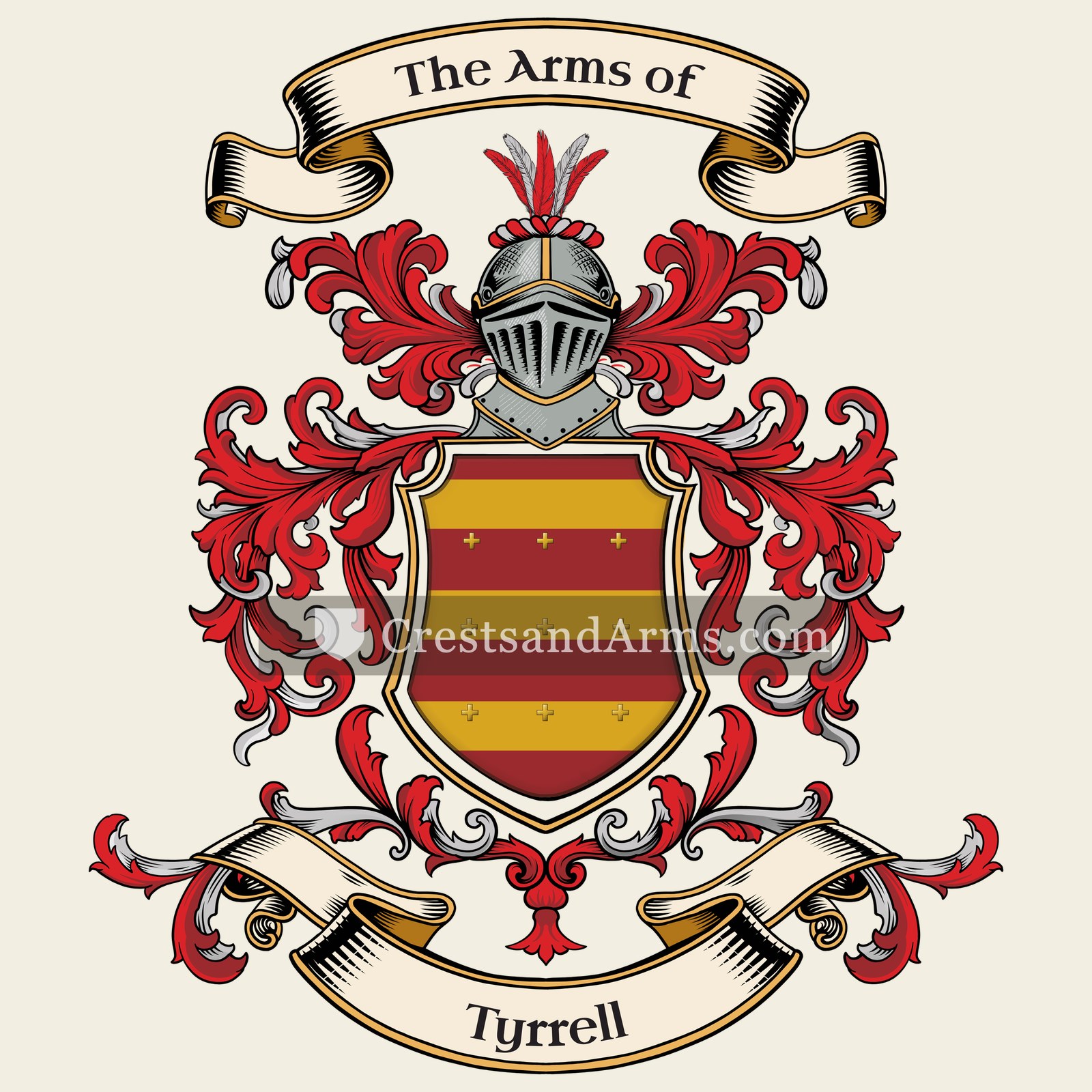
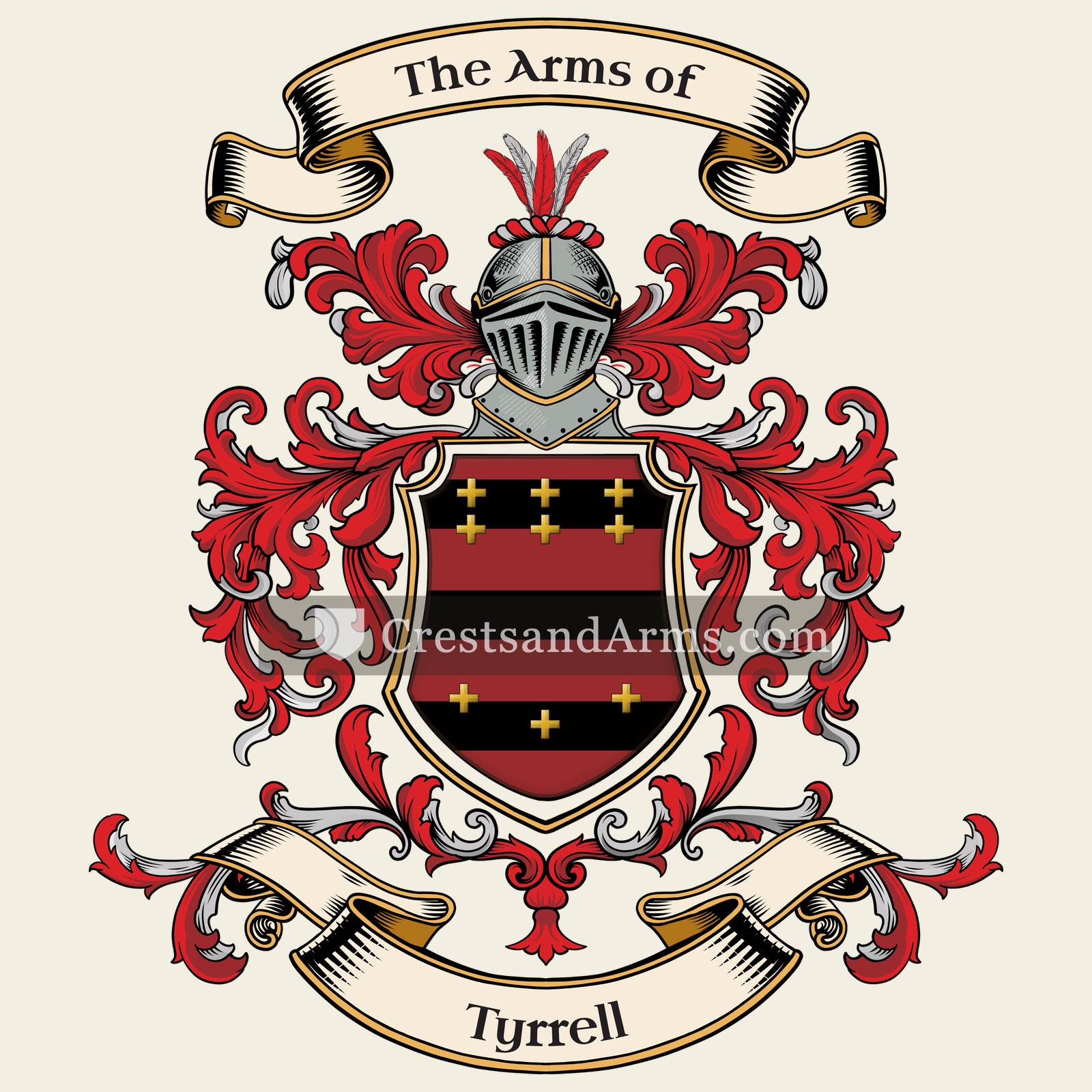
Symbols on this shield
cross symbolChristian faith and service
Colours
Red (Gules)Means: Military strength
ErmineMeans: Dignity
Gold (Or)Means: Generosity
Historical info
Source
Sir Bernard Burke, The General Armory of England, Scotland, Ireland and Wales, London: Harrison & Sons, 1884
Blazon (the actual original written record)
“Gu. three bars erm. betw. nine crosses pattée, three, three, two, and one or”
WestmeathFartullagh · Westmeath, c. 1757
Digital archive packCoat of arms PNG, gold border print PDF, vector SVG and the certificate of authenticity. Sent to your email in minutes.
Map of Italy showing where the Tyrrell arms are recorded
The Tyrrell arms were recorded in Westmeath, c. 1757.
Westmeath was midland grazing country in Ireland, taken by Norman families and held for centuries. Its estates were large and passed down whole, and unbroken tenure brought arms with it.
This is where the arms were entered in the register. Families often moved to other parts of the country, so the same name can turn up in more than one region.
The body that granted and recorded arms in Italy in this period.
Charles III of Spain
Sovereign of the period
Charles III of Spain
1734–1759
Reigning in Ireland when the Tyrrell arms are first recorded.
How Arms Worked in Italy
In the Italian states, coats of arms were often used by noble families to show their status and history. These symbols were passed down through the generations to all legitimate male descendants. Younger branches of a family usually kept the original design but sometimes added small changes to distinguish their specific line from the main branch.
Granting authority
Various local rulers and city governments controlled the use of coats of arms across the different Italian states.
How they got arms
Families often assumed their own arms or received them as official grants from local lords, popes, or city councils.
Where arms were recorded
Arms were recorded in local city archives or private family books rather than in one single national register.
The family's standing
Recorded among the armigerous families of Westmeath.
Origin & History of the Tyrrell Family in Italy
The history of the Tyrrell name is deeply rooted in the movement of families across medieval Europe, with early connections often traced back to the region of Normandy. While the family became prominent in Ireland, particularly in County Westmeath by the mid-eighteenth century, their ancestral path likely involved migration patterns that touched upon various Mediterranean territories. Some historical theories suggest that the name evolved from linguistic roots found in Northern Italy, where early variations of the surname were associated with specific landholdings and local administrative roles. These families were often involved in the complex political shifts of the Middle Ages, which encouraged them to travel through France and eventually into the British Isles. By the time the Tyrrells established a firm presence in Westmeath in 1757, they carried a legacy shaped by centuries of European transition and adaptation to new cultural landscapes.
Tyrrell Meaning & Related Branches
Root word
Tirel
Derived from the Old French word for pulling or drawing.
This name
TyrrellAn Anglo-Norman surname brought to Ireland, historically associated with a stubborn or obstinate person.
also spelled
Tirrell
Tirell
Related arms
Rushallsimilar arms
Tirrellsimilar arms
Terellvariant spelling
Terrellvariant spelling
Documented Sources
Sir Bernard Burke, The General Armory of England, Scotland, Ireland and Wales, London: Harrison & Sons, 1884
Curtis, Edmund, A History of Medieval Ireland, 1938
National Archives of Ireland, Calendar of the State Papers Relating to Ireland, 1592–1596
Simington, Robert C., The Civil Survey, A.D. 1654-1656, 1931
Digital archive packCoat of arms PNG, gold border print PDF, vector SVG and the certificate of authenticity. Sent to your email in minutes.


 cross symbolChristian faith and service
 cross symbolChristian faith and service