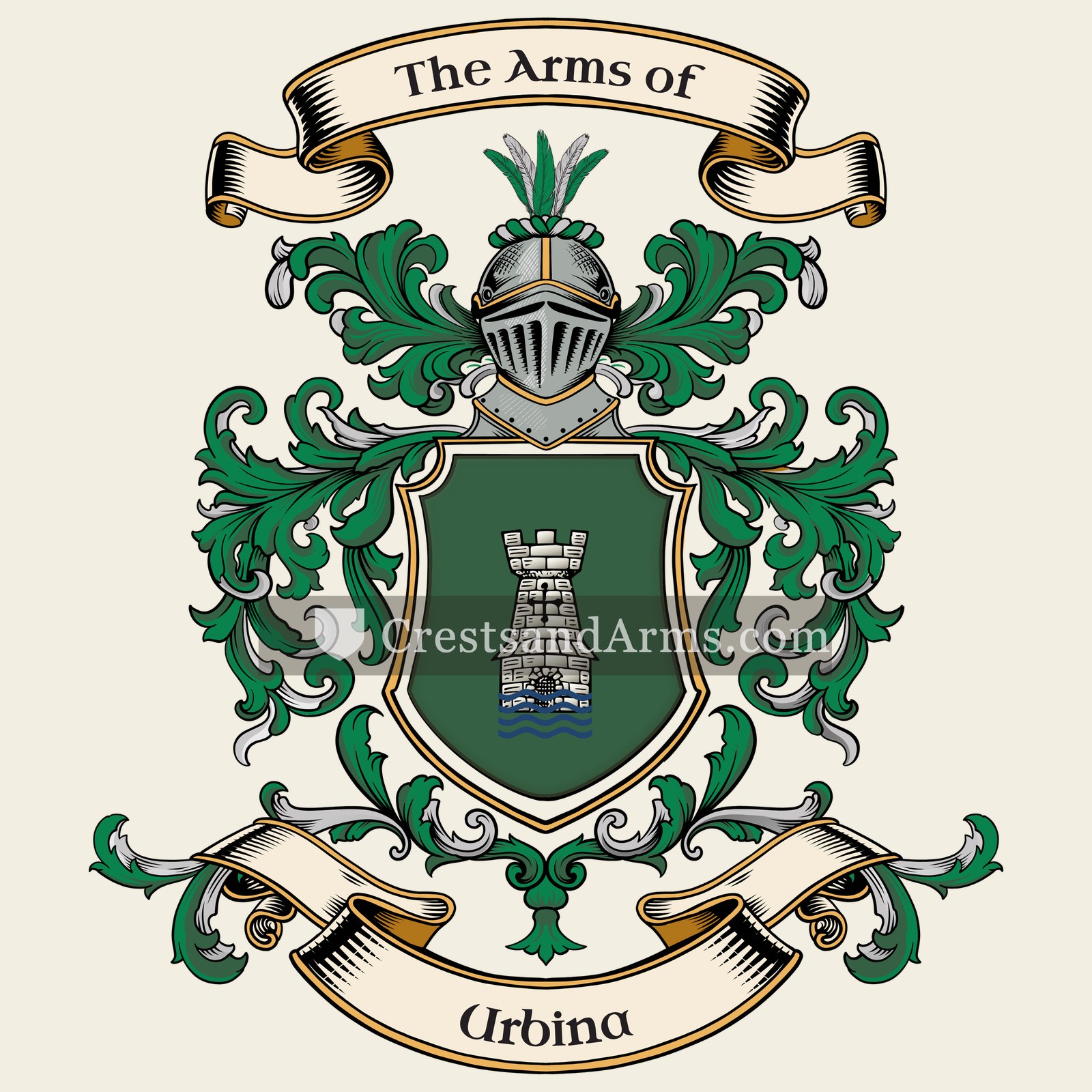
A record of documented arms, meaning and origin, researched for the Urbina family of Spain.
Reg. 4147 · Spanish, T–V
Coat of Arms & Family Crest Details
Symbols on this shield
towerGrandeur and solidity, and a stronghold defended
riverThe bounds of a land, and life carried through it
Colours
Green (Vert)Means: Hope
Silver (Argent)Means: Peace and sincerity
Blue (Azure)Means: Loyalty and truth
Historical info
Source
J. B. Rietstap, Armorial Général, Gouda: G. B. van Goor Zonen, 1884–87
Blazon (the actual original written record)
“De sin. à une porte crén., sans battants, et dans l'ouverture une axe sur laquelle tourne une roue, le tout d'arg.; ladite porte s'élevant d'une eau d'azur, agitée d'arg.”
SpainBiscaye, c. 1722
Digital archive packCoat of arms PNG, gold border print PDF, vector SVG and the certificate of authenticity. Sent to your email in minutes.
Map of Spain showing where the Urbina arms are recorded
The Urbina arms were recorded in Biscaye, c. 1722.
This is where the arms were entered in the register. Families often moved to other parts of the country, so the same name can turn up in more than one region.
The body that granted and recorded arms in Spain in this period.
Philip V of Spain
Sovereign of the period
Philip V of Spain
1714–1724
Reigning in Spain when the Urbina arms are first recorded.
How Arms Worked in Spain
In Spain, a coat of arms was considered a form of property that belonged to the entire family line. These arms were passed down from a father to all his children equally. Younger branches of the family usually kept the original design without needing to add any special marks to distinguish their specific line.
Granting authority
The Cronista Rey de Armas was the official body that regulated and granted coats of arms throughout Spain.
How they got arms
Families often obtained their arms through royal grants or by proving their noble status to the official heraldic authority.
Where arms were recorded
Coats of arms were officially recorded in the registers of the Cronista Rey de Armas starting in 1496.
The family's standing
Recorded among the armigerous families of Spain.
Origin & History of the Urbina Family in Spain
The family name Urbina originates from the Basque Country in northern Spain, a region known for its rugged mountains and deep-rooted traditions. Historical records confirm that members of the Urbina family were well-established in the province of Biscay by the year 1722. The name itself is derived from the Basque language, likely combining words that describe a specific type of terrain or a settlement near water. During this period, families in the Basque region often maintained strong connections to their local land and ancestral homes. As the family grew, individuals began to move from their original settlements into other parts of Spain and eventually across the Atlantic. This early presence in Biscay marks the family as part of a long-standing Basque lineage that has preserved its identity through centuries of regional history.
Related Branches & Arms
Root word
Urbs
Latin term meaning a city or a walled town.
This name
UrbinaRefers to someone who lived in or originated from a city or town.
Related arms
Insaustisimilar arms
Uncetasimilar arms
Documented Sources
J. B. Rietstap, Armorial Général, Gouda: G. B. van Goor Zonen, 1884–87
Mendizábal, Juan de, Diccionario Etimológico de Apellidos Vascos, 1985
Archivo de la Real Chancillería de Valladolid, Registro de Hidalguía, 1722
Gorrotxategi, Mikel, Los Apellidos en el País Vasco, 2005
Digital archive packCoat of arms PNG, gold border print PDF, vector SVG and the certificate of authenticity. Sent to your email in minutes.


 towerGrandeur and solidity, and a stronghold defended
 riverThe bounds of a land, and life carried through it
 towerGrandeur and solidity, and a stronghold defended
 riverThe bounds of a land, and life carried through it