Map of France showing where the Urry arms are recorded
The Urry arms were recorded in Franche-Comte, c. 1663.
Franche-Comte sat between France and the Empire and changed hands more than once. Border families held their land under arms and expected to defend it, so a shield was a practical thing rather than an ornament.
This is where the arms were entered in the register. Families often moved to other parts of the country, so the same name can turn up in more than one region.
The body that granted and recorded arms in France in this period.
Louis XIV of France
Sovereign of the period
Louis XIV of France
1643–1715
Reigning in France when the Urry arms are first recorded.
How Arms Worked in France
In France, a coat of arms was a mark of honor that passed down through the male line to all legitimate descendants. Families often used the same shield without changes to show their shared heritage. If a branch wanted to stand out, they could add a small mark to their shield to show their specific place in the family tree.
Granting authority
The Juge d'armes de France acted as the official authority that regulated and verified coats of arms across the country.
How they got arms
Families typically inherited their arms from ancestors, though they could also receive them through royal grants or by proving their noble status.
Where arms were recorded
Coats of arms were officially recorded in the Armorial Général de France, which began its main collection in the year 1696.
The family's standing
Recorded among the armigerous families of Franche-Comte.
Origin & History of the Urry Family in France
The history of the Urry family in France is deeply rooted in the rugged landscape of the Franche-Comté region. By the year 1663, records confirm that members of the family were established in this area, which sits along the border of modern-day France and Switzerland. During the seventeenth century, this territory was a place of significant transition and cultural exchange, often influenced by the nearby Jura Mountains. Families living in this region frequently worked within the local agricultural or artisanal systems that defined village life at the time. The presence of the Urry name in these early administrative documents suggests that the family was part of a stable community that navigated the complex political shifts occurring between the French crown and the neighboring regions. This period in Franche-Comté was marked by a strong sense of local identity, and the family likely played a role in the daily operations of their parish and township as they built their life in the heart of the province.
Meaning of the Urry family crest colors & symbols
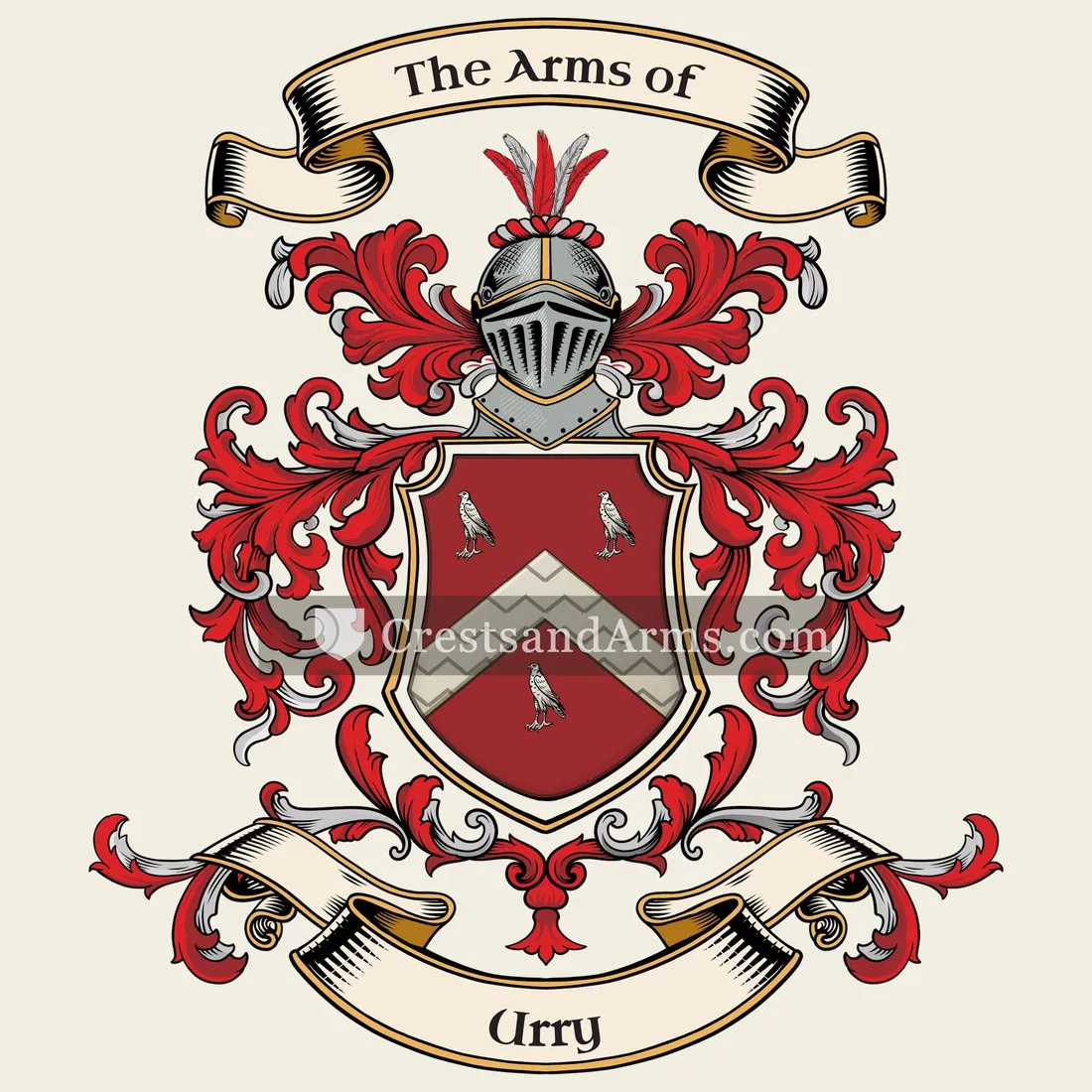
Symbols on this shield
chevronProtection, and faithful service completed
falconOne eager and quick in pursuit
Colours
Red (Gules)Means: Military strength
Silver (Argent)Means: Peace and sincerity
Historical info
Source
Sir Bernard Burke, The General Armory of England, Scotland, Ireland and Wales, London: Harrison & Sons, 1884
Blazon (the actual original written record)
“Gu. a chev. betw. three falcons ar”
EnglandThorley, c. 1620
Digital archive packCoat of arms PNG, gold border print PDF, vector SVG and the certificate of authenticity. Sent to your email in minutes.
Map of England showing where the Urry arms are recorded
The Urry arms were recorded in Thorley, c. 1620.
Arms such as these were typically recorded in York.
Yorkshire is the largest of the English counties, and it held more gentry families than any other. Land there was split among a great many households rather than a few, so a great many of them carried arms.
This is where the arms were entered in the register. Families often moved to other parts of the country, so the same name can turn up in more than one region.
The body that granted and recorded arms in England in this period.
James VI and I
Sovereign of the period
James VI and I
1603–1625
Reigning in France when the Urry arms are first recorded.
How Arms Worked in England
English heraldry allowed arms to be shared by all legitimate descendants of the original owner. These symbols were treated as personal property that moved through the generations to all children. While the eldest son kept the original design, other family members could use the same shield without needing to change it or register their own unique versions.
Granting authority
The College of Arms in London has regulated the use of coats of arms throughout England and Wales since 1484.
How they got arms
Families typically obtained their coats of arms through a formal grant from the Crown or by proving their ancient right to them.
Where arms were recorded
All official coats of arms are recorded in the registers kept at the College of Arms, which date back to the fifteenth century.
The family's standing
Recorded among the armigerous families of England.
Origin & History of the Urry Family in England
The surname Urry has deep roots in the English landscape, with historical records indicating that the family was well-established in the city of York by the early 17th century. The name is generally considered a variation of the Old French name Urri, which likely arrived in England following the Norman Conquest. Over several centuries, families bearing this name integrated into local communities, often working as tradespeople or landowners in northern regions. By the year 1620, the presence of the Urry family in York suggests they were part of the growing urban middle class during the Stuart period. This era was a time of significant social change in England, and families like the Urrys were often involved in the local governance and commercial life of their home cities. Through these early generations, the name became a permanent fixture in English genealogical history, reflecting the broader patterns of migration and settlement that shaped the country.
Urry Meaning & Related Branches
Root word
Ulricus
Derived from Germanic elements meaning noble and power or ruler.
This name
UrryA locational or occupational surname likely denoting a person of noble heritage or strength.
also spelled
Urrie
Urie
Related arms
Urievariant spelling
Urreyvariant spelling
Urrievariant spelling
Penningtonrecorded with Urry, same area
Documented Sources
J. B. Rietstap, Armorial Général, Gouda: G. B. van Goor Zonen, 1884–87
Archives départementales du Doubs, Série E (Registres paroissiaux et état civil)
Gauthier, Jules, Histoire de la Franche-Comté, 1895
Febvre, Lucien, Philippe II et la Franche-Comté, 1911
Digital archive packCoat of arms PNG, gold border print PDF, vector SVG and the certificate of authenticity. Sent to your email in minutes.


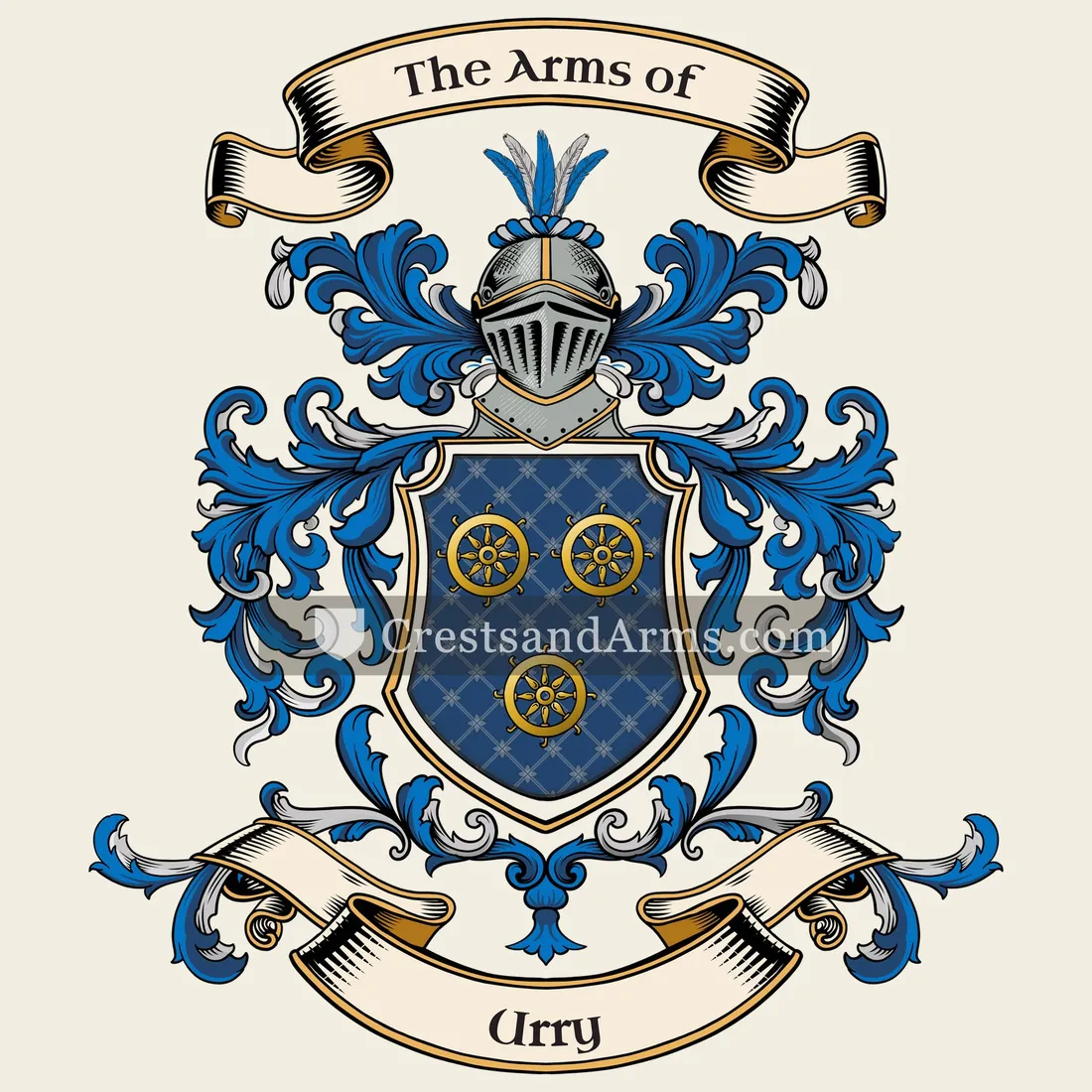
 wheelFortune's turning, and the carter's trade
 wheelFortune's turning, and the carter's trade


 chevronProtection, and faithful service completed
 falconOne eager and quick in pursuit