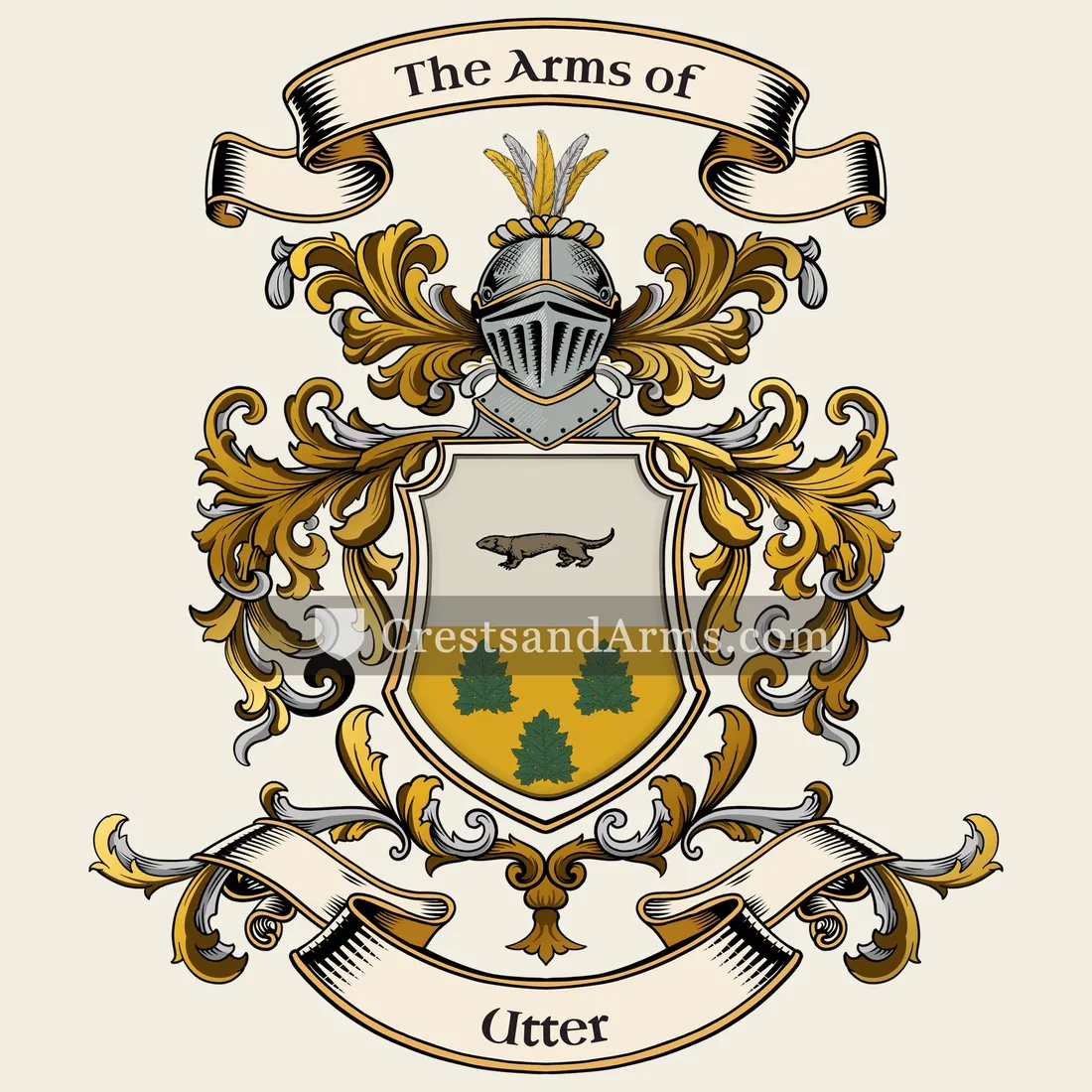
A record of documented arms, meaning and origin, researched for the Utter family of Sweden.
Reg. 7110 · Swedish, T–V
Meaning of the Utter family crest colors & symbols
Symbols on this shield
otterOne who lives life to the full
leafHappiness and abundance
Colours
Silver (Argent)Means: Peace and sincerity
Gold (Or)Means: Generosity
Green (Vert)Means: Hope
Historical info
Source
J. B. Rietstap, Armorial Général, Gouda: G. B. van Goor Zonen, 1884–87
Blazon (the actual original written record)
“Coupé: au 1 d'arg. à une loutre courante dans une eau d'azur, tenant entre ses dents un poisson: au 2 d'or à trois feuilles de tilleul de sin., mouv. d'une même racine et iss. de la p. C.: la loutre, iss., entre trois feuilles de tilleul tigées, une à dextre et deux à sen. L.: à dextre d'arg. et de gu., à sen. d'or et d'azur.”
Swedenc. 1700
Digital archive packCoat of arms PNG, gold border print PDF, vector SVG and the certificate of authenticity. Sent to your email in minutes.
Map of Sweden showing where the Utter arms are recorded
The Utter arms were recorded in Sweden, c. 1700.
Arms such as these were typically recorded in Stockholm.
Stockholm held the Swedish court and the House of Nobility, where every noble family's arms were entered and kept. Families ennobled for service registered there, which is why so many are recorded around the city.
This is where the arms were entered in the register. Families often moved to other parts of the country, so the same name can turn up in more than one region.
The body that granted and recorded arms in Sweden in this period.
Carl XII of Sweden
Sovereign of the period
Carl XII of Sweden
1697–1718
Reigning in Sweden when the Utter arms are first recorded.
How Arms Worked in Sweden
In Sweden, a coat of arms belonged to a noble family as a whole rather than just one individual. These arms were passed down through the generations to all legitimate descendants. Younger branches of the family used the same shield without needing to change it. This system ensured that the entire lineage shared the same identity and status under the law.
Granting authority
The Riddarhuset, or House of Nobility, regulated all noble coats of arms in Sweden under royal authority.
How they got arms
Families received their coats of arms through royal grants of nobility which were then officially registered with the House.
Where arms were recorded
Coats of arms were officially recorded in the Swedish House of Nobility register starting in the year 1626.
The family's standing
Recorded among the armigerous families of Sweden.
Origin & History of the Utter Family in Sweden
The surname Utter has deep roots in Swedish history, with records confirming that family members were established in Stockholm by the early 1700s. In the Swedish language, the word "utter" translates directly to the animal known as the otter. During the eighteenth century, it was common for families to adopt names inspired by the natural world, particularly animals that represented agility or a connection to the waterways that defined the Swedish landscape. As the family became more prominent in the capital, they integrated into the urban life of Stockholm, often working as skilled craftsmen or members of the growing administrative class. This transition from rural origins to city life helped the family name persist through generations, marking them as a stable part of the Swedish social fabric during a time of significant national change.
Utter Meaning & Related Branches
Root word
Utter
A semi-aquatic carnivorous mammal of the subfamily Lutrinae.
This name
UtterAn ornamental or topographic surname referring to an otter, likely denoting a hunter or trapper.
also spelled
Utterr
Uttere
Utterh
Documented Sources
J. B. Rietstap, Armorial Général, Gouda: G. B. van Goor Zonen, 1884–87
Sveriges Släktforskarförbund, Svenska släktnamn, 2005
Riksarkivet (National Archives of Sweden), Stockholms stadsarkiv: Mantalslängder 1700–1720
Digital archive packCoat of arms PNG, gold border print PDF, vector SVG and the certificate of authenticity. Sent to your email in minutes.


 otterOne who lives life to the full
 leafHappiness and abundance
 otterOne who lives life to the full
 leafHappiness and abundance