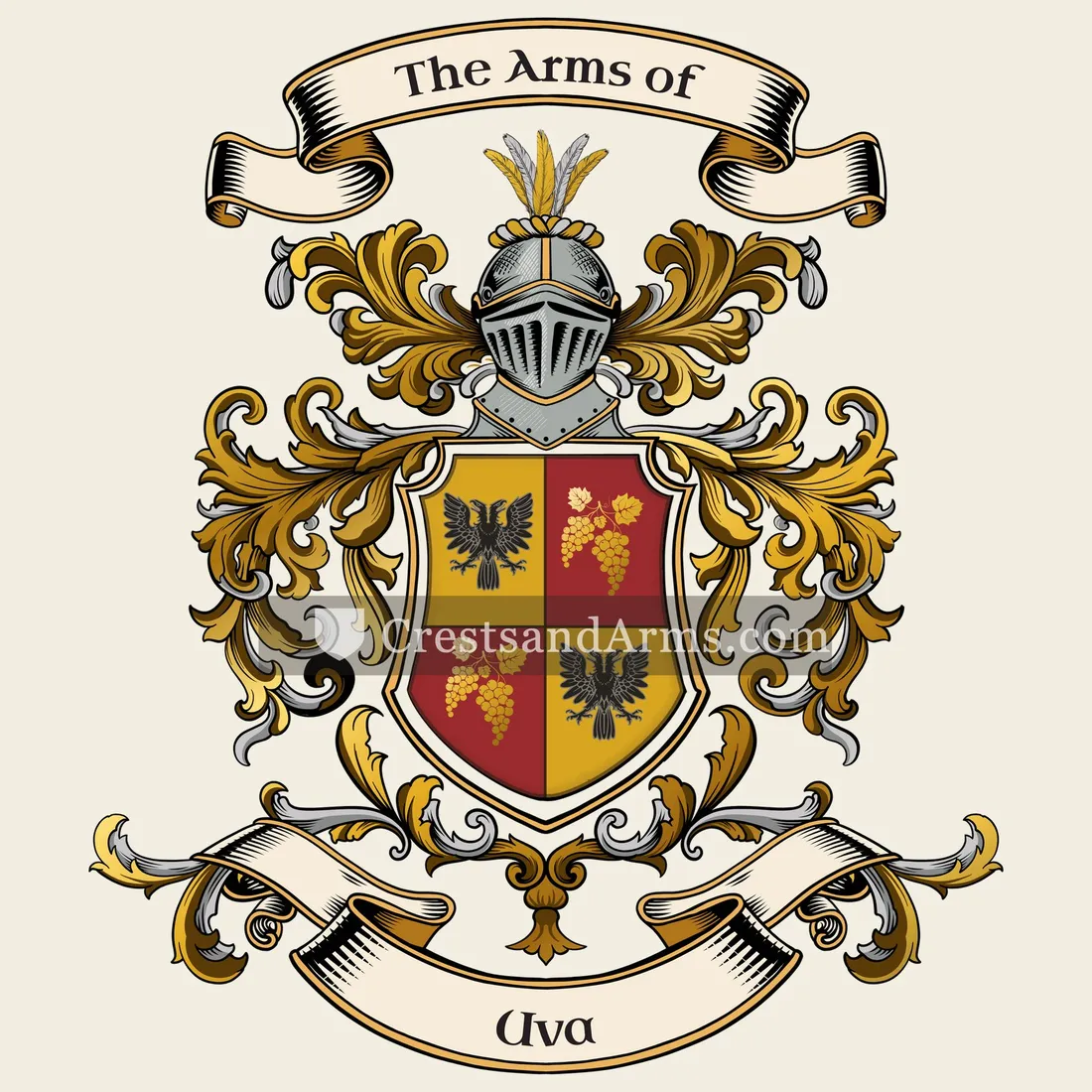
A record of documented arms, meaning and origin, researched for the Uva family of Germany.
Reg. 5058 · German, T–V
Meaning of the Uva family crest colors & symbols
Symbols on this shield
eagleNobility, strength and a keen mind
grapesPlenty, and the labour of the vine
Colours
Gold (Or)Means: Generosity
Red (Gules)Means: Military strength
Black (Sable)Means: Constancy
Historical info
Source
J. B. Rietstap, Armorial Général, Gouda: G. B. van Goor Zonen, 1884–87
Blazon (the actual original written record)
“Ec.: aux 1 et 4 d'or à l'aigle de sa., cour. d'or; aux 2 et 3 de gu. à une grappe de raisins d'or, sans pampres, la queue en haut; le gu. chapé-ployé d'arg. plein. Cq. cour. C.: l'aigle, iss. L.: à dextre d'or et de sa., à sen. d'arg. et de gu.”
Germanyc. 1765
Digital archive packCoat of arms PNG, gold border print PDF, vector SVG and the certificate of authenticity. Sent to your email in minutes.
Map of Germany showing where the Uva arms are recorded
The Uva arms were recorded in Germany, c. 1765.
Arms such as these were typically recorded in Bavaria.
Bavaria was a country of old landed families and walled market towns. Estates passed down the same line for centuries, and both the landowners and the leading townsmen kept arms, which is why so many Bavarian names sit in the registers.
This is where the arms were entered in the register. Families often moved to other parts of the country, so the same name can turn up in more than one region.
The body that granted and recorded arms in Germany in this period.
Francis I, Holy Roman Emperor
Sovereign of the period
Francis I, Holy Roman Emperor
1745–1765
Reigning in Germany when the Uva arms are first recorded.
How Arms Worked in Germany
In the Holy Roman Empire, coats of arms were often granted to individuals by the Emperor or his representatives. These arms were then passed down through the generations to all legitimate descendants of the original holder. Younger branches of a family usually kept the same shield design without needing to change it, as the arms belonged to the entire lineage.
Granting authority
The Holy Roman Emperor held the sole power to grant new coats of arms throughout his vast imperial territories.
How they got arms
Families typically obtained their coats of arms through a formal imperial grant or by proving their noble status to the authorities.
Where arms were recorded
These grants were officially recorded in the Imperial Chancery registers, which began keeping formal records of such honors during the Middle Ages.
The family's standing
Recorded among the armigerous families of Germany.
Origin & History of the Uva Family in Germany
The name Uva traces its roots to the historical landscape of Bavaria, where records confirm the family was established by at least 1765. During this period, the region was part of the Holy Roman Empire, and families often adopted surnames based on their trade, local geography, or unique personal characteristics. The name itself is linguistically distinct, and in various European contexts, it has been linked to the Latin word for grape, suggesting that early ancestors may have been involved in viticulture or lived near vineyards. As the family settled into the Bavarian social structure of the eighteenth century, they became part of a society defined by agrarian traditions and local craftsmanship. Over time, members of the family moved through the changing political borders of Central Europe, carrying the name forward as a marker of their specific ancestral origins in the German lands.
Uva Meaning & Related Branches
Root word
Uva
Latin term for a grape or a cluster of grapes.
This name
UvaA topographic or occupational name referring to a vineyard worker or someone living near a vineyard.
also spelled
Uvae
Uvah
Uvva
Documented Sources
J. B. Rietstap, Armorial Général, Gouda: G. B. van Goor Zonen, 1884–87


 eagleNobility, strength and a keen mind
 grapesPlenty, and the labour of the vine
 eagleNobility, strength and a keen mind
 grapesPlenty, and the labour of the vine