Map of Spain showing where the Va arms are recorded
The Va arms were recorded in Spain, c. 1722.
Arms such as these were typically recorded in Castile.
Castile was the heart of Spain and the source of most of its noble families. Land won in the long wars against the Moors was granted out to fighting men, and a man granted land was granted arms along with it.
This is where the arms were entered in the register. Families often moved to other parts of the country, so the same name can turn up in more than one region.
The body that granted and recorded arms in Spain in this period.
Philip V of Spain
Sovereign of the period
Philip V of Spain
1714–1724
Reigning in Spain when the Va arms are first recorded.
How Arms Worked in Spain
In Spain, a coat of arms was considered a form of property that belonged to the entire family line. These arms were passed down from a father to all his children equally. Younger branches of the family usually kept the original design without needing to add any special marks to distinguish their specific line.
Granting authority
The Cronista Rey de Armas was the official body that regulated and granted coats of arms throughout Spain.
How they got arms
Families often obtained their arms through royal grants or by proving their noble status to the official heraldic authority.
Where arms were recorded
Coats of arms were officially recorded in the registers of the Cronista Rey de Armas starting in 1496.
The family's standing
Recorded among the armigerous families of Spain.
Origin & History of the Va Family in Spain
The family name Va traces its roots to the historical region of Castile in central Spain. By the year 1722, records confirm that members of the family were already established within this area. During the eighteenth century, Castile was a central hub for agricultural development and trade, which likely shaped the daily lives and occupations of those living there. Families in this region often lived in small, tight-knit communities where they contributed to the local economy through farming or craftsmanship. As the name is quite short, it may have originated as a descriptive term or a shortened form of a longer place name common to the Castilian landscape. Over time, the family likely moved through the provinces of Spain as they sought new opportunities, carrying their name and history with them across the changing political landscape of the Iberian Peninsula.
Va Meaning & Related Branches
Root word
Vallis
Latin term meaning a valley or low-lying land between hills.
This name
VaA topographic surname referring to someone who lived in or near a valley.
also spelled
Evae
Va
Evas
Ev
Documented Sources
J. B. Rietstap, Armorial Général, Gouda: G. B. van Goor Zonen, 1884–87
Archivo de la Real Chancillería de Valladolid, Registro de Ejecutorias
Archivo Histórico Nacional, Sección Nobleza
Moll, Francesc de Borja, Els llinatges catalans: Catalunya, País Valencià, Illes Balears, 1959
Pescador del Hoyo, María del Carmen, La población de Castilla en el siglo XVIII, 1964
Digital archive packCoat of arms PNG, gold border print PDF, vector SVG and the certificate of authenticity. Sent to your email in minutes.


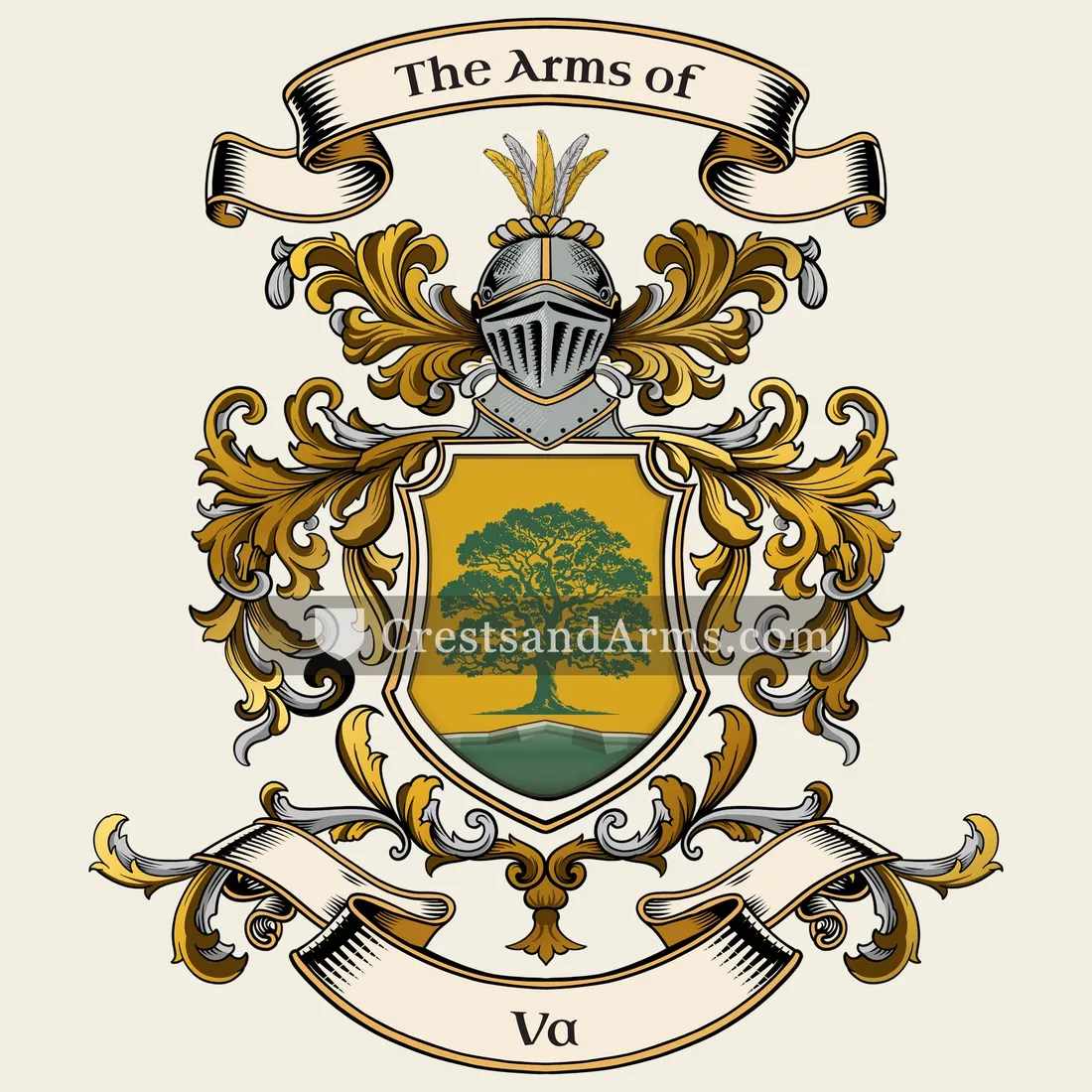
 mountThe ground held, and steadfastness upon it
 treeLife, endurance and deep roots
 mountThe ground held, and steadfastness upon it
 treeLife, endurance and deep roots