Map of France showing where the Vala arms are recorded
The Vala arms were recorded in Lorraine, c. 1559.
Lorraine sat on the border between France and the German lands, and border country bred soldiers. Families here held small estates and served in arms, and a fighting man was exactly the sort who carried a shield of his own.
This is where the arms were entered in the register. Families often moved to other parts of the country, so the same name can turn up in more than one region.
The body that granted and recorded arms in France in this period.
Henry II of France
Sovereign of the period
Henry II of France
1547–1559
Reigning in France when the Vala arms are first recorded.
How Arms Worked in France
In France, a coat of arms was a mark of honor that passed down through the male line to all legitimate descendants. Families often used the same shield without changes to show their shared heritage. If a branch wanted to stand out, they could add a small mark to their shield to show their specific place in the family tree.
Granting authority
The Juge d'armes de France acted as the official authority that regulated and verified coats of arms across the country.
How they got arms
Families typically inherited their arms from ancestors, though they could also receive them through royal grants or by proving their noble status.
Where arms were recorded
Coats of arms were officially recorded in the Armorial Général de France, which began its main collection in the year 1696.
The family's standing
Recorded among the armigerous families of Lorraine.
Origin & History of the Vala Family in France
The history of the Vala family in France is deeply rooted in the historical province of Lorraine, where records confirm their presence as early as 1559. During the sixteenth century, Lorraine served as a vital crossroads between the Holy Roman Empire and the Kingdom of France, creating a unique cultural environment for families living in the region. The name likely emerged from the local linguistic landscape, which blended various dialects common to the borderlands of the Meuse and Moselle rivers. Families like the Vala were often involved in the agricultural and administrative life of these rural communities, helping to shape the social fabric of the duchy during a time of significant religious and political transition. By establishing themselves in this territory, the early members of the family became part of a long tradition of resilience and regional identity that defined the people of Lorraine for generations.
Meaning of the Vala family crest colors & symbols
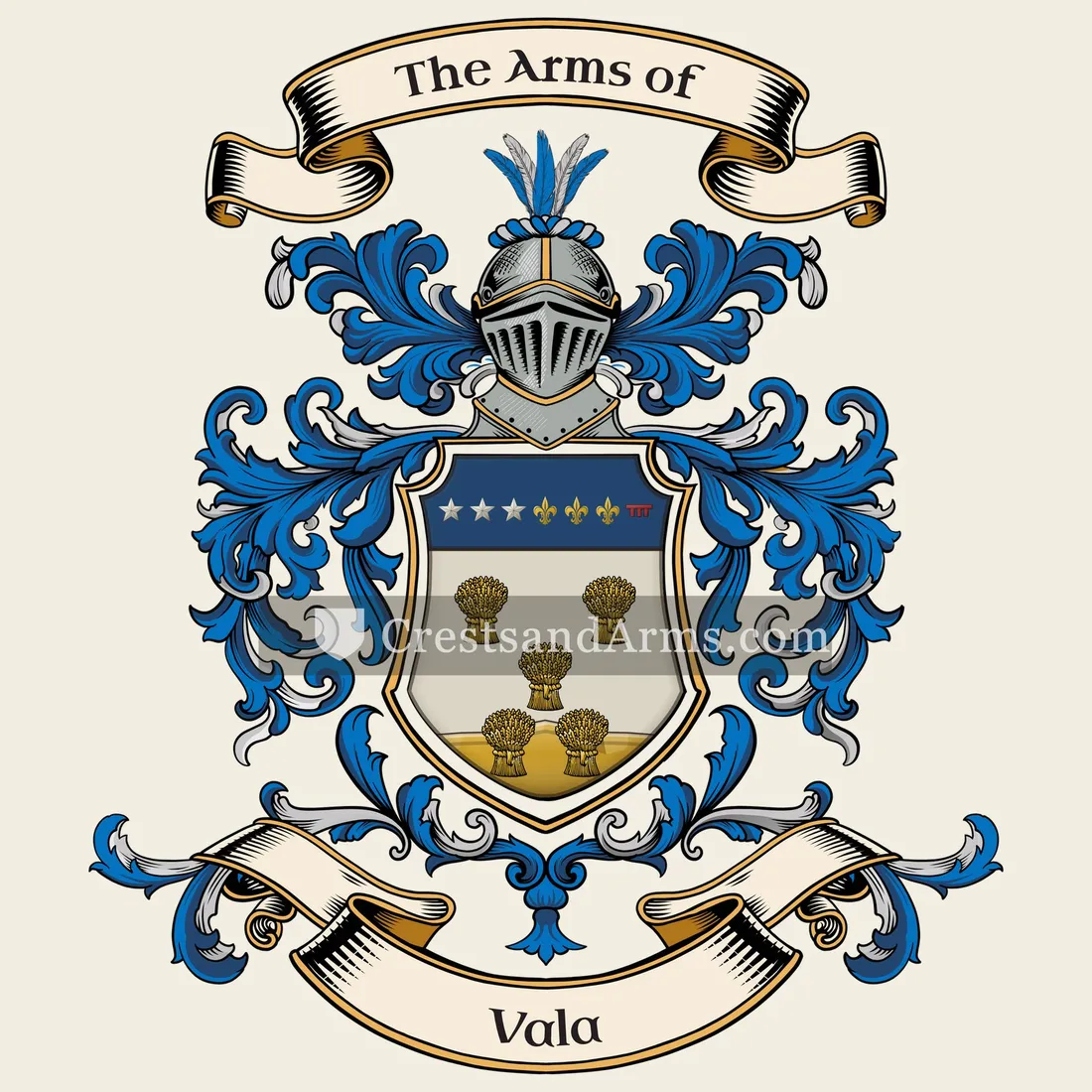
Symbols on this shield
mountThe ground held, and steadfastness upon it
chiefAuthority, wisdom and dominion
labelThe eldest son, during his father's life
wheatsheafPlenty, and the harvest of one's own labour
mulletThe third son, and a divine quality from above
fleur de lisPurity, light, and the sixth son
Colours
Silver (Argent)Means: Peace and sincerity
Blue (Azure)Means: Loyalty and truth
Gold (Or)Means: Generosity
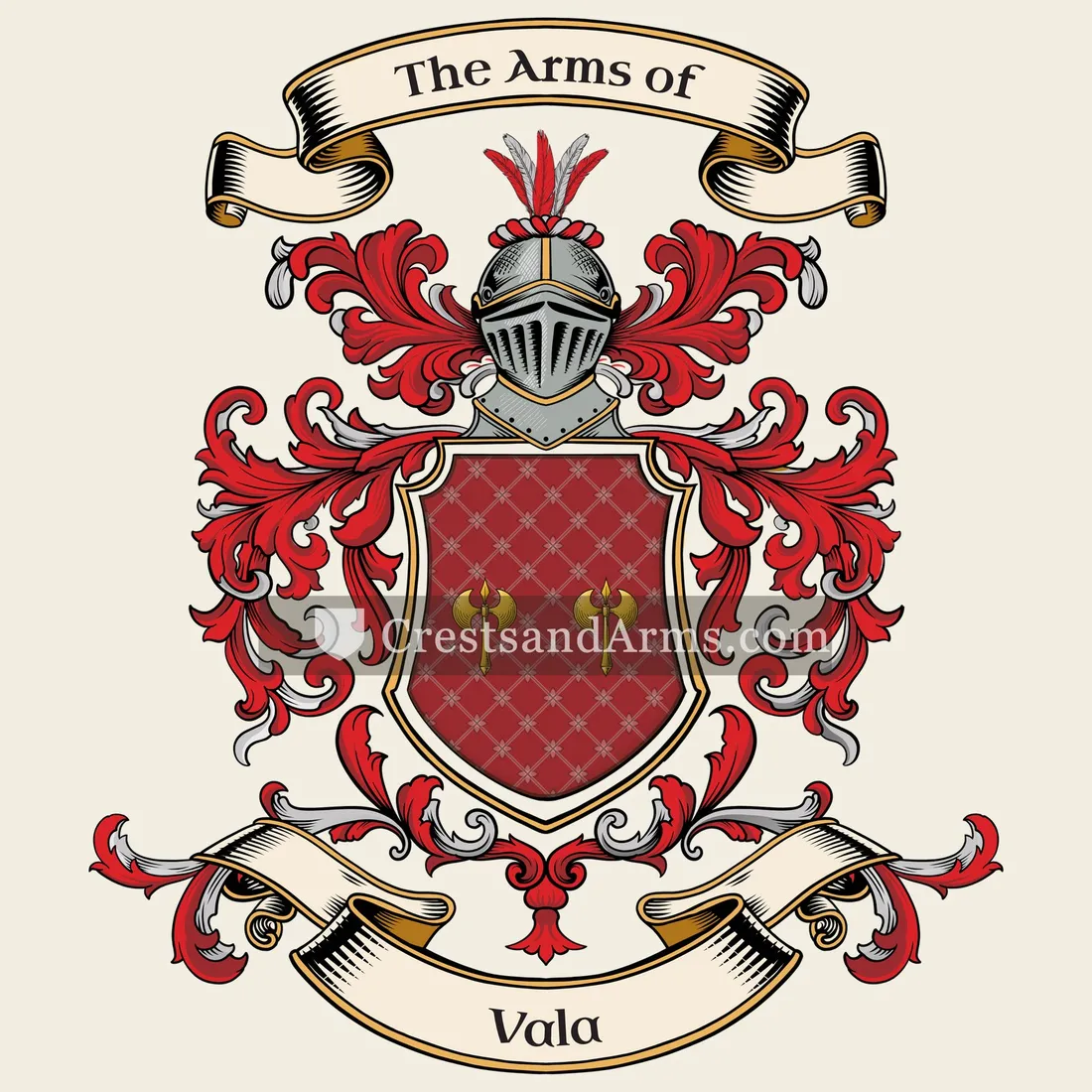
Red (Gules)Means: Military strength
Historical info
Source
J. B. Rietstap, Armorial Général, Gouda: G. B. van Goor Zonen, 1884–87
Blazon (the actual original written record)
“D'arg. à cinq épis d'or, tigés et feuillés de sin., rangés sur une terrasse du même et acc. en chef de trois étoiles (5) rangées du sec.; au chef d'azur, ch. de trois fleurs-de-lis d'or, rangées entre les quatre pendants d'un lambel de gu.”
ItalyBologne, c. 1775
Digital archive packCoat of arms PNG, gold border print PDF, vector SVG and the certificate of authenticity. Sent to your email in minutes.
Map of Italy showing where the Vala arms are recorded
The Vala arms were recorded in Bologne, c. 1775.
This is where the arms were entered in the register. Families often moved to other parts of the country, so the same name can turn up in more than one region.
The body that granted and recorded arms in Italy in this period.
Alvise Giovanni Mocenigo
Sovereign of the period
Alvise Giovanni Mocenigo
1763–1778
Reigning in France when the Vala arms are first recorded.
How Arms Worked in Italy
In the Italian states, coats of arms were often used by noble families to show their status and history. These symbols were passed down through the generations to all legitimate male descendants. Younger branches of a family usually kept the original design but sometimes added small changes to distinguish their specific line from the main branch.
Granting authority
Various local rulers and city governments controlled the use of coats of arms across the different Italian states.
How they got arms
Families often assumed their own arms or received them as official grants from local lords, popes, or city councils.
Where arms were recorded
Arms were recorded in local city archives or private family books rather than in one single national register.
The family's standing
Recorded among the armigerous families of Italy.
Origin & History of the Vala Family in Italy
The Vala family name possesses deep roots in the historical landscape of Northern Italy, with documented evidence placing the family in the city of Bologna by the year 1775. During this period, Bologna was a prominent center of intellectual and commercial activity within the Papal States, and families like the Vala were often integrated into the local urban fabric as skilled tradespeople or minor landowners. The name itself likely evolved from regional linguistic variations, potentially linked to the Latin term *vallis*, which refers to a valley or a low-lying area. This suggests that the earliest ancestors may have been identified by their geographic surroundings or their proximity to specific natural landmarks in the Italian countryside. By the late 18th century, the family had established a presence in the city, participating in the daily life of a region known for its ancient university and thriving agricultural markets. This early residency in Bologna reflects a broader trend of families settling in stable, prosperous urban hubs to secure their social and economic standing during the transition into the modern era.
Vala Meaning & Related Branches
Root word
Valere
Latin verb meaning to be strong, healthy, or powerful.
This name
ValaDerived from a topographic reference to someone living near a valley or a derivative of the Latin term for strength.
also spelled
Vallat
Vala
Documented Sources
J. B. Rietstap, Armorial Général, Gouda: G. B. van Goor Zonen, 1884–87
Archives départementales de Meurthe-et-Moselle, Série B (Cours et juridictions)
Cabourdin, Guy, Histoire de la Lorraine, 1991
Lepage, Henri, Les communes de la Meurthe: journal historique des villes, bourgs, villages, hameaux et censes de ce département, 1853
Digital archive packCoat of arms PNG, gold border print PDF, vector SVG and the certificate of authenticity. Sent to your email in minutes.


 axeThe execution of military duty
 axeThe execution of military duty


 mountThe ground held, and steadfastness upon it
 chiefAuthority, wisdom and dominion
 labelThe eldest son, during his father's life
 wheatsheafPlenty, and the harvest of one's own labour
 mulletThe third son, and a divine quality from above
 fleur de lisPurity, light, and the sixth son