Map of France showing where the Valandra arms are recorded
The Valandra arms were recorded in France, c. 1663.
Arms such as these were typically recorded in Bretagne.
More families held coats of arms in Bretagne than anywhere else in France. The land was divided into many small estates rather than a few large ones, so far more households counted as gentry, and each needed a shield of its own to be told apart.
This is where the arms were entered in the register. Families often moved to other parts of the country, so the same name can turn up in more than one region.
The body that granted and recorded arms in France in this period.
Louis XIV of France
Sovereign of the period
Louis XIV of France
1643–1715
Reigning in France when the Valandra arms are first recorded.
How Arms Worked in France
In France, a coat of arms was a mark of honor that passed down through the male line to all legitimate descendants. Families often used the same shield without changes to show their shared heritage. If a branch wanted to stand out, they could add a small mark to their shield to show their specific place in the family tree.
Granting authority
The Juge d'armes de France acted as the official authority that regulated and verified coats of arms across the country.
How they got arms
Families typically inherited their arms from ancestors, though they could also receive them through royal grants or by proving their noble status.
Where arms were recorded
Coats of arms were officially recorded in the Armorial Général de France, which began its main collection in the year 1696.
The family's standing
Recorded among the armigerous families of France.
Origin & History of the Valandra Family in France
The Valandra family name traces its roots to the rugged landscape of Bretagne, France, where records confirm the presence of family members as early as 1663. During the seventeenth century, this region was defined by a strong sense of local identity and a deep connection to the Atlantic coastline. Families living in Bretagne at this time often relied on maritime trade, agriculture, or skilled craftsmanship to sustain their households. The name likely developed as a way to identify individuals based on their specific village or the unique topography of the land they cultivated. As the family established their roots in this province, they became part of the long history of Breton society, which was known for maintaining distinct cultural traditions and a resilient spirit. Over time, the name served as a link to these early ancestors who navigated the social and economic shifts of seventeenth-century France.
Valandra Meaning & Related Branches
Root word
Valere
Latin origin meaning to be strong, healthy, or powerful.
This name
ValandraA locative or habitational name derived from a valley, signifying one who dwells in a valley.
also spelled
Villandra
Villandrass
Villand
Vilandras
Documented Sources
J. B. Rietstap, Armorial Général, Gouda: G. B. van Goor Zonen, 1884–87
Archives départementales du Finistère, Série B (Archives de la juridiction seigneuriale)
Archives départementales d'Ille-et-Vilaine, Série E (Documents familiaux et notariaux)
Croix, Alain, La Bretagne aux 16e et 17e siècles: la vie, la mort, la foi, 1984
Le Moyne de La Borderie, Arthur, Histoire de Bretagne, 1896
Digital archive packCoat of arms PNG, gold border print PDF, vector SVG and the certificate of authenticity. Sent to your email in minutes.


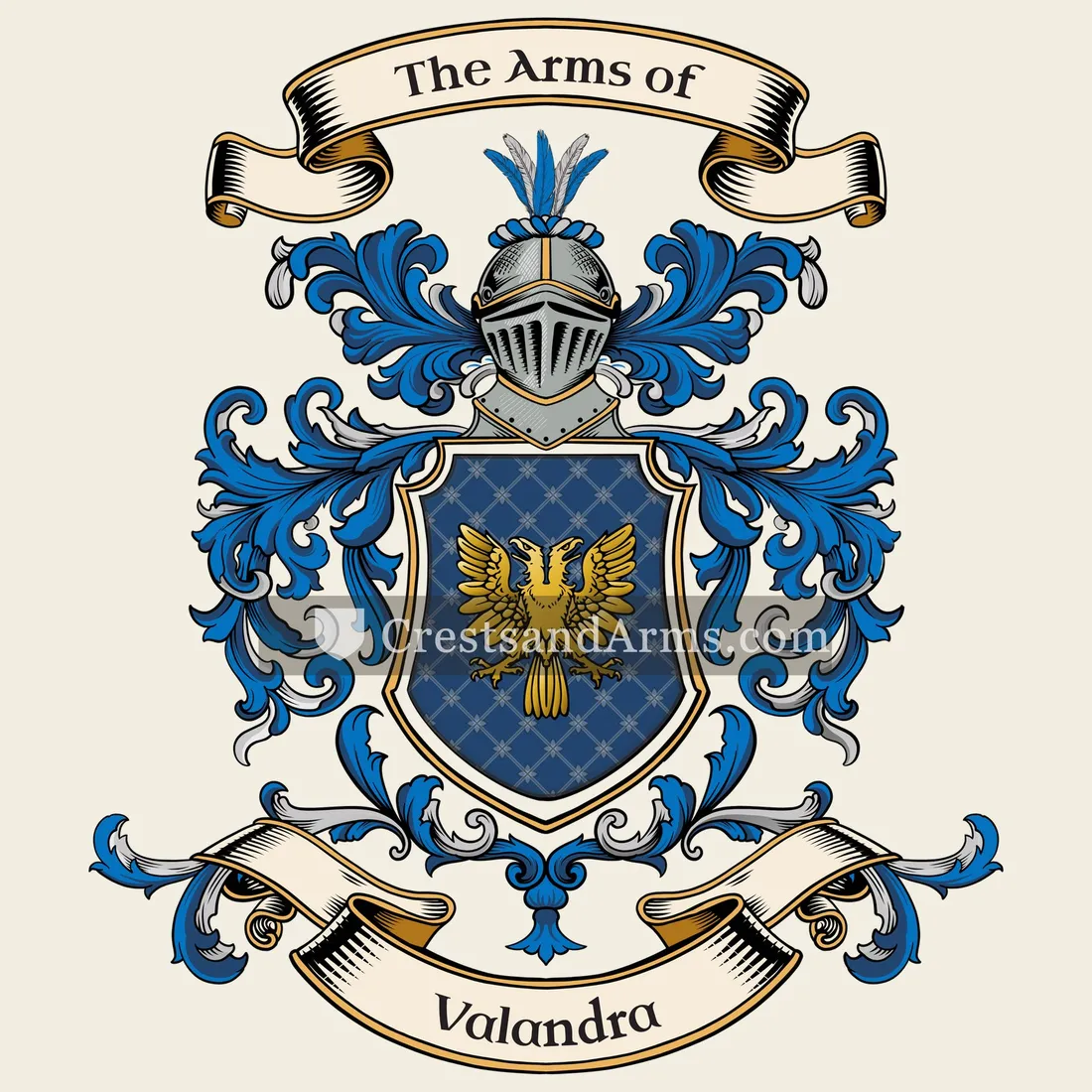
 eagleNobility, strength and a keen mind
 eagleNobility, strength and a keen mind