Map of Netherlands showing where the Van Geest arms are recorded
The Van Geest arms were recorded in Alkmaar, c. 1725.
This is where the arms were entered in the register. Families often moved to other parts of the country, so the same name can turn up in more than one region.
Region
Alkmaar
Town
Alkmaar
First recorded
1725
Granting Authority for the Van Geest Arms
Hoge Raad van Adel
Photograph made by me · CC BY-SA 3.0
The body that granted and recorded arms in Netherlands in this period.
How Arms Worked in Netherlands
In the Netherlands, coats of arms were often used by noble families and those who held specific public offices. These arms were passed down through the generations to legitimate descendants. Younger branches of a family usually kept the original design without needing to add special marks. This system ensured that the family identity remained clear and consistent over many years.
Granting authority
The Hoge Raad van Adel is the official body that regulates and manages noble titles and coats of arms in the Netherlands.
How they got arms
Families typically obtained their coats of arms through official royal grants or by proving their long-standing historical use of the symbols.
Where arms were recorded
Coats of arms are officially recorded in the registers held by the Hoge Raad van Adel, which began its work in 1814.
The family's standing
Recorded among the armigerous families of Netherlands.
Origin & History of the Van Geest Family in Netherlands
The surname Van Geest originates from the Dutch language and carries a descriptive meaning related to the landscape. The word geest refers to a specific type of high, sandy soil found near the coast of the Netherlands, which was often used for early farming and bulb cultivation. Families who took this name likely lived on or near these elevated ridges of land. By 1725, records confirm that members of the Van Geest family were established in the city of Alkmaar. During this period, Alkmaar was a thriving center for trade and agriculture in the province of North Holland. The family members living there were part of a society shaped by the unique geography of the region, where the management of sandy soil and water levels was essential for daily life and economic success.
Related Branches & Arms
Root word
Geest
A sandy ridge or elevated piece of land.
This name
Van GeestRefers to someone who lived on or near a sandy ridge.
also spelled
vanGeest
Geest
vanderGheest
vander gest
Documented Sources
J. B. Rietstap, Armorial Général, Gouda: G. B. van Goor Zonen, 1884–87


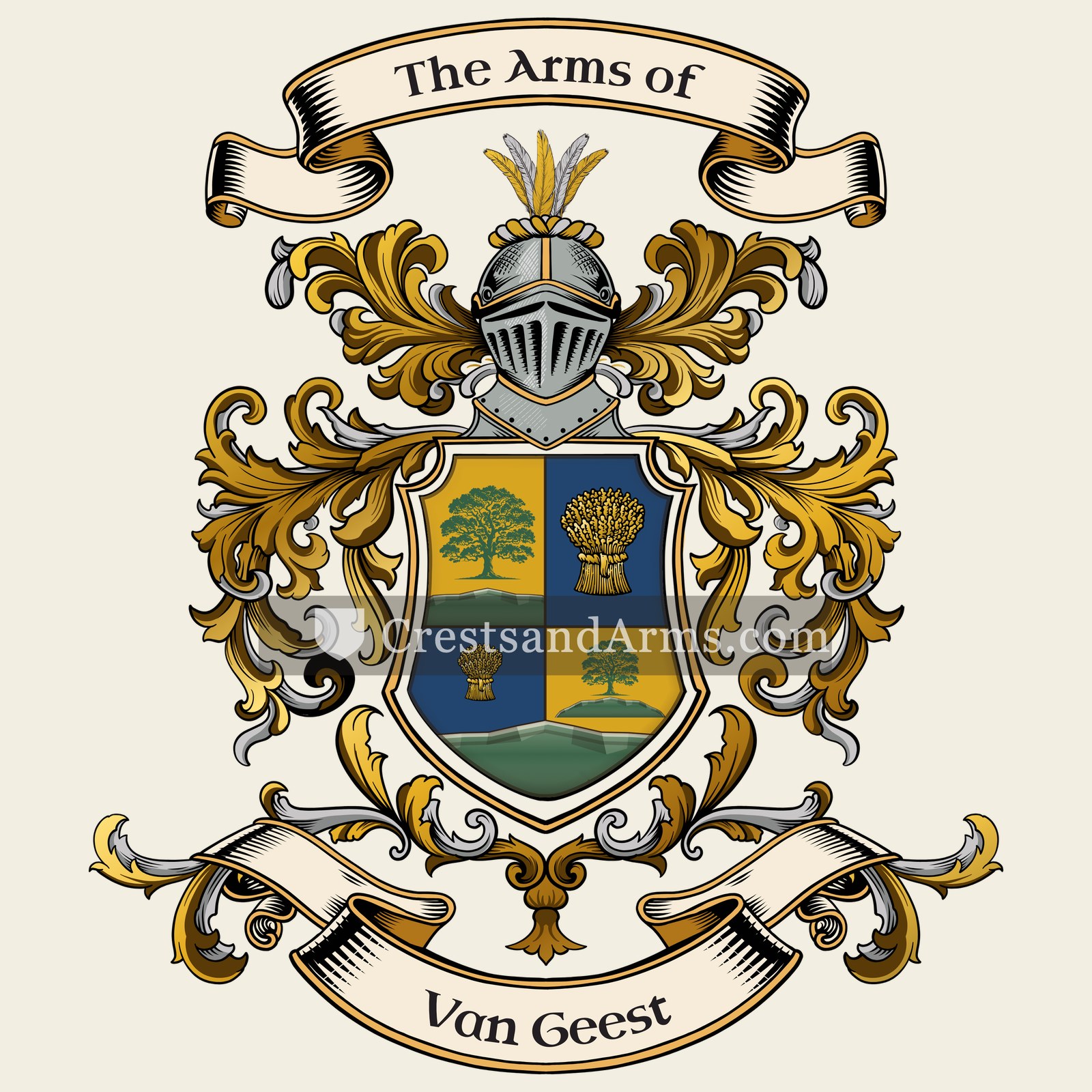
 mountThe ground held, and steadfastness upon it
 treeLife, endurance and deep roots
 wheatsheafPlenty, and the harvest of one's own labour
 mountThe ground held, and steadfastness upon it
 treeLife, endurance and deep roots
 wheatsheafPlenty, and the harvest of one's own labour