Map of Belgium showing where the Vanacker arms are recorded
The Vanacker arms were recorded in Flandre, c. 1663.
Flandre grew rich on cloth, and its towns were among the busiest in Europe. Merchant families bought land with their profits and took arms to go with it, so trade put as many names in the registers here as land did.
This is where the arms were entered in the register. Families often moved to other parts of the country, so the same name can turn up in more than one region.
The body that granted and recorded arms in Belgium in this period.
Philip IV of Spain
Sovereign of the period
Philip IV of Spain
1621–1665
Reigning in Belgium when the Vanacker arms are first recorded.
How Arms Worked in Belgium
In Belgium, a coat of arms is considered personal property that is passed down through the male line to legitimate descendants. Families often use the same shield design across generations to show their shared heritage. If a branch of the family wants to change the design, they must apply for an official update to their specific version of the arms.
Granting authority
The Conseil héraldique is the official body that regulates and approves all coats of arms in Belgium.
How they got arms
Families obtain their coats of arms through formal royal grants or by confirming their historical right to use existing designs.
Where arms were recorded
All approved coats of arms are officially recorded in the public registers of the Conseil héraldique since 1844.
The family's standing
Recorded among the armigerous families of Flandre.
Origin & History of the Vanacker Family in Belgium
The surname Vanacker is deeply rooted in the historical landscape of the Flanders region in Belgium. The name itself is a topographic descriptor, derived from the Dutch words "van" meaning from and "acker" meaning a field or cultivated land. This suggests that the earliest families bearing this name were likely farmers or landowners who lived near a specific plot of land. By 1663, records confirm that members of the Vanacker family were well-established within the local communities of the Flemish countryside. During this period, Flanders was a center of agricultural innovation and trade, and families like the Vanackers played a vital role in the rural economy. Because the name is tied to the physical landscape, it reflects a long-standing connection to the soil and the development of the region throughout the seventeenth century.
Coat of Arms & Family Crest Details
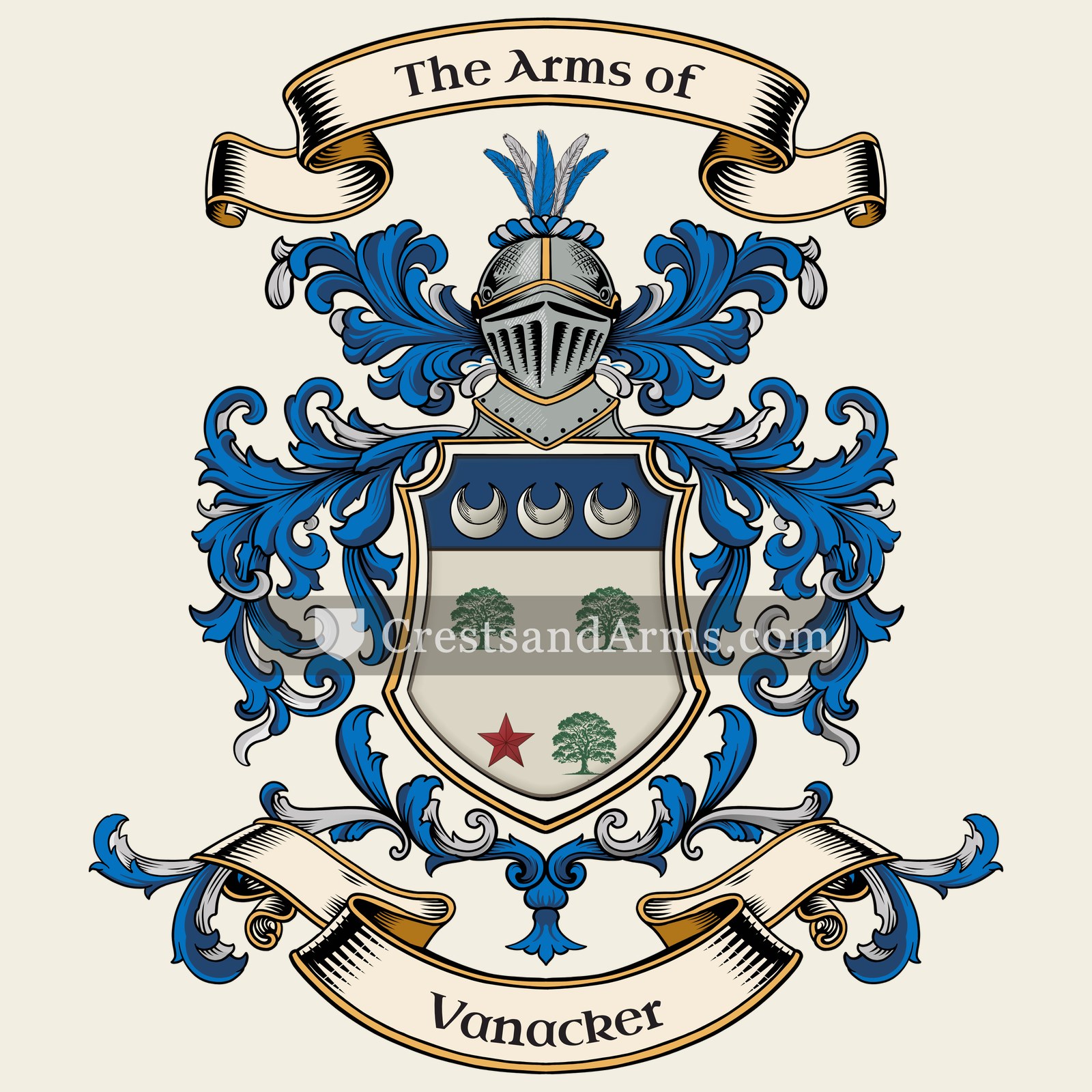
Symbols on this shield
chiefAuthority, wisdom and dominion
mulletThe third son, and a divine quality from above
treeLife, endurance and deep roots
crescentHonour by the sovereign, and the second son
Colours
Silver (Argent)Means: Peace and sincerity
Blue (Azure)Means: Loyalty and truth
Red (Gules)Means: Military strength
Green (Vert)Means: Hope
Historical info
Source
J. B. Rietstap, Armorial Général, Gouda: G. B. van Goor Zonen, 1884–87
Blazon (the actual original written record)
“D'arg. à une étoile de gu., acc. de trois arbres de sin.; au chef d'azur, ch. de trois croiss. du champ.”
Britainc. 1700
Digital archive packCoat of arms PNG, gold border print PDF, vector SVG and the certificate of authenticity. Sent to your email in minutes.
Map of Britain showing where the Vanacker arms are recorded
The Vanacker arms were recorded in Britain, c. 1700.
Arms such as these were typically recorded in Kent.
Kent sits between London and the short crossing to Europe, and the trade passing through made it wealthy. Merchant families bought land with that money, and it was landowners who took coats of arms.
This is where the arms were entered in the register. Families often moved to other parts of the country, so the same name can turn up in more than one region.
The body that granted and recorded arms in Britain in this period.
William III of England
Sovereign of the period
William III of England
1694–1702
Reigning in Belgium when the Vanacker arms are first recorded.
How Arms Worked in Britain
English heraldry allowed arms to be shared by all legitimate descendants of the original owner. These symbols were treated as personal property that moved through the generations to all children. While the eldest son kept the original design, other family members could use the same shield without needing to change it or register their own unique versions.
Granting authority
The College of Arms in London has regulated the use of coats of arms throughout England and Wales since 1484.
How they got arms
Families typically obtained their coats of arms through a formal grant from the Crown or by proving their ancient right to them.
Where arms were recorded
All official coats of arms are recorded in the registers kept at the College of Arms, which date back to the fifteenth century.
The family's standing
Recorded among the armigerous families of Britain.
Origin & History of the Vanacker Family in Britain
The Vanacker family name arrived in Britain as part of a significant wave of migration from the Low Countries during the late seventeenth century. While the name originates from the Dutch and Flemish regions, where it often denoted someone who lived near a field or an acre of land, its presence in Kent by 1700 marks a pivotal shift in the family history. Many families with similar names settled in the coastal areas of Kent and East Anglia to escape religious persecution or to seek new economic opportunities in the growing textile and trade industries. These early settlers often integrated into local communities by working as skilled laborers or merchants, gradually anglicizing their daily lives while maintaining the distinct spelling of their ancestral name. By establishing roots in Kent, the Vanackers became part of a broader demographic change that saw skilled continental immigrants contribute to the agricultural and commercial development of southern England during the turn of the eighteenth century.
Related Branches & Arms
Root word
Acker
A field or cultivated land.
This name
VanackerA person who lived near or worked on a field.
also spelled
Acker
Vanaker
Related arms
Barresame arms
Gonsanssame arms
Documented Sources
J. B. Rietstap, Armorial Général, Gouda: G. B. van Goor Zonen, 1884–87
Debrabandere, Frans, Woordenboek van de familienamen in België en Noord-Frankrijk, 1993
State Archives in Belgium, Parochieregisters (Registers van de parochies), 1663
Digital archive packCoat of arms PNG, gold border print PDF, vector SVG and the certificate of authenticity. Sent to your email in minutes.


 mountThe ground held, and steadfastness upon it
 wheatsheafPlenty, and the harvest of one's own labour
 mountThe ground held, and steadfastness upon it
 wheatsheafPlenty, and the harvest of one's own labour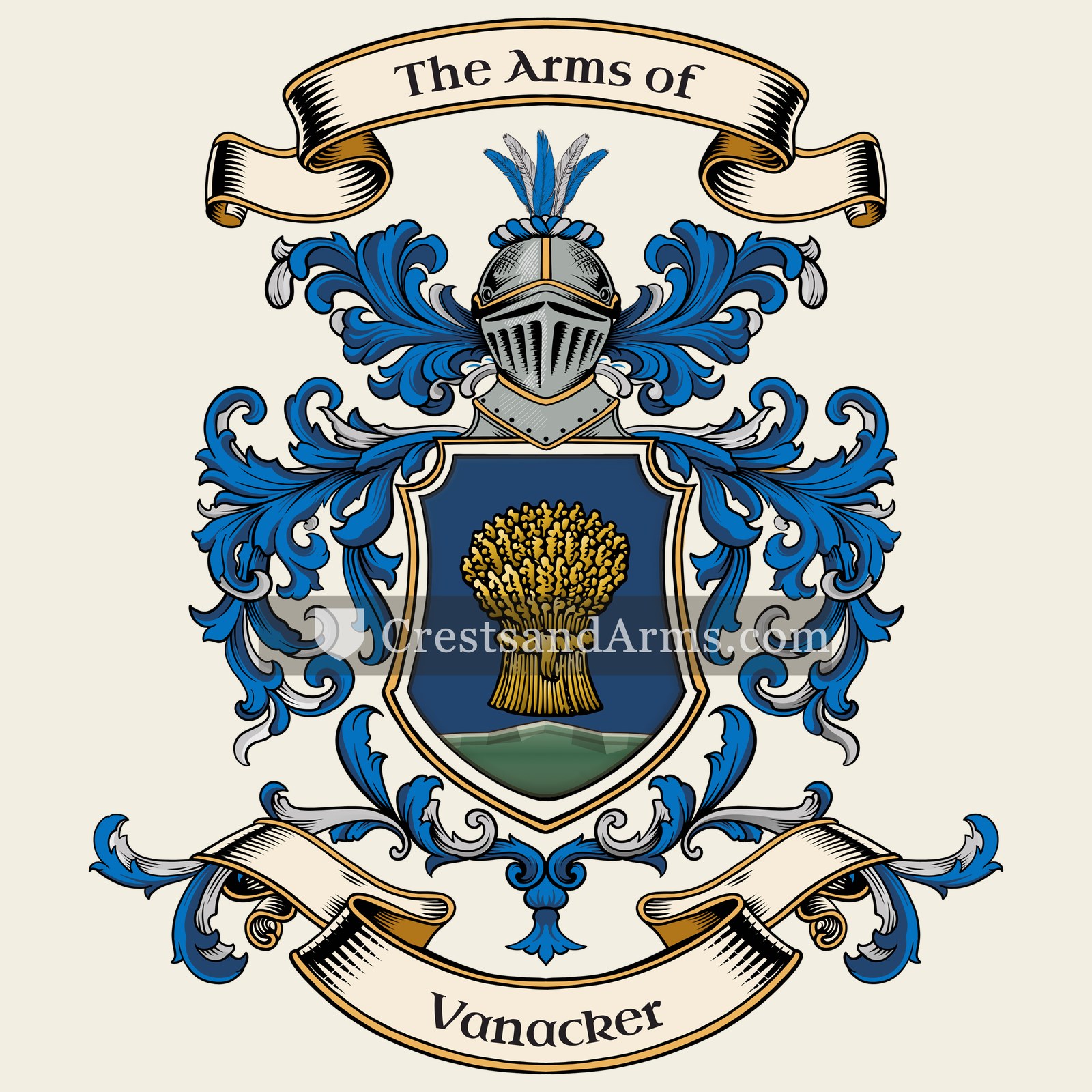


 chiefAuthority, wisdom and dominion
 mulletThe third son, and a divine quality from above
 treeLife, endurance and deep roots
 crescentHonour by the sovereign, and the second son