Map of France showing where the Vanantwerp arms are recorded
The Vanantwerp arms were recorded in Flandre, c. 1771.
Flandre grew rich on cloth, and its towns were among the busiest in Europe. Merchant families bought land with their profits and took arms to go with it, so trade put as many names in the registers here as land did.
This is where the arms were entered in the register. Families often moved to other parts of the country, so the same name can turn up in more than one region.
The body that granted and recorded arms in France in this period.
Louis XV of France
Sovereign of the period
Louis XV of France
1715–1774
Reigning in France when the Vanantwerp arms are first recorded.
How Arms Worked in France
In France, a coat of arms was a mark of honor that passed down through the male line to all legitimate descendants. Families often used the same shield without changes to show their shared heritage. If a branch wanted to stand out, they could add a small mark to their shield to show their specific place in the family tree.
Granting authority
The Juge d'armes de France acted as the official authority that regulated and verified coats of arms across the country.
How they got arms
Families typically inherited their arms from ancestors, though they could also receive them through royal grants or by proving their noble status.
Where arms were recorded
Coats of arms were officially recorded in the Armorial Général de France, which began its main collection in the year 1696.
The family's standing
Recorded among the armigerous families of Flandre.
Origin & History of the Vanantwerp Family in France
The name Van Antwerp carries a history deeply rooted in the cultural crossroads of the Low Countries and northern France. While the name itself translates to "from Antwerp," the family established a significant presence in the region of Flanders by the late 18th century. During this period, the borderlands between modern-day Belgium and France were fluid, and families frequently moved across these lines for trade and agricultural opportunities. Records from 1771 confirm that members of the family were settled in this area, living within a society that blended French administrative traditions with long-standing Flemish customs. As they navigated life in this bilingual environment, the family became part of the local fabric of the region, contributing to the agricultural and social development of the French-Flemish frontier. Their presence reflects the broader movement of people who shaped the identity of northern France during the twilight of the Ancien Régime.
Meaning of the Vanantwerp family crest colors & symbols
Colours
Silver (Argent)Means: Peace and sincerity
Historical info
Source
J. B. Rietstap, Armorial Général, Gouda: G. B. van Goor Zonen, 1884–87
Blazon (the actual original written record)
“D'arg. à trois crémaillères de sa., rangées en fasce.”
Netherlandsc. 1815
Digital archive packCoat of arms PNG, gold border print PDF, vector SVG and the certificate of authenticity. Sent to your email in minutes.
Map of Netherlands showing where the Vanantwerp arms are recorded
The Vanantwerp arms were recorded in Netherlands, c. 1815.
Arms such as these were typically recorded in Friesland.
Friesland was low, wet country on the northern coast of the Netherlands, farmed by families who had held the same land for centuries. Free landholders were unusually common there, and a free landholder could carry arms.
This is where the arms were entered in the register. Families often moved to other parts of the country, so the same name can turn up in more than one region.
Region
Friesland
First recorded
1815
Granting Authority for the Vanantwerp Arms
Hoge Raad van Adel
Photograph made by me · CC BY-SA 3.0
The body that granted and recorded arms in Netherlands in this period.
William I of the Netherlands
Sovereign of the period
William I of the Netherlands
1815–1840
Reigning in France when the Vanantwerp arms are first recorded.
How Arms Worked in Netherlands
In the Netherlands, coats of arms were often used by noble families and those who held specific public offices. These arms were passed down through the generations to legitimate descendants. Younger branches of a family usually kept the original design without needing to add special marks. This system ensured that the family identity remained clear and consistent over many years.
Granting authority
The Hoge Raad van Adel is the official body that regulates and manages noble titles and coats of arms in the Netherlands.
How they got arms
Families typically obtained their coats of arms through official royal grants or by proving their long-standing historical use of the symbols.
Where arms were recorded
Coats of arms are officially recorded in the registers held by the Hoge Raad van Adel, which began its work in 1814.
The family's standing
Recorded among the armigerous families of Netherlands.
Origin & History of the Vanantwerp Family in Netherlands
The name Van Antwerp originates from the city of Antwerp, which is located in the modern-day region of Flanders in Belgium. In the Dutch language, the name literally translates to "from Antwerp." During the sixteenth and seventeenth centuries, many families moved northward from the southern Netherlands to the northern provinces due to religious conflicts and economic shifts. By the early nineteenth century, records confirm that members of the family were established in the province of Friesland. This migration was common for families seeking new opportunities in the northern territories. The name serves as a historical marker of this movement, connecting the family’s roots in a major southern trading hub to their later life in the northern Dutch countryside.
Vanantwerp Meaning & Related Branches
Root word
Antwerpen
A Germanic place name meaning at the wharf or on the wharf.
This name
VanantwerpRefers to an individual originating from the city of Antwerp in modern-day Belgium.
also spelled
Antwerpe
Antwerpen
van Antwerp
Documented Sources
J. B. Rietstap, Armorial Général, Gouda: G. B. van Goor Zonen, 1884–87
Archives départementales du Nord, Série B: Cours et juridictions
De Smet, A., Histoire de la Flandre française, 1965
Lottin, A., Chavatte, ouvrier lillois: un contemporain de Louis XIV, 1979
Digital archive packCoat of arms PNG, gold border print PDF, vector SVG and the certificate of authenticity. Sent to your email in minutes.


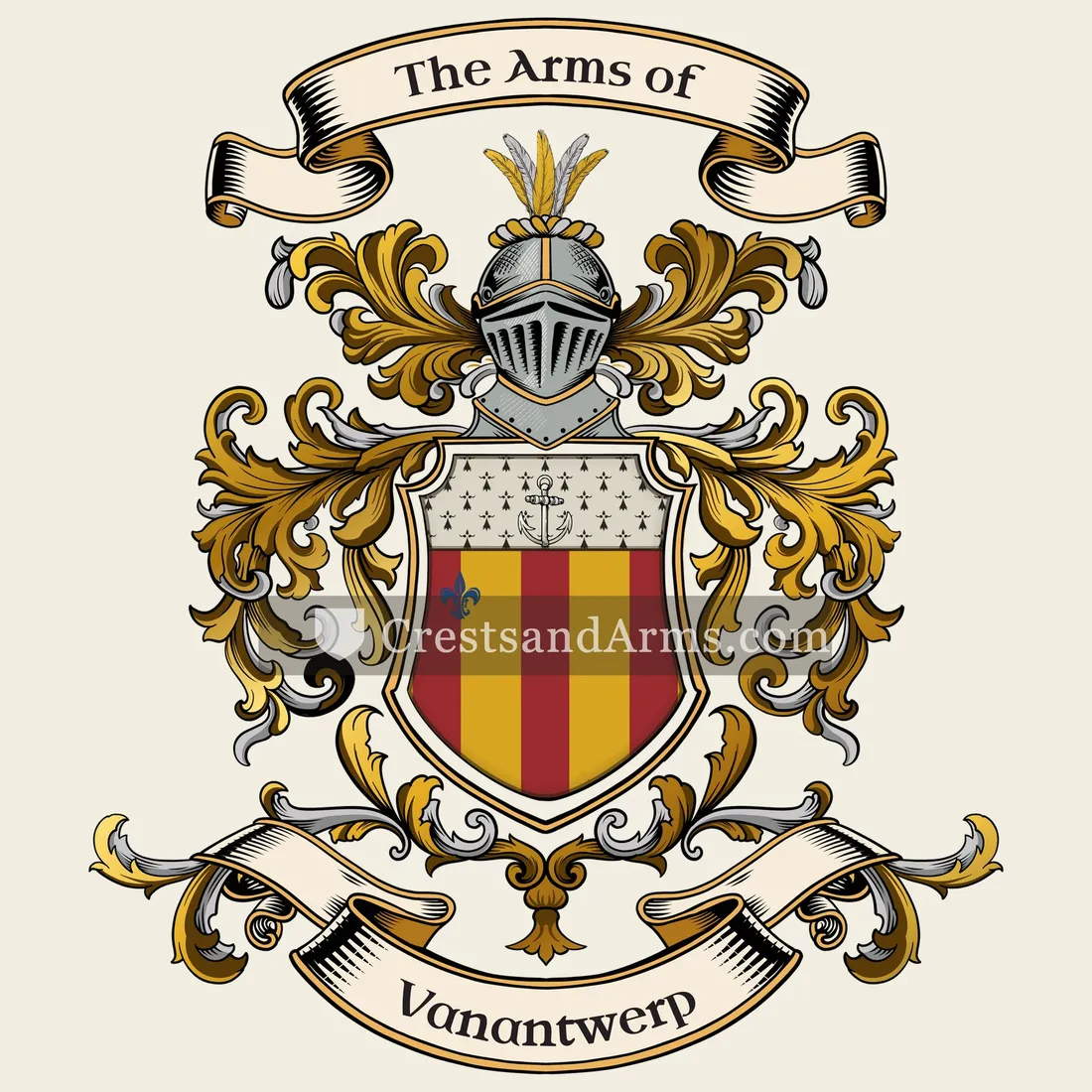
 chiefAuthority, wisdom and dominion
 paleMilitary strength, and a fortified defence
 fleur de lisPurity, light, and the sixth son
 anchorHope, and steadfastness in trouble
 chiefAuthority, wisdom and dominion
 paleMilitary strength, and a fortified defence
 fleur de lisPurity, light, and the sixth son
 anchorHope, and steadfastness in trouble