A record of documented arms, meaning and origin, researched for the Vane family lines. Documented in 3 countries.
Reg. 8848 · French, W–Z
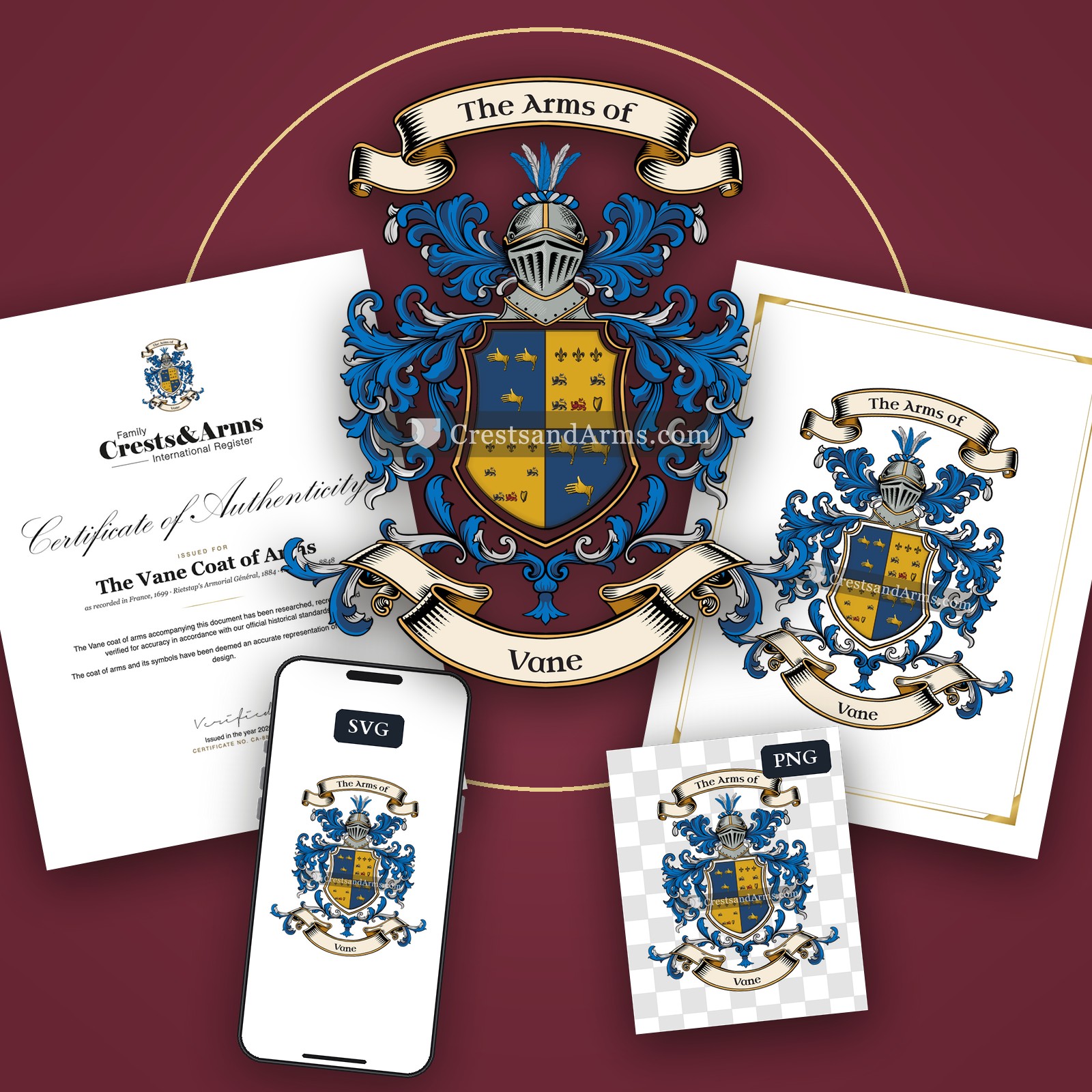
Meaning of the Vane family crest colors & symbols
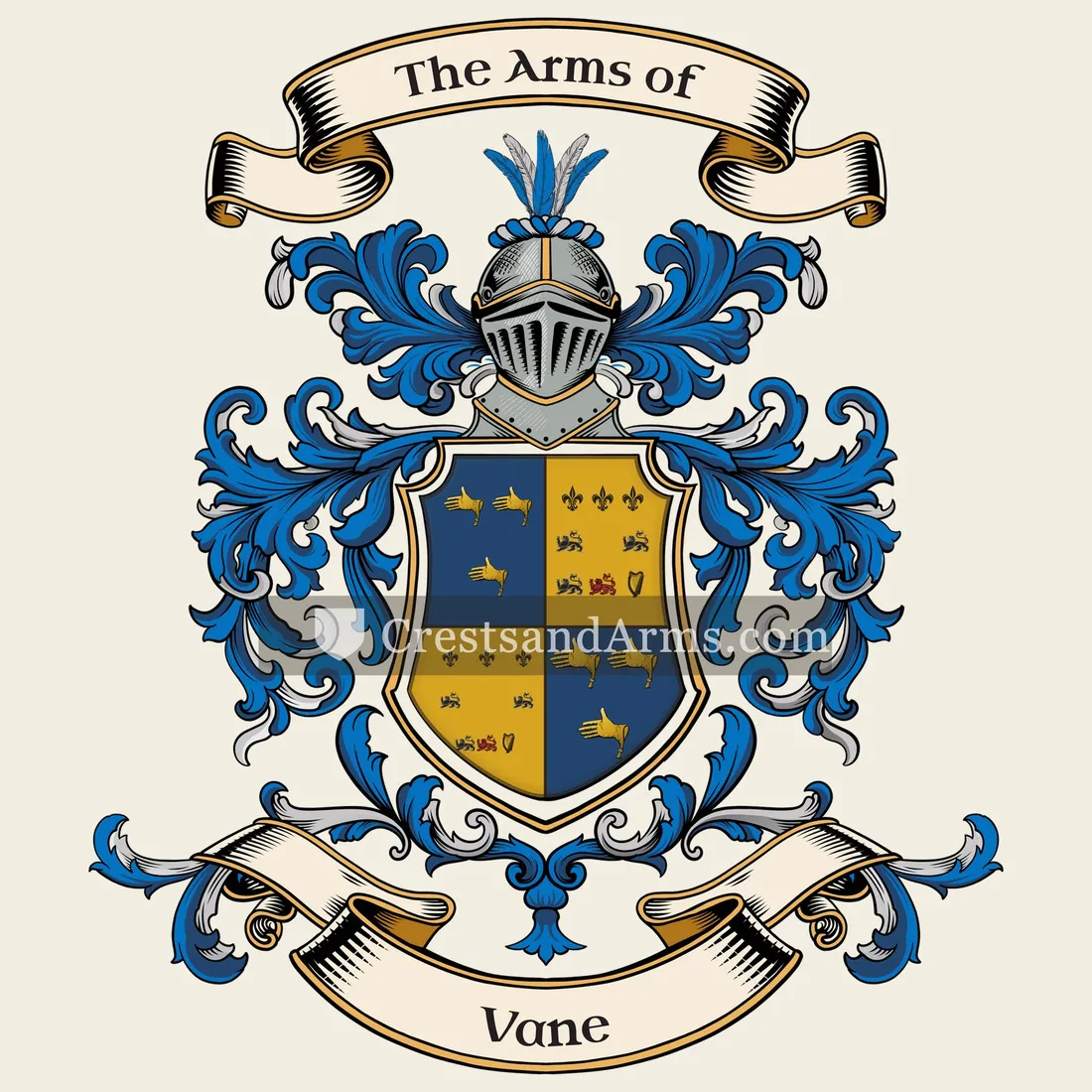
Symbols on this shield
gauntletA challenge given and the readiness to meet it
fleur de lisPurity, light, and the sixth son
lionCourage, strength and royalty
harpWell-tuned governance and love of music
Colours
Blue (Azure)Means: Loyalty and truth
Gold (Or)Means: Generosity
Red (Gules)Means: Military strength
Historical info
Source
J. B. Rietstap, Armorial Général, Gouda: G. B. van Goor Zonen, 1884–87
Blazon (the actual original written record)
“Ec.: aux 1 et 4 d'azur à trois gantelets d'or (Vane); aux II. et III. de Fitzroy, qui est éc.: aux 1 et 4 éc., d'azur à trois fleurs-de-lis d'or (France), et de gu. à trois léopards d'or, l'un sur l'autre (Angleterre); au 2 d'or au lion de gu., enclos dans un double trêcheur fleur. et c.-fleur. du même (Ecosse); au 3 d'azur à une harpe d'or, cordée d'arg. (Irlande); au bâton alésé d'herm., br. en barre sur les écartelures. C.: 1° un gantelet d'or, tenant une épée d'arg. (Vane); 2° un léopard d'or, cour. d'azur, coll. d'un collier comp. d'herm. et d'azur, et posé sur un chapeau de tournoi de gu., retr. d'herm. (Fitzroy). S.: à dextre un griffon d'arg., au collier d'azur ch. de trois gantelets d'or; à sen. une antelope d'or, au collier d'azur ch. de trois martinets d'or. D.: NEC TEMERE NEC TIMIDE [V. Powlett duc de Cleveland.]”
Francec. 1699
Digital archive packCoat of arms PNG, gold border print PDF, vector SVG and the certificate of authenticity. Sent to your email in minutes.
Map of France showing where the Vane arms are recorded
The Vane arms were recorded in France, c. 1699.
Arms such as these were typically recorded in Bretagne.
More families held coats of arms in Bretagne than anywhere else in France. The land was divided into many small estates rather than a few large ones, so far more households counted as gentry, and each needed a shield of its own to be told apart.
This is where the arms were entered in the register. Families often moved to other parts of the country, so the same name can turn up in more than one region.
The body that granted and recorded arms in France in this period.
Louis XIV of France
Sovereign of the period
Louis XIV of France
1643–1715
Reigning in France when the Vane arms are first recorded.
How Arms Worked in France
In France, a coat of arms was a mark of honor that passed down through the male line to all legitimate descendants. Families often used the same shield without changes to show their shared heritage. If a branch wanted to stand out, they could add a small mark to their shield to show their specific place in the family tree.
Granting authority
The Juge d'armes de France acted as the official authority that regulated and verified coats of arms across the country.
How they got arms
Families typically inherited their arms from ancestors, though they could also receive them through royal grants or by proving their noble status.
Where arms were recorded
Coats of arms were officially recorded in the Armorial Général de France, which began its main collection in the year 1696.
The family's standing
Recorded among the armigerous families of France.
Origin & History of the Vane Family in France
The history of the Vane family in France is deeply rooted in the rugged landscape of Bretagne, where records confirm their presence by the year 1699. During this period, the region was a center for maritime activity and local trade, which likely shaped the lives of early family members. Many families living in coastal Brittany at the turn of the 18th century were closely tied to the sea or to the agricultural traditions of the rural countryside. While the name itself may have evolved from older linguistic roots, its firm establishment in the Breton records suggests that these individuals were integrated into the local parish life and community structures of the time. By settling in this specific part of France, the early Vane ancestors became part of a unique cultural history defined by the distinct traditions and social customs of the Breton people.
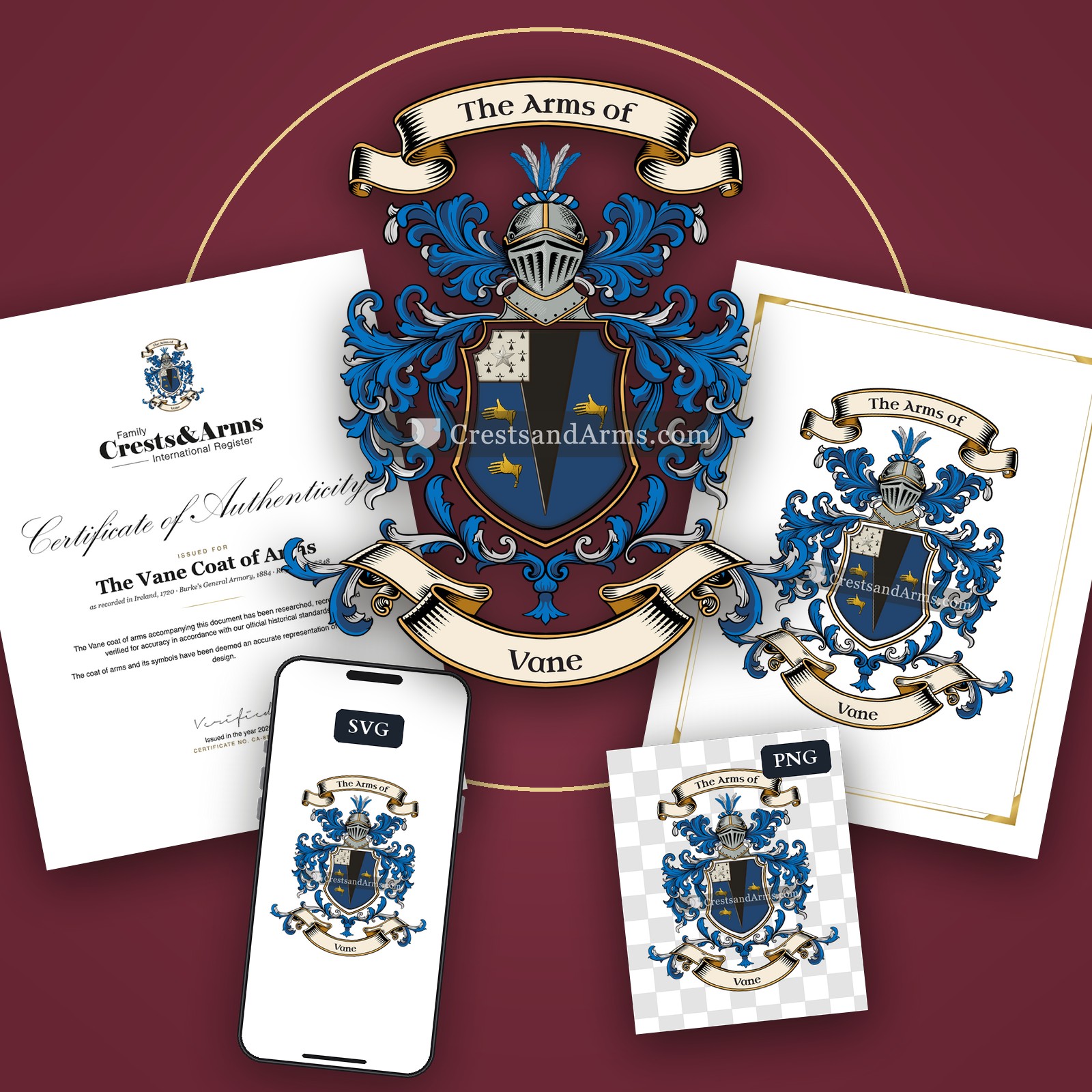
Meaning of the Vane family crest colors & symbols
Symbols on this shield
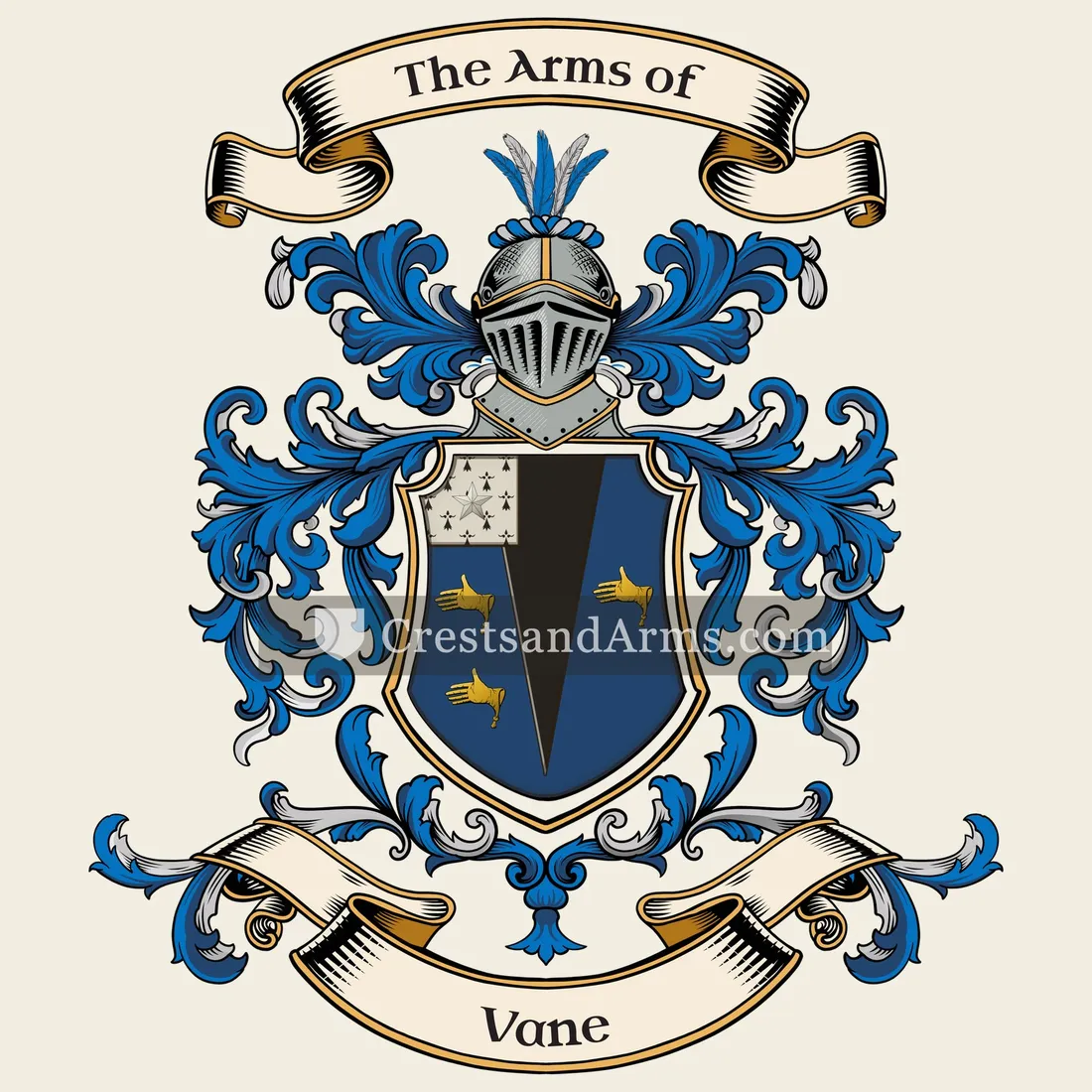
cantonA mark of honour granted by the sovereign
pileWell-doing, and a mark of distinction
gauntletA challenge given and the readiness to meet it
mulletThe third son, and a divine quality from above
Colours
Blue (Azure)Means: Loyalty and truth
Black (Sable)Means: Constancy
ErmineMeans: Dignity
Gold (Or)Means: Generosity
Silver (Argent)Means: Peace and sincerity
Historical info
Source
Sir Bernard Burke, The General Armory of England, Scotland, Ireland and Wales, London: Harrison & Sons, 1884
Blazon (the actual original written record)
“Az. three sinister gauntlets or, on a canton erm. a pile sa. thereon a mullet ar”
Irelandc. 1720
Digital archive packCoat of arms PNG, gold border print PDF, vector SVG and the certificate of authenticity. Sent to your email in minutes.
Map of Ireland showing where the Vane arms are recorded
The Vane arms were recorded in Ireland, c. 1720.
Arms such as these were typically recorded in Dublin.
Dublin was the seat of government in Ireland and the place where grants were sought and recorded. Families with business at the castle or the courts settled nearby, and settling there put their arms on record.
This is where the arms were entered in the register. Families often moved to other parts of the country, so the same name can turn up in more than one region.
The body that granted and recorded arms in Ireland in this period.
George I of Great Britain
Sovereign of the period
George I of Great Britain
1714–1727
Reigning in France when the Vane arms are first recorded.
How Arms Worked in Ireland
The Ulster King of Arms granted coats of arms to individuals who proved their social standing and good character. These symbols were typically inherited by all legitimate descendants of the original holder. If a family branch wanted a unique look, they could apply for a specific change to their design through the office to ensure their identity remained distinct.
Granting authority
The Ulster King of Arms acted as the official body that regulated and issued all coats of arms throughout Ireland.
How they got arms
Families obtained their arms through formal grants issued by the office after proving their eligibility and paying the required fees.
Where arms were recorded
All official grants were recorded in the registers held by the Ulster King of Arms starting from the year 1552.
The family's standing
Recorded among the armigerous families of Ireland.
Origin & History of the Vane Family in Ireland
The Vane family name established a notable presence in Dublin by 1720, marking a period of transition and settlement for the family in Ireland. During the early eighteenth century, Dublin served as a bustling hub for trade and administration, attracting families who sought new opportunities within the city’s growing professional and merchant classes. While the name itself has roots that stretch back to older English and Norman traditions, its appearance in Irish records during this era suggests that these early members were likely integrated into the urban fabric of the capital. They lived during a time when Dublin was expanding rapidly, and their presence in the city’s historical documentation reflects the broader movement of families across the Irish Sea. By settling in such a central location, these early Vanes participated in the social and economic life of a city that was becoming a vital center for the British Isles. Their history in Ireland is defined by this early foothold in Dublin, which provided a foundation for the family’s continued influence in the region throughout the following century.
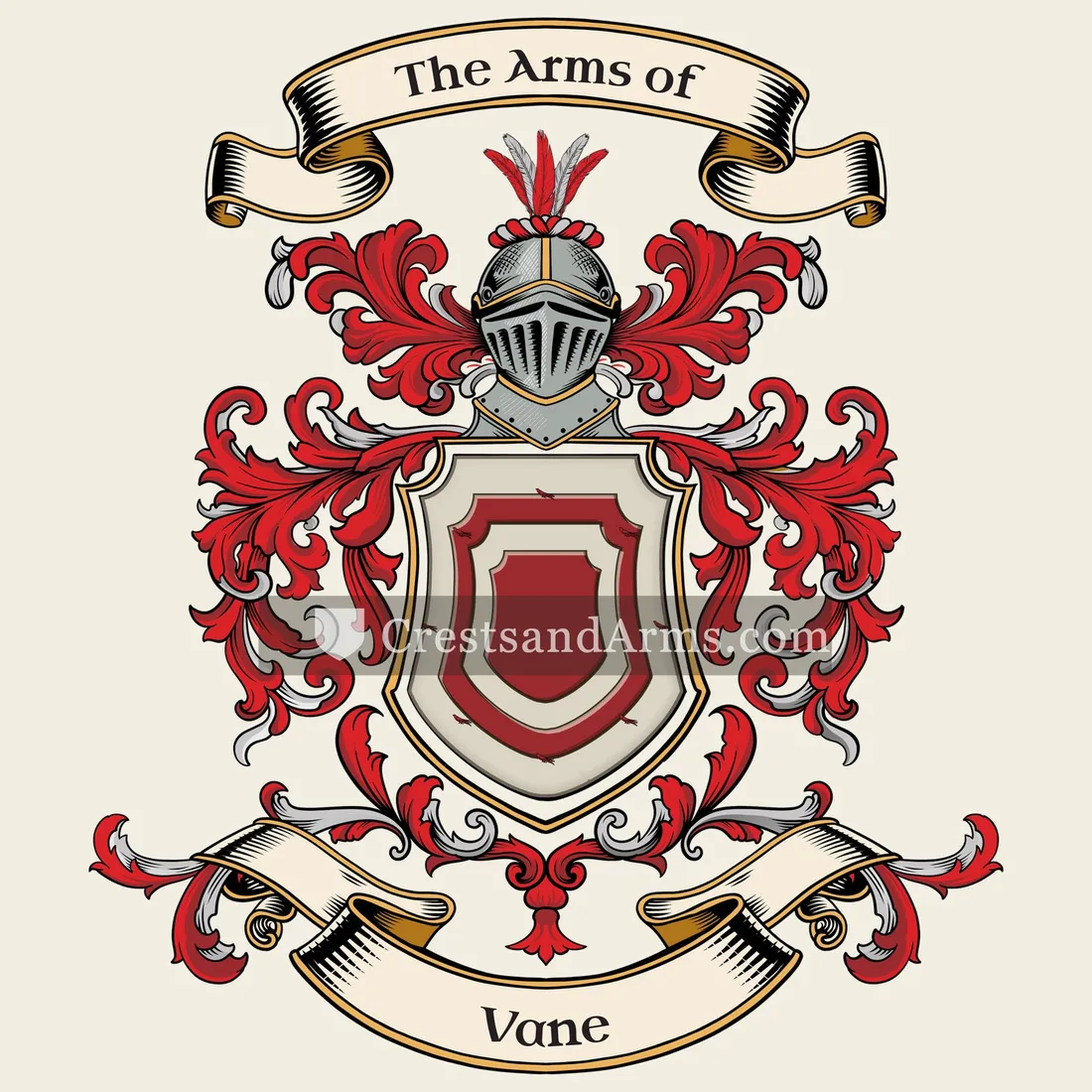
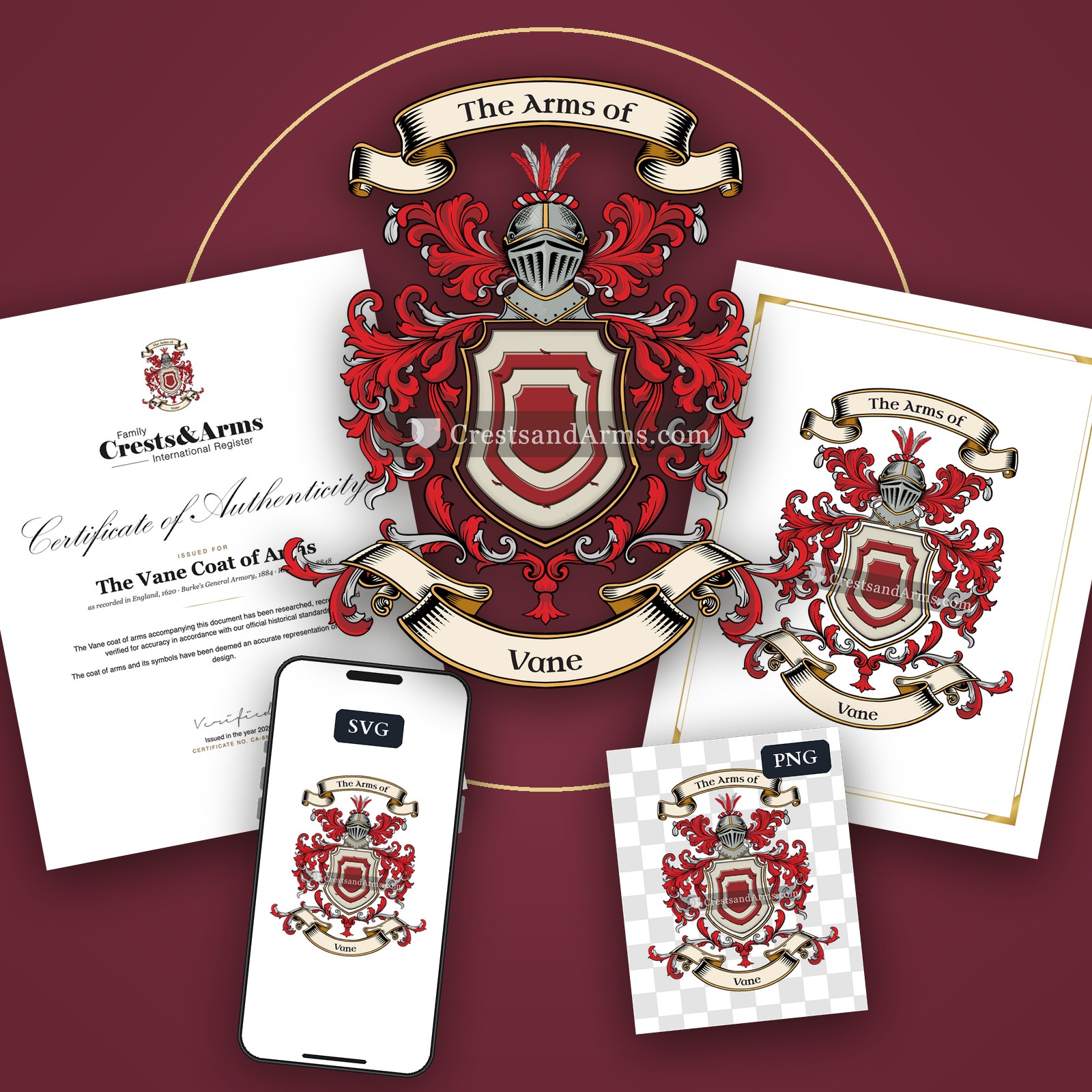
Meaning of the Vane family crest colors & symbols
Symbols on this shield
orlePreservation, and protection in battle
martletA younger son, who must win his own land
Colours
Silver (Argent)Means: Peace and sincerity
Red (Gules)Means: Military strength
Historical info
Source
Sir Bernard Burke, The General Armory of England, Scotland, Ireland and Wales, London: Harrison & Sons, 1884
Blazon (the actual original written record)
“Ar. an inescutcheon gu. an orle of martlets of the last”
NorfolkNorfolk, c. 1620
Digital archive packCoat of arms PNG, gold border print PDF, vector SVG and the certificate of authenticity. Sent to your email in minutes.
Map of England showing where the Vane arms are recorded
The Vane arms were recorded in Norfolk, c. 1620.
Norfolk grew rich on wool and grain, and its wealth was spread among many middling families rather than a few great ones. Households of that kind bought land and took arms, and the county holds a large share of English names.
This is where the arms were entered in the register. Families often moved to other parts of the country, so the same name can turn up in more than one region.
The body that granted and recorded arms in England in this period.
James VI and I
Sovereign of the period
James VI and I
1603–1625
Reigning in France when the Vane arms are first recorded.
How Arms Worked in England
English heraldry allowed arms to be shared by all legitimate descendants of the original owner. These symbols were treated as personal property that moved through the generations to all children. While the eldest son kept the original design, other family members could use the same shield without needing to change it or register their own unique versions.
Granting authority
The College of Arms in London has regulated the use of coats of arms throughout England and Wales since 1484.
How they got arms
Families typically obtained their coats of arms through a formal grant from the Crown or by proving their ancient right to them.
Where arms were recorded
All official coats of arms are recorded in the registers kept at the College of Arms, which date back to the fifteenth century.
The family's standing
Recorded among the armigerous families of Norfolk.
Origin & History of the Vane Family in England
The surname Vane has deep roots in the English landscape, with early records placing the family firmly within the county of Norfolk by the year 1620. The name itself is believed to be a topographical surname, which means it was originally used to describe someone who lived near a specific landmark, such as a weather vane or a prominent local feature. During the seventeenth century, families in Norfolk were often deeply connected to the agricultural and mercantile life of the region. As the Vane family established themselves in this area, they became part of the local social fabric that defined rural England before the Industrial Revolution. Their presence in Norfolk suggests they were likely independent landowners or tradespeople who contributed to the steady growth of the county during the early Stuart period. By settling in this specific part of East Anglia, the early members of the Vane family helped shape the local history of the region as they navigated the changing economic and political landscape of seventeenth-century England.
Vane Meaning & Related Branches
Root word
vannus
A Latin term referring to a winnowing basket or fan.
This name
VaneAn occupational name for a winnower who separated grain from chaff.
also spelled
Vain
Vayne
Vayn
Vans
Related arms
van Nesvariant spelling
Vansvariant spelling
Fitz-Royrecorded with Vane, same area
Wentworthrecorded with Vane, same area
Documented Sources
J. B. Rietstap, Armorial Général, Gouda: G. B. van Goor Zonen, 1884–87
Archives départementales du Morbihan, Série B (Archives civiles)
Archives départementales du Finistère, Série E (Familles et notaires)
Le Moyne de La Borderie, Arthur, Histoire de Bretagne, 1896
Pocquet du Haut-Jussé, Barthélemy, Histoire de la Bretagne, 1937
Digital archive packCoat of arms PNG, gold border print PDF, vector SVG and the certificate of authenticity. Sent to your email in minutes.


 gauntletA challenge given and the readiness to meet it
 fleur de lisPurity, light, and the sixth son
 lionCourage, strength and royalty
 harpWell-tuned governance and love of music


 cantonA mark of honour granted by the sovereign
 pileWell-doing, and a mark of distinction
 mulletThe third son, and a divine quality from above


 orlePreservation, and protection in battle
 martletA younger son, who must win his own land