Map of France showing where the Vanmeer arms are recorded
The Vanmeer arms were recorded in Flandre, c. 1663.
Flandre grew rich on cloth, and its towns were among the busiest in Europe. Merchant families bought land with their profits and took arms to go with it, so trade put as many names in the registers here as land did.
This is where the arms were entered in the register. Families often moved to other parts of the country, so the same name can turn up in more than one region.
The body that granted and recorded arms in France in this period.
Louis XIV of France
Sovereign of the period
Louis XIV of France
1643–1715
Reigning in France when the Vanmeer arms are first recorded.
How Arms Worked in France
In France, a coat of arms was a mark of honor that passed down through the male line to all legitimate descendants. Families often used the same shield without changes to show their shared heritage. If a branch wanted to stand out, they could add a small mark to their shield to show their specific place in the family tree.
Granting authority
The Juge d'armes de France acted as the official authority that regulated and verified coats of arms across the country.
How they got arms
Families typically inherited their arms from ancestors, though they could also receive them through royal grants or by proving their noble status.
Where arms were recorded
Coats of arms were officially recorded in the Armorial Général de France, which began its main collection in the year 1696.
The family's standing
Recorded among the armigerous families of Flandre.
Origin & History of the Vanmeer Family in France
The family name Vanmeer finds its roots in the low-lying territories of the historic region of Flandre, which straddled the border between modern-day France and Belgium. By 1663, records confirm that members of the family were firmly established in this area, living among a population that often moved fluidly between French and Flemish cultural influences. The name itself is topographic in origin, derived from the Dutch words for "from the lake" or "from the sea," reflecting the family's deep connection to the marshy, canal-rich landscape of the northern French frontier. During the seventeenth century, this region was a frequent site of territorial shifts and military conflict under the reign of Louis XIV. As the French crown expanded its influence into these northern lands, families like the Vanmeers navigated the transition from local traditional governance to the centralized administration of the French state. Their presence in the region during this era suggests a history rooted in agricultural labor or trade, as these families were essential to maintaining the complex water management systems that allowed life to flourish in the coastal plains.
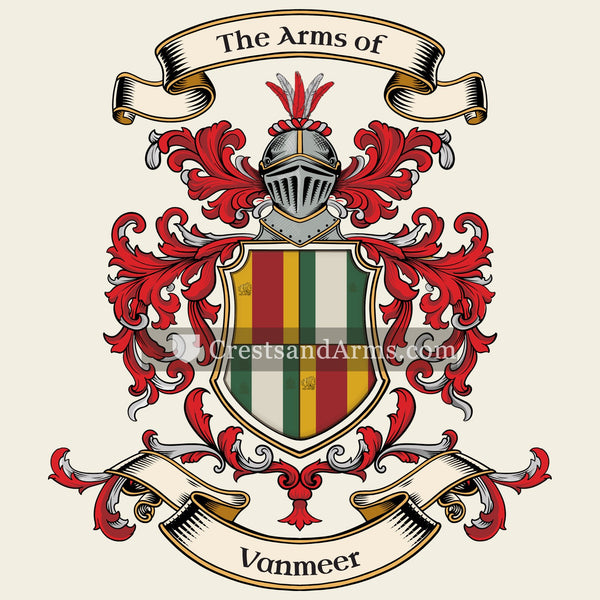
Coat of Arms & Family Crest Details
Symbols on this shield
paleMilitary strength, and a fortified defence
griffinValour and vigilance, guarding great treasure
leafHappiness and abundance
Colours
Red (Gules)Means: Military strength
Silver (Argent)Means: Peace and sincerity
Gold (Or)Means: Generosity
Green (Vert)Means: Hope
Historical info
Source
J. B. Rietstap, Armorial Général, Gouda: G. B. van Goor Zonen, 1884–87
Blazon (the actual original written record)
“Ec.: aux 1 et 4 de Kuffeler qui est c.-éc.: a. et d. de gu. à deux pals d'arg.; b. et c. d'azur à un griffon d'or; aux 2 et 3 de van der Meer, qui est d'arg. à trois feuilles de nénuphar de sin. Deux cq., le 1 cour. C.: 1° cinq pl. d'aut., alt. d'arg. et de gu. (van Kuffeler); 1. d'arg. et de gu.; 2° deux prob. d'arg., ornées chacune dans son embouchure d'une feuille de nénuphar de sin. (van der Meer); 1. d'arg. et de sin. S.: deux griffons d'or, langués de gu. D.: VIRTUTEM EXTENDERE FACTIS.”
Netherlandsc. 1815
Digital archive packCoat of arms PNG, gold border print PDF, vector SVG and the certificate of authenticity. Sent to your email in minutes.
Map of Netherlands showing where the Vanmeer arms are recorded
The Vanmeer arms were recorded in Netherlands, c. 1815.
Arms such as these were typically recorded in Friesland.
Friesland was low, wet country on the northern coast of the Netherlands, farmed by families who had held the same land for centuries. Free landholders were unusually common there, and a free landholder could carry arms.
This is where the arms were entered in the register. Families often moved to other parts of the country, so the same name can turn up in more than one region.
Region
Friesland
First recorded
1815
Granting Authority for the Vanmeer Arms
Hoge Raad van Adel
Photograph made by me · CC BY-SA 3.0
The body that granted and recorded arms in Netherlands in this period.
William I of the Netherlands
Sovereign of the period
William I of the Netherlands
1815–1840
Reigning in France when the Vanmeer arms are first recorded.
How Arms Worked in Netherlands
In the Netherlands, coats of arms were often used by noble families and those who held specific public offices. These arms were passed down through the generations to legitimate descendants. Younger branches of a family usually kept the original design without needing to add special marks. This system ensured that the family identity remained clear and consistent over many years.
Granting authority
The Hoge Raad van Adel is the official body that regulates and manages noble titles and coats of arms in the Netherlands.
How they got arms
Families typically obtained their coats of arms through official royal grants or by proving their long-standing historical use of the symbols.
Where arms were recorded
Coats of arms are officially recorded in the registers held by the Hoge Raad van Adel, which began its work in 1814.
The family's standing
Recorded among the armigerous families of Netherlands.
Origin & History of the Vanmeer Family in Netherlands
The name Vanmeer is a topographic surname, which means it was originally used to describe where a person lived. In the Dutch language, the prefix "van" means from, and "meer" refers to a lake or a large body of water. Families carrying this name likely settled near a prominent lake or marshland in the northern provinces of the Netherlands. By the early 19th century, records confirm that members of the Vanmeer family were established in the province of Friesland. This region is famous for its vast network of waterways and lakes, which provided a natural environment for a family whose name was tied to the landscape. During this period, the family would have been part of the local Frisian community, living in a society shaped by the unique culture and maritime history of the northern Netherlands.
Vanmeer Meaning & Related Branches
Root word
Meer
A Dutch or Low German term referring to a lake or sea.
This name
VanmeerIndicates a person who lived near a lake or a body of water.
also spelled
vanderMeere
vanMeer
Meere
vanderMeir
Documented Sources
J. B. Rietstap, Armorial Général, Gouda: G. B. van Goor Zonen, 1884–87
De Smet, J., De bevolking van de Franse Westhoek in de 17e eeuw, 1962
Archives Départementales du Nord, Série B: Cours et juridictions (Chambre des comptes de Lille), 1663
Lottin, A., Histoire des provinces françaises du Nord, 1989
Digital archive packCoat of arms PNG, gold border print PDF, vector SVG and the certificate of authenticity. Sent to your email in minutes.


 martletA younger son, who must win his own land
 martletA younger son, who must win his own land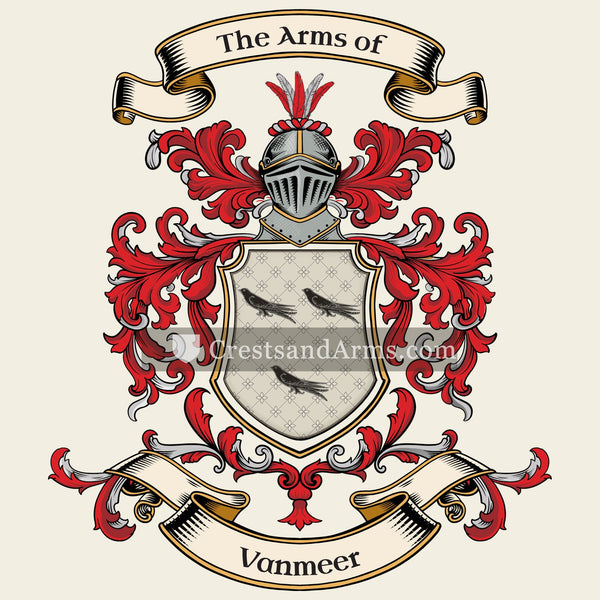


 paleMilitary strength, and a fortified defence
 griffinValour and vigilance, guarding great treasure
 leafHappiness and abundance