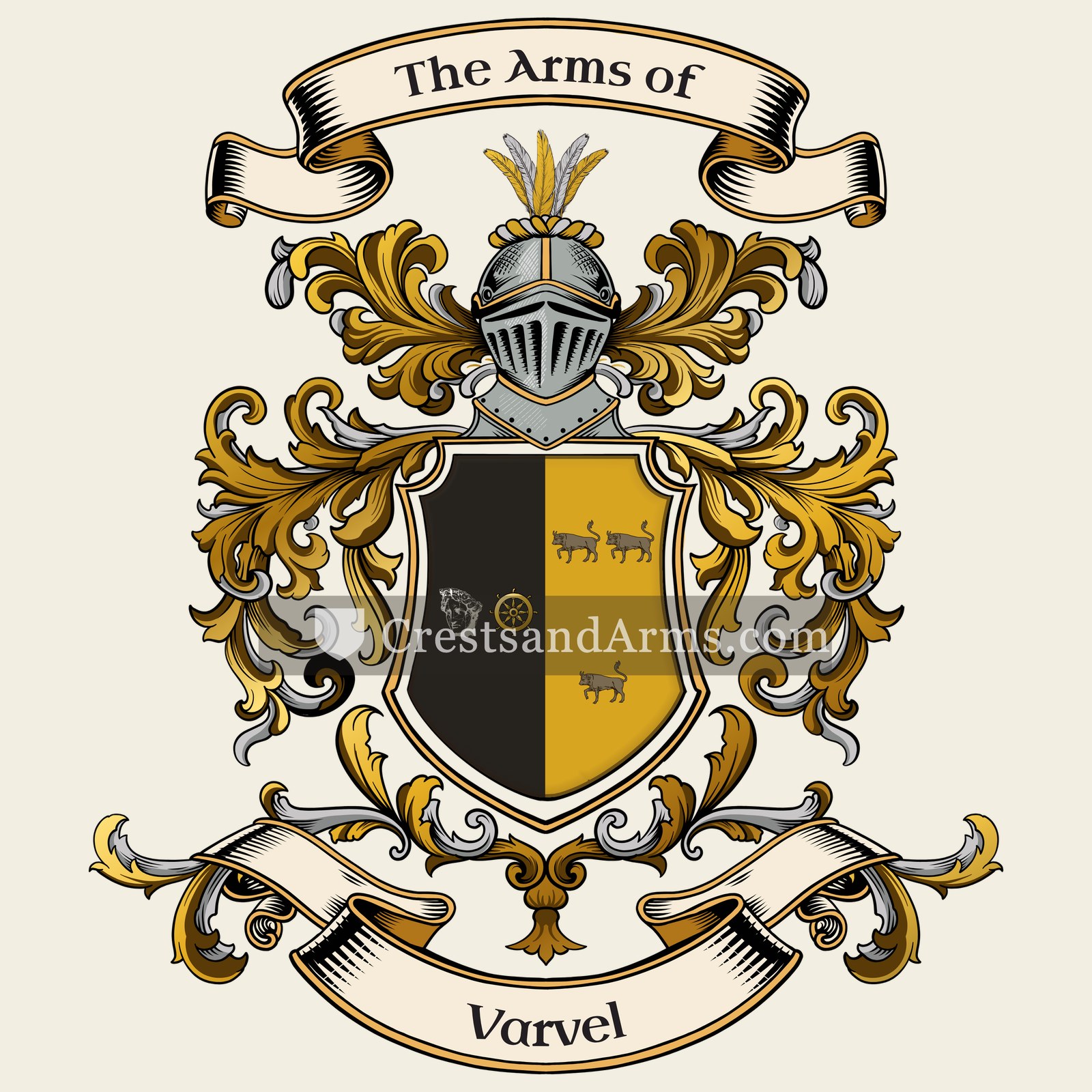
A record of documented arms, meaning and origin, researched for the Varvel family of Netherlands.
Reg. 8218 · Dutch, W–Z
Coat of Arms & Family Crest Details
Symbols on this shield
womanGrace, and the founding of a house
wheelFortune's turning, and the carter's trade
bullValour and generosity
Colours
Black (Sable)Means: Constancy
Gold (Or)Means: Generosity
Historical info
Source
J. B. Rietstap, Armorial Général, Gouda: G. B. van Goor Zonen, 1884–87
Blazon (the actual original written record)
“Parti: au 1 de sa. à une femme nue de carn., posée de front, les cheveux épars, supp. de la main dextre une roue de Ste.-Catherine d'or, la sen. posée sur son coeur; au 2 d'or à trois rencontres de boeuf au nat.”
NetherlandsSchiedam, c. 1725
Digital archive packCoat of arms PNG, gold border print PDF, vector SVG and the certificate of authenticity. Sent to your email in minutes.
Map of Netherlands showing where the Varvel arms are recorded
The Varvel arms were recorded in Schiedam, c. 1725.
This is where the arms were entered in the register. Families often moved to other parts of the country, so the same name can turn up in more than one region.
Region
Schiedam
Town
Schiedam
First recorded
1725
Granting Authority for the Varvel Arms
Hoge Raad van Adel
Photograph made by me · CC BY-SA 3.0
The body that granted and recorded arms in Netherlands in this period.
How Arms Worked in Netherlands
In the Netherlands, coats of arms were often used by noble families and those who held specific public offices. These arms were passed down through the generations to legitimate descendants. Younger branches of a family usually kept the original design without needing to add special marks. This system ensured that the family identity remained clear and consistent over many years.
Granting authority
The Hoge Raad van Adel is the official body that regulates and manages noble titles and coats of arms in the Netherlands.
How they got arms
Families typically obtained their coats of arms through official royal grants or by proving their long-standing historical use of the symbols.
Where arms were recorded
Coats of arms are officially recorded in the registers held by the Hoge Raad van Adel, which began its work in 1814.
The family's standing
Recorded among the armigerous families of Netherlands.
Origin & History of the Varvel Family in Netherlands
The Varvel family name has deep roots in the Netherlands, with historical records placing members of the family in the city of Schiedam as early as 1725. During the eighteenth century, Schiedam was a bustling center for the gin distilling industry, which attracted many workers and merchants to the area. Families like the Varvels were often part of this growing urban middle class, participating in the local trade and maritime activities that defined the Dutch economy at the time. The name itself likely evolved from regional dialects or local geographical markers common in the South Holland province. As the family established themselves in the region, they became integrated into the civic life of the city, leaving behind traces in local parish registers and municipal tax documents that help historians map their early presence.
Related Branches & Arms
Root word
Varre
A Middle Dutch term referring to a crossing or a ford.
This name
VarvelA topographic name for someone who lived near a river crossing or ferry point.
also spelled
Vervell
Vervelle
Documented Sources
J. B. Rietstap, Armorial Général, Gouda: G. B. van Goor Zonen, 1884–87
Gemeentearchief Schiedam, Doop-, trouw- en begraafboeken (DTB) van Schiedam, 1725
Gemeentearchief Schiedam, Archief van de stad Schiedam, 1700-1750
Digital archive packCoat of arms PNG, gold border print PDF, vector SVG and the certificate of authenticity. Sent to your email in minutes.


 womanGrace, and the founding of a house
 wheelFortune's turning, and the carter's trade
 bullValour and generosity
 womanGrace, and the founding of a house
 wheelFortune's turning, and the carter's trade
 bullValour and generosity