Map of France showing where the Vaux arms are recorded
The Vaux arms were recorded in France, c. 1725.
Arms such as these were typically recorded in Bretagne.
More families held coats of arms in Bretagne than anywhere else in France. The land was divided into many small estates rather than a few large ones, so far more households counted as gentry, and each needed a shield of its own to be told apart.
This is where the arms were entered in the register. Families often moved to other parts of the country, so the same name can turn up in more than one region.
The body that granted and recorded arms in France in this period.
Louis XV of France
Sovereign of the period
Louis XV of France
1715–1774
Reigning in France when the Vaux arms are first recorded.
How Arms Worked in France
In France, a coat of arms was a mark of honor that passed down through the male line to all legitimate descendants. Families often used the same shield without changes to show their shared heritage. If a branch wanted to stand out, they could add a small mark to their shield to show their specific place in the family tree.
Granting authority
The Juge d'armes de France acted as the official authority that regulated and verified coats of arms across the country.
How they got arms
Families typically inherited their arms from ancestors, though they could also receive them through royal grants or by proving their noble status.
Where arms were recorded
Coats of arms were officially recorded in the Armorial Général de France, which began its main collection in the year 1696.
The family's standing
Recorded among the armigerous families of France.
Origin & History of the Vaux Family in France
The family name Vaux finds its roots in the landscape of northern France, where the term originally described people who lived in or near a valley. By the time the family established a documented presence in the region of Bretagne in 1725, they were already part of a long tradition of families who took their identity from the geography of their home. During this period, the name was closely tied to the rural life of the province, where families often worked the land or served in local administrative roles. Because the name is derived from a common geographical feature, it appeared in various parts of France as different branches settled in distinct valleys. The history of the name in Bretagne reflects the broader movement of families who maintained their ancestral identity while adapting to the social and economic shifts of eighteenth-century French society.
Meaning of the Vaux family crest colors & symbols
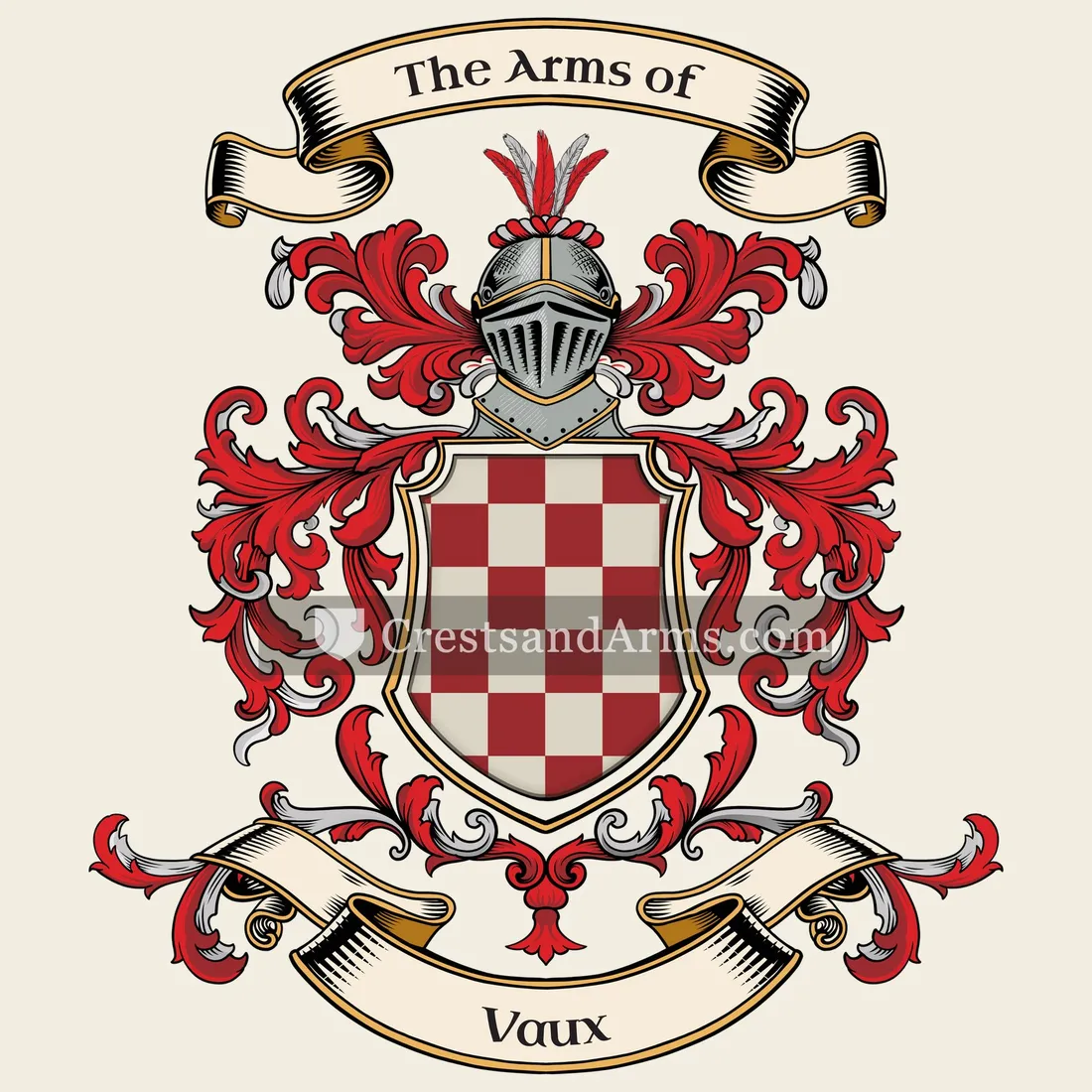
Symbols on this shield
chequyConstancy, and the counting-board
Colours
Silver (Argent)Means: Peace and sincerity
Red (Gules)Means: Military strength
Historical info
Source
Sir Bernard Burke, The General Armory of England, Scotland, Ireland and Wales, London: Harrison & Sons, 1884
Blazon (the actual original written record)
“Chequy ar. and gu”
OxfordFringford · Oxford, c. 1574
Digital archive packCoat of arms PNG, gold border print PDF, vector SVG and the certificate of authenticity. Sent to your email in minutes.
Map of England showing where the Vaux arms are recorded
The Vaux arms were recorded in Oxford, c. 1574.
Oxfordshire was farming country with the university at its centre, and both produced families of standing. Scholars and lawyers who did well bought manors nearby, and holding a manor was the ordinary route to a coat of arms.
This is where the arms were entered in the register. Families often moved to other parts of the country, so the same name can turn up in more than one region.
The body that granted and recorded arms in England in this period.
Elizabeth I of England
Sovereign of the period
Elizabeth I of England
1558–1603
Reigning in France when the Vaux arms are first recorded.
How Arms Worked in England
English heraldry allowed arms to be shared by all legitimate descendants of the original owner. These symbols were treated as personal property that moved through the generations to all children. While the eldest son kept the original design, other family members could use the same shield without needing to change it or register their own unique versions.
Granting authority
The College of Arms in London has regulated the use of coats of arms throughout England and Wales since 1484.
How they got arms
Families typically obtained their coats of arms through a formal grant from the Crown or by proving their ancient right to them.
Where arms were recorded
All official coats of arms are recorded in the registers kept at the College of Arms, which date back to the fifteenth century.
The family's standing
Recorded among the armigerous families of Oxford.
Origin & History of the Vaux Family in England
The name Vaux is a topographical surname that originated from the French word for valleys. Following the Norman Conquest, families bearing this name settled across England, bringing the influence of their continental roots into the local landscape. By the late sixteenth century, the family established a notable presence in Oxford, where records from 1574 confirm their involvement in the life of that academic city. During this era, families with this name were often integrated into the local administration and the growing merchant classes. As they moved through the English countryside and into urban centers like Oxford, the Vaux name became a permanent fixture of the regional history. This transition from a descriptive French term to a recognized English family name reflects the broader patterns of migration and social change that shaped the country during the early modern period.
Vaux Meaning & Related Branches
Root word
Vallis
A Latin term referring to a valley or low-lying land.
This name
VauxA topographical surname denoting someone who lived in or near a valley.
also spelled
Vau
Vo
Vaus
Vause
Related arms
Vallibus, or Vauxvariant spelling
Vausvariant spelling
Vause, or Vausvariant spelling
Wenmanrecorded with Vaux, same area
Documented Sources
J. B. Rietstap, Armorial Général, Gouda: G. B. van Goor Zonen, 1884–87
Dauzat, Albert. Dictionnaire étymologique des noms et prénoms de France. 1951
Morvan, Françoise. Les archives de Bretagne. 2005
Archives départementales d'Ille-et-Vilaine, Série E: Familles et seigneuries
Digital archive packCoat of arms PNG, gold border print PDF, vector SVG and the certificate of authenticity. Sent to your email in minutes.


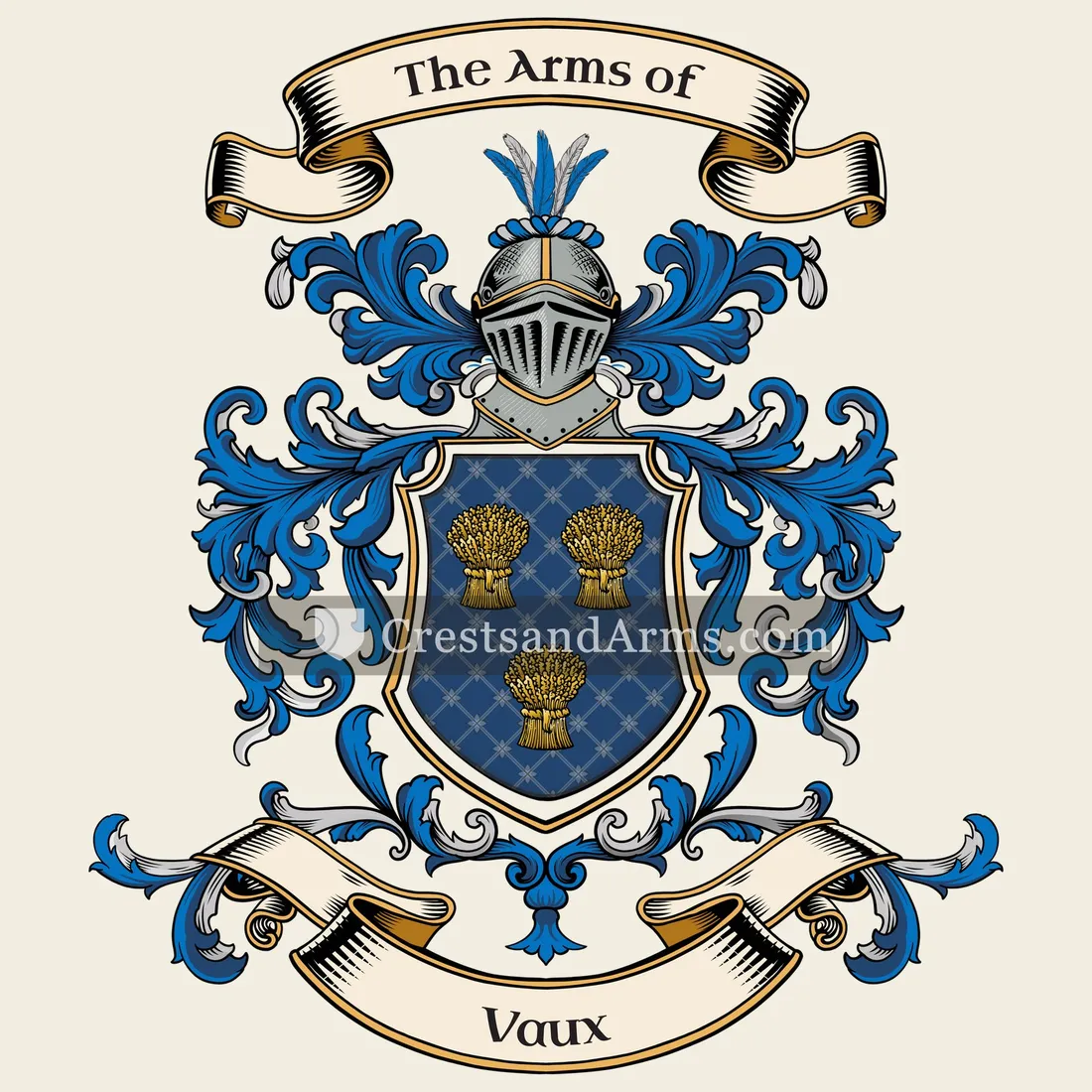
 wheatsheafPlenty, and the harvest of one's own labour
 wheatsheafPlenty, and the harvest of one's own labour


 chequyConstancy, and the counting-board