Map of England showing where the Vealey arms are recorded
The Vealey arms were recorded in Gloucester, c. 1620.
Gloucestershire had good farmland, a cloth trade in its valleys and a river carrying goods to Bristol. All three made money, and money bought the estates that brought arms with them.
This is where the arms were entered in the register. Families often moved to other parts of the country, so the same name can turn up in more than one region.
The body that granted and recorded arms in England in this period.
James VI and I
Sovereign of the period
James VI and I
1603–1625
Reigning in England when the Vealey arms are first recorded.
How Arms Worked in England
English heraldry allowed arms to be shared by all legitimate descendants of the original owner. These symbols were treated as personal property that moved through the generations to all children. While the eldest son kept the original design, other family members could use the same shield without needing to change it or register their own unique versions.
Granting authority
The College of Arms in London has regulated the use of coats of arms throughout England and Wales since 1484.
How they got arms
Families typically obtained their coats of arms through a formal grant from the Crown or by proving their ancient right to them.
Where arms were recorded
All official coats of arms are recorded in the registers kept at the College of Arms, which date back to the fifteenth century.
The family's standing
Recorded among the armigerous families of Gloucester.
Origin & History of the Vealey Family in England
The family name Vealey has deep roots in the coastal landscape of England, with records confirming that family members were established in Gloucester by 1620. During this period, the name was often associated with families living near the River Severn, a region known for its bustling trade and maritime activity. The name likely evolved from local dialects and descriptive terms used to identify people based on their occupation or the specific geography of their home. As the family grew, they became part of the social fabric of the West Country, participating in the local economy and community life of the early seventeenth century. This era was a time of significant transition in England, and the presence of the Vealey family in a major hub like Gloucester suggests they were well-integrated into the regional society of the time.
Vealey Meaning & Related Branches
Root word
Val
Derived from the Latin word valere meaning to be strong or healthy.
This name
VealeyA topographical surname referring to someone who lived in a valley or a small dale.
also spelled
Vele
Veele
Documented Sources
Sir Bernard Burke, The General Armory of England, Scotland, Ireland and Wales, London: Harrison & Sons, 1884
Atkyns, Robert. The Ancient and Present State of Glocestershire. 1712
Gloucestershire Archives. Records of the Diocese of Gloucester: Bishop's Transcripts of Parish Registers. 1620
Rudder, Samuel. A New History of Gloucestershire. 1779
Digital archive packCoat of arms PNG, gold border print PDF, vector SVG and the certificate of authenticity. Sent to your email in minutes.


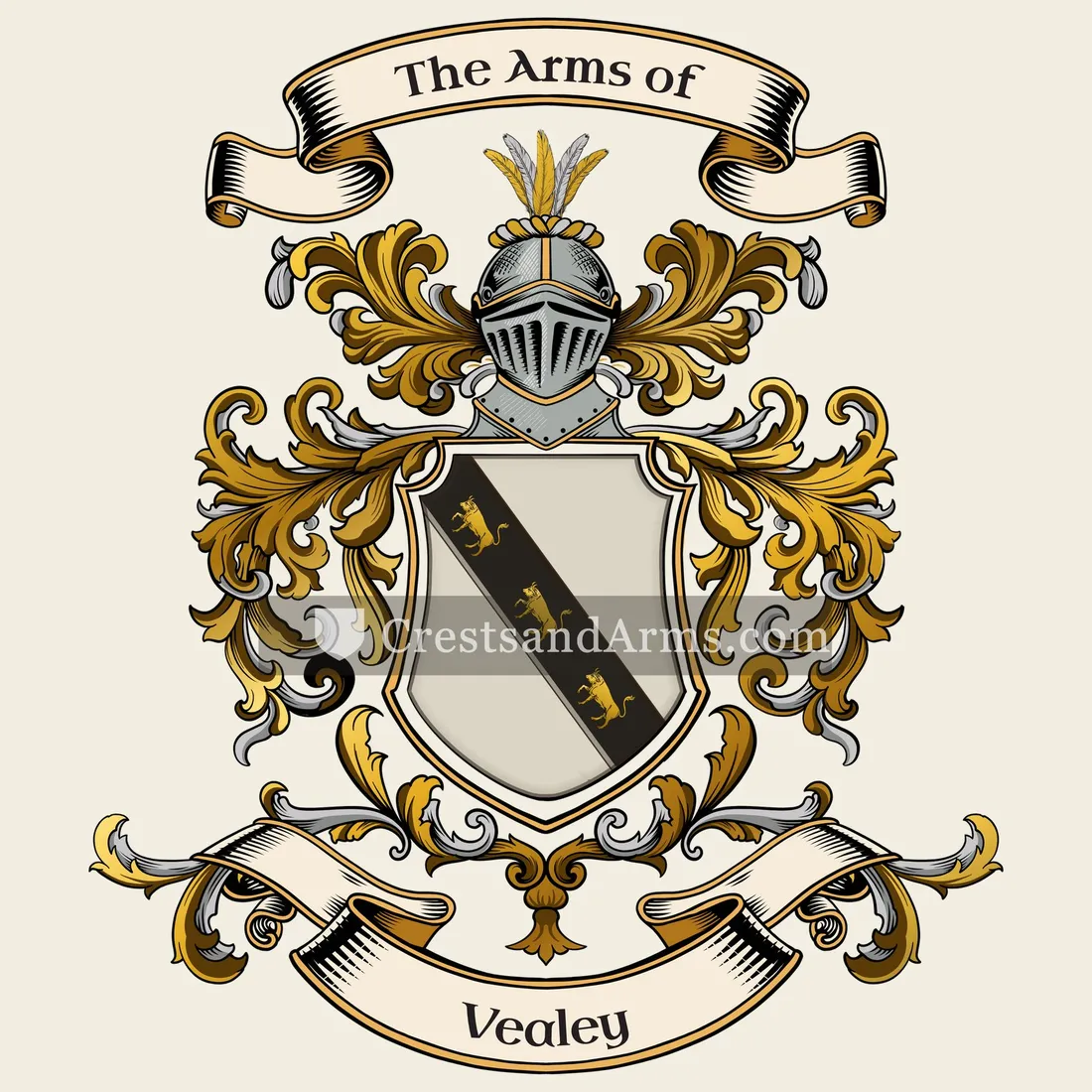
 bendDefence, and the scarf of a commander
 bullValour and generosity
 bendDefence, and the scarf of a commander
 bullValour and generosity