Map of England showing where the Venable arms are recorded
The Venable arms were recorded in England, c. 1422.
Arms such as these were typically recorded in York.
Yorkshire is the largest of the English counties, and it held more gentry families than any other. Land there was split among a great many households rather than a few, so a great many of them carried arms.
This is where the arms were entered in the register. Families often moved to other parts of the country, so the same name can turn up in more than one region.
The body that granted and recorded arms in England in this period.
Henry V of England
Sovereign of the period
Henry V of England
1413–1422
Reigning in England when the Venable arms are first recorded.
How Arms Worked in England
English heraldry allowed arms to be shared by all legitimate descendants of the original owner. These symbols were treated as personal property that moved through the generations to all children. While the eldest son kept the original design, other family members could use the same shield without needing to change it or register their own unique versions.
Granting authority
The College of Arms in London has regulated the use of coats of arms throughout England and Wales since 1484.
How they got arms
Families typically obtained their coats of arms through a formal grant from the Crown or by proving their ancient right to them.
Where arms were recorded
All official coats of arms are recorded in the registers kept at the College of Arms, which date back to the fifteenth century.
The family's standing
Recorded among the armigerous families of England.
Origin & History of the Venable Family in England
The family name Venable has deep roots in the history of medieval England, where it emerged as a distinct identifier during a time when surnames were becoming essential for record-keeping. By the year 1422, historical documents confirm that members of the family were established in the city of York. During this period, York was a major center for trade and religious life, serving as a hub for merchants and skilled craftsmen. Families like the Venables often settled in such urban environments to take advantage of the growing economy and the protection offered by city walls. Over the following centuries, the name spread from these northern strongholds into other regions, reflecting the natural migration of people seeking new opportunities in agriculture and local government. The history of the name is tied to the development of English society, as families moved from being identified by their local surroundings to carrying a permanent name that linked them to their ancestors.
Coat of Arms & Family Crest Details
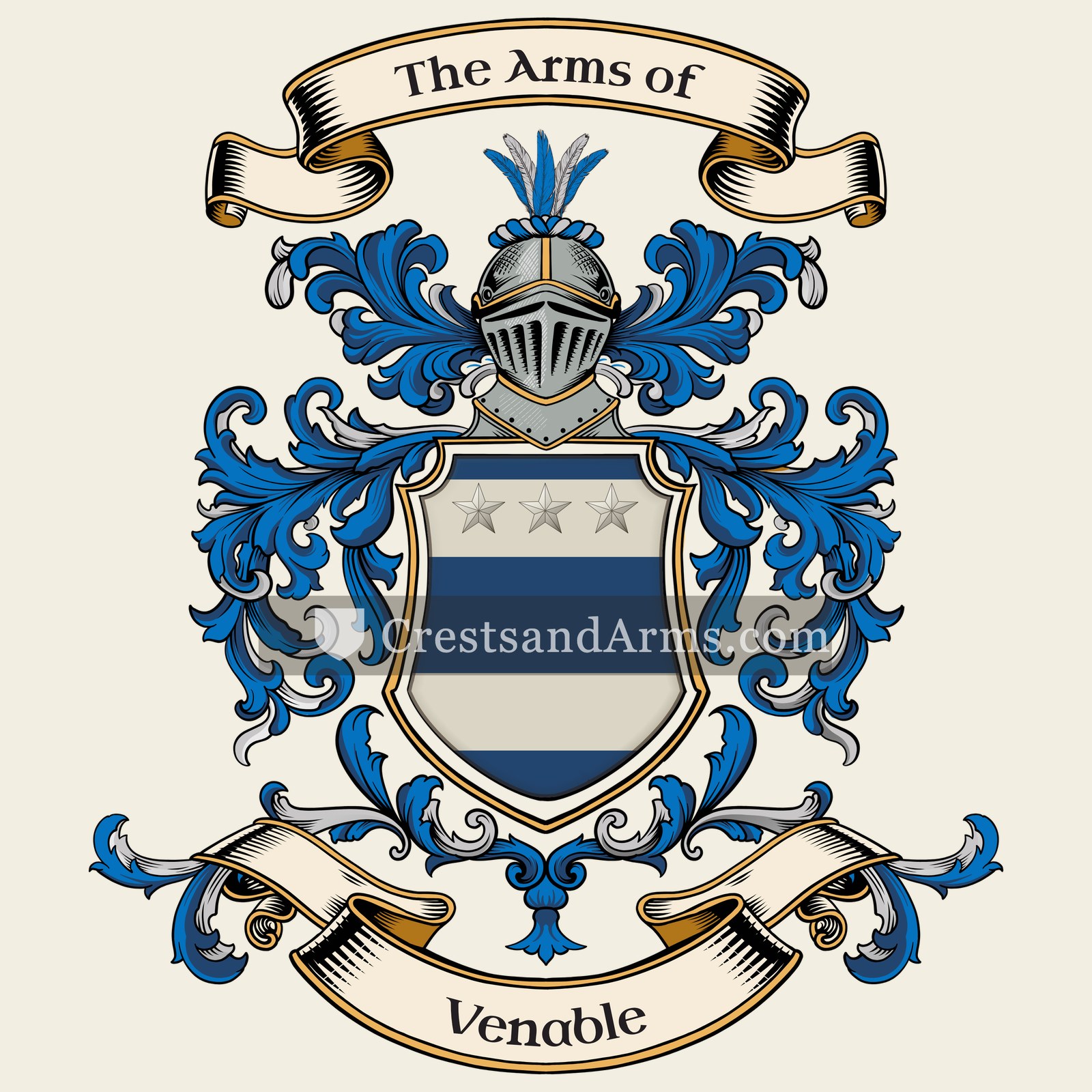
Symbols on this shield
mulletThe third son, and a divine quality from above
Colours
Blue (Azure)Means: Loyalty and truth
Silver (Argent)Means: Peace and sincerity
Historical info
Source
Sir Bernard Burke, The General Armory of England, Scotland, Ireland and Wales, London: Harrison & Sons, 1884
Blazon (the actual original written record)
“Az. two bars ar. in chief three mullets pierced of the last”
BreconLlysdinam Hall · Brecon, c. 1647
Digital archive packCoat of arms PNG, gold border print PDF, vector SVG and the certificate of authenticity. Sent to your email in minutes.
Map of Wales showing where the Venable arms are recorded
The Venable arms were recorded in Brecon, c. 1647.
Brecon was mid-Welsh hill country, held in small estates by families who stayed for generations. Land was worth less than in the lowlands, but holding it still brought arms.
This is where the arms were entered in the register. Families often moved to other parts of the country, so the same name can turn up in more than one region.
The body that granted and recorded arms in Wales in this period.
Charles I of England
Sovereign of the period
Charles I of England
1625–1649
Reigning in England when the Venable arms are first recorded.
How Arms Worked in Wales
English heraldry allowed arms to be shared by all legitimate descendants of the original owner. These symbols were treated as personal property that moved through the generations to all children. While the eldest son kept the original design, other family members could use the same shield without needing to change it or register their own unique versions.
Granting authority
The College of Arms in London has regulated the use of coats of arms throughout England and Wales since 1484.
How they got arms
Families typically obtained their coats of arms through a formal grant from the Crown or by proving their ancient right to them.
Where arms were recorded
All official coats of arms are recorded in the registers kept at the College of Arms, which date back to the fifteenth century.
The family's standing
Recorded among the armigerous families of Brecon.
Origin & History of the Venable Family in Wales
The surname Venable has deep roots in the rugged landscape of Wales, where the family established a notable presence by the mid-seventeenth century. Historical records confirm that members of the family were living in the town of Brecon as early as 1647. During this era, Brecon served as a vital market center and a hub for local administration, suggesting that the family likely held a stable position within the community. While the name itself carries linguistic ties to broader European origins, its adoption in the Welsh Marches reflects the integration of families into the social and economic life of the region. By settling in Brecon, these early ancestors became part of the long history of Welsh town life, contributing to the local culture during a time of significant political change in Britain.
Coat of Arms & Family Crest Details
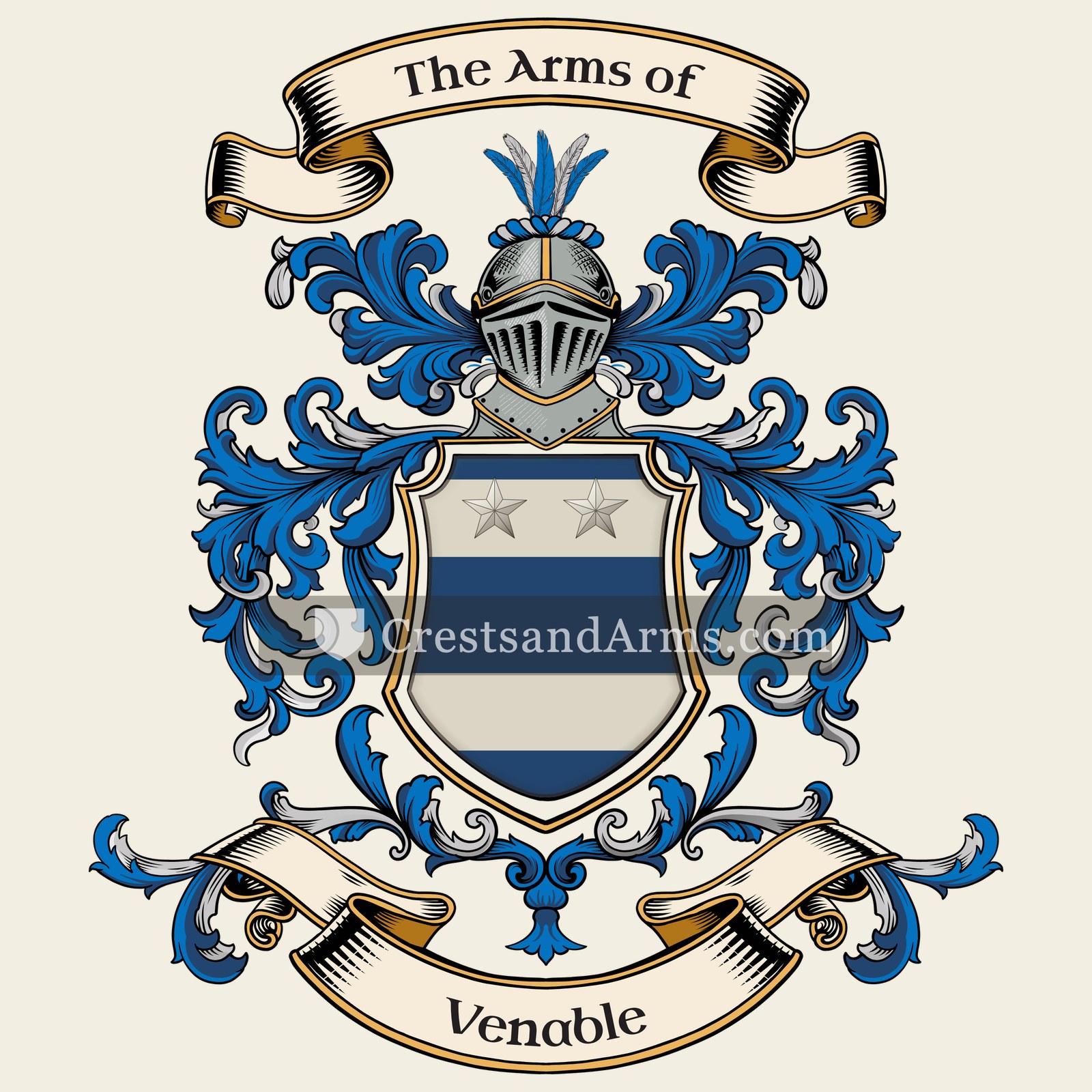
Symbols on this shield
mulletThe third son, and a divine quality from above
Colours
Blue (Azure)Means: Loyalty and truth
Silver (Argent)Means: Peace and sincerity
Historical info
Source
Sir Bernard Burke, The General Armory of England, Scotland, Ireland and Wales, London: Harrison & Sons, 1884
Blazon (the actual original written record)
“Az. two bars ar. in chief as many mullets pierced of the last”
Irelandc. 1649
Digital archive packCoat of arms PNG, gold border print PDF, vector SVG and the certificate of authenticity. Sent to your email in minutes.
Map of Ireland showing where the Venable arms are recorded
The Venable arms were recorded in Ireland, c. 1649.
Arms such as these were typically recorded in Dublin.
Dublin was the seat of government in Ireland and the place where grants were sought and recorded. Families with business at the castle or the courts settled nearby, and settling there put their arms on record.
This is where the arms were entered in the register. Families often moved to other parts of the country, so the same name can turn up in more than one region.
The body that granted and recorded arms in Ireland in this period.
Charles I of England
Sovereign of the period
Charles I of England
1625–1649
Reigning in England when the Venable arms are first recorded.
How Arms Worked in Ireland
The Ulster King of Arms granted coats of arms to individuals who proved their social standing and good character. These symbols were typically inherited by all legitimate descendants of the original holder. If a family branch wanted a unique look, they could apply for a specific change to their design through the office to ensure their identity remained distinct.
Granting authority
The Ulster King of Arms acted as the official body that regulated and issued all coats of arms throughout Ireland.
How they got arms
Families obtained their arms through formal grants issued by the office after proving their eligibility and paying the required fees.
Where arms were recorded
All official grants were recorded in the registers held by the Ulster King of Arms starting from the year 1552.
The family's standing
Recorded among the armigerous families of Ireland.
Origin & History of the Venable Family in Ireland
The Venable family name arrived in Ireland during a period of intense political and social upheaval in the seventeenth century. By 1649, records confirm that members of the family were established in Dublin, a city that served as a central hub for the English military and administrative presence during the Cromwellian conquest. The name itself is of Norman-French origin, meaning "hunting" or "hunter," and it likely traveled to Ireland through soldiers or settlers who had previously migrated from England. Once in Dublin, these early family members integrated into the urban landscape, taking on roles that supported the growing colonial administration. Their presence in the capital during this transformative era suggests they were part of the wave of newcomers who helped reshape the city’s demographics and social structure following the mid-century conflicts.
Venable Meaning & Related Branches
Root word
venabilis
Latin term meaning huntable or worthy of being hunted.
This name
VenableA habitational name derived from Venables in Normandy, referring to a place for hunting.
also spelled
Venebles
Documented Sources
Sir Bernard Burke, The General Armory of England, Scotland, Ireland and Wales, London: Harrison & Sons, 1884
Borthwick Institute for Archives, York Diocesan Probate Records
The National Archives, Early Chancery Proceedings
Reaney, P.H., A Dictionary of English Surnames, 1958
Yorkshire Archaeological Society, Testamenta Eboracensia: A Selection of Wills from the Registry at York, 1836
Digital archive packCoat of arms PNG, gold border print PDF, vector SVG and the certificate of authenticity. Sent to your email in minutes.


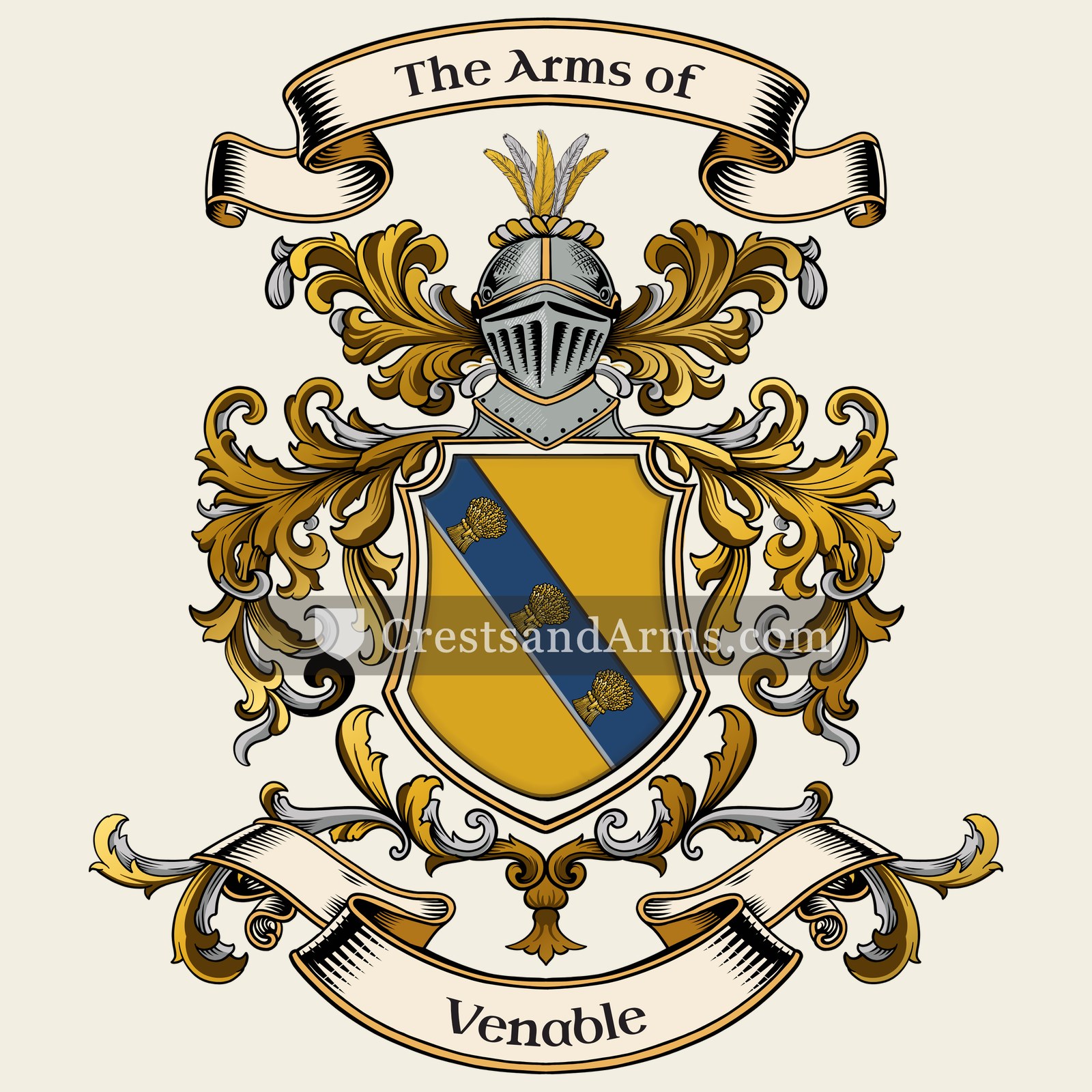
 bendDefence, and the scarf of a commander
 wheatsheafPlenty, and the harvest of one's own labour
 bendDefence, and the scarf of a commander
 wheatsheafPlenty, and the harvest of one's own labour


 mulletThe third son, and a divine quality from above