Map of Switzerland showing where the Verdone arms are recorded
The Verdone arms were recorded in Genevois, c. 1745.
Genevois was Alpine country south of Geneva, held in small estates by families who stayed put. Land there passed down the same line for centuries, and long tenure counted for more than wealth.
This is where the arms were entered in the register. Families often moved to other parts of the country, so the same name can turn up in more than one region.
The body that granted and recorded arms in Switzerland in this period.
How Arms Worked in Switzerland
In Switzerland, coats of arms were not restricted to the nobility and were often adopted by common citizens and families. These symbols were passed down through generations to show family identity. When branches of a family grew, they often changed small details of the design to distinguish their own line from the original group.
Granting authority
Cantonal and civic authorities managed the use of coats of arms within their specific regions and local jurisdictions.
How they got arms
Families typically assumed their own coats of arms based on local custom rather than receiving them from a central monarch.
Where arms were recorded
Arms were recorded in various cantonal and civic registers starting from the fourteenth century throughout the Swiss region.
The family's standing
Recorded among the armigerous families of Genevois.
Origin & History of the Verdone Family in Switzerland
The family name Verdone has deep roots in the region of Genevois, where records confirm members of the family were established by 1745. During this period, the area was a crossroads of culture and trade between the Swiss Confederation and the neighboring Duchy of Savoy. Families with this name often lived in rural or semi-rural settings, likely working in agriculture or local crafts that supported the growing population near Lake Geneva. Because the region was a hub for movement and migration, the Verdone name became part of the local social fabric as families built lives in the shadow of the Alps. Over the following decades, these early ancestors helped shape the community through their participation in parish life and local commerce, establishing a lasting presence that persisted as the political borders of the region shifted.
Meaning of the Verdone family crest colors & symbols
Symbols on this shield
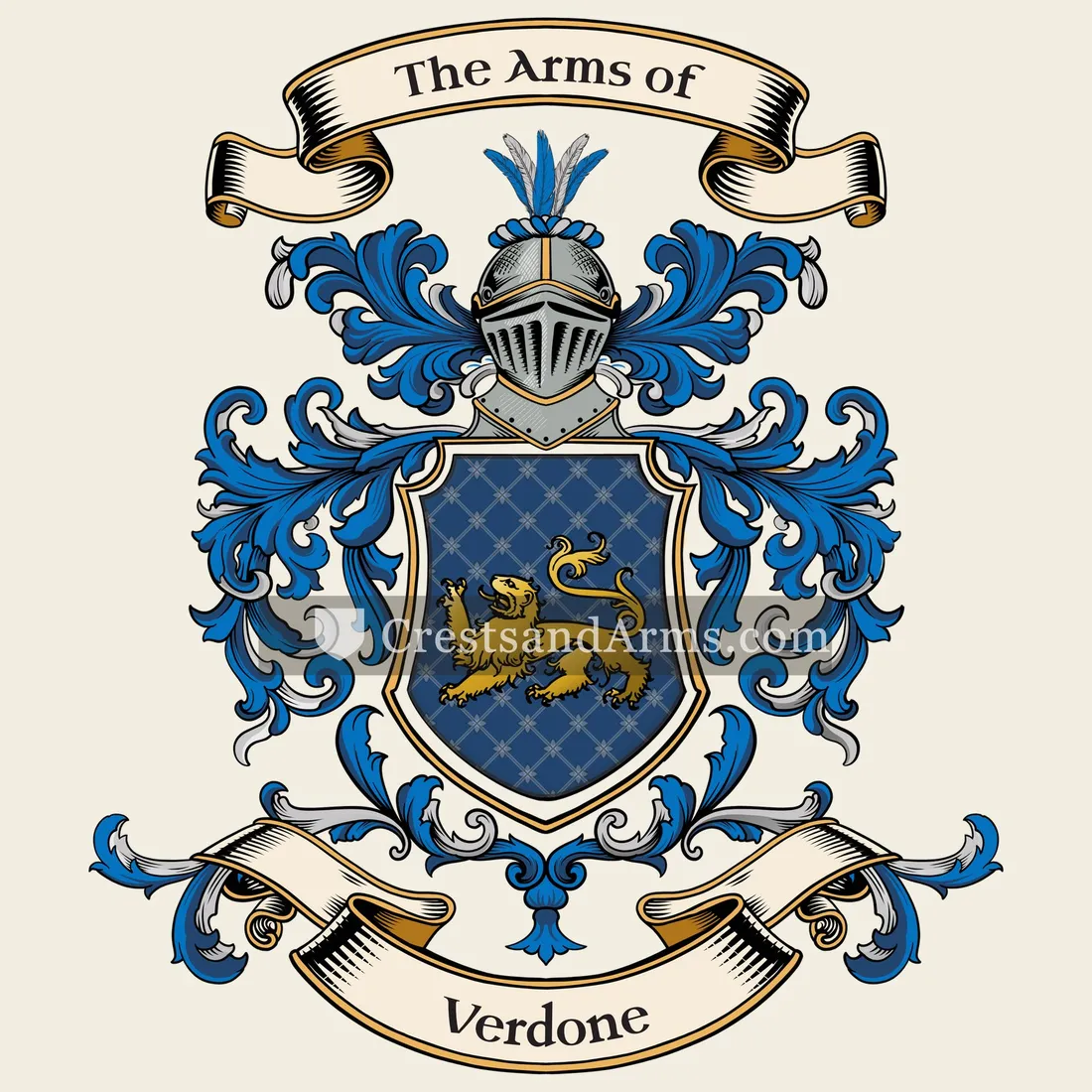
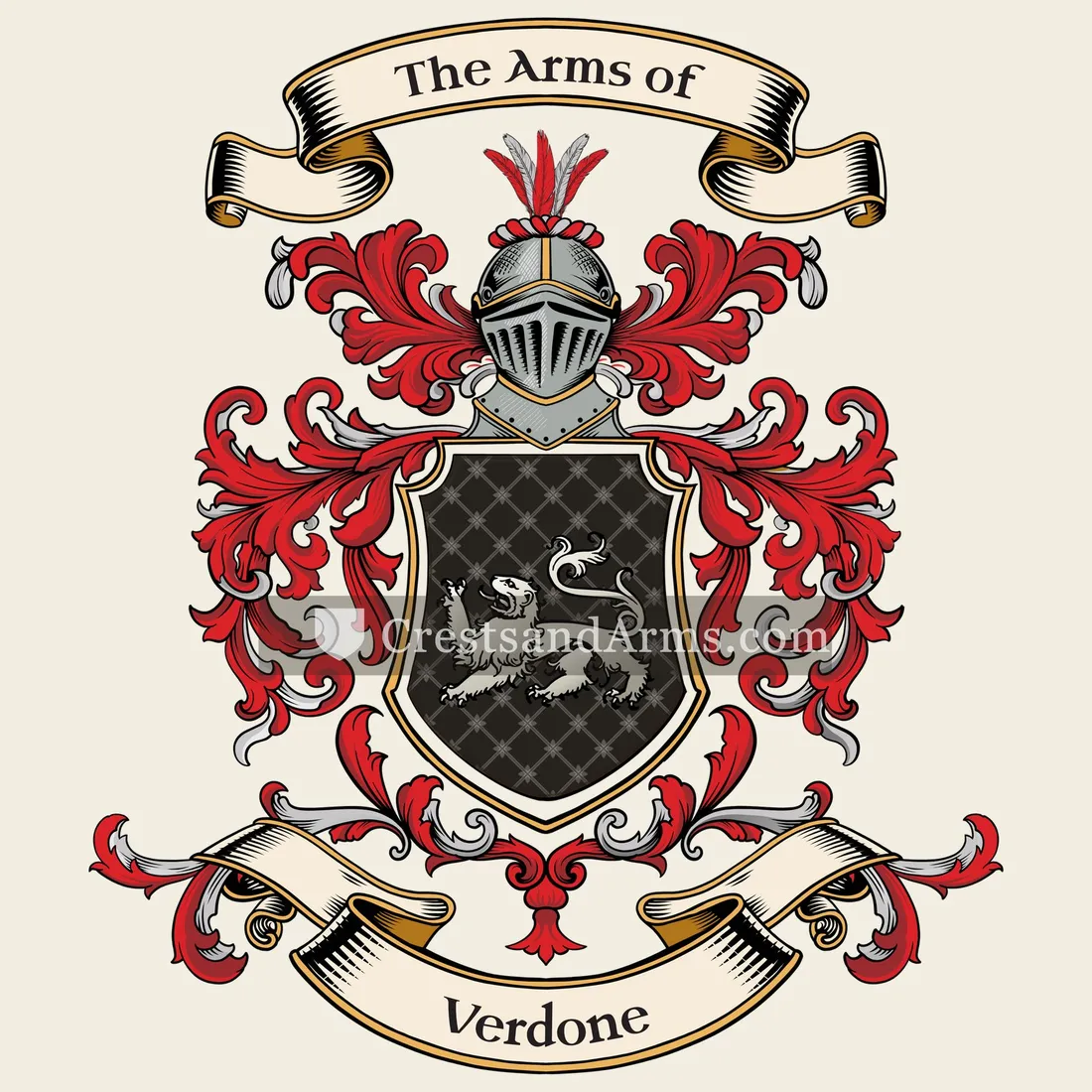
lionCourage, strength and royalty
Colours
Black (Sable)Means: Constancy
Silver (Argent)Means: Peace and sincerity
Historical info
Source
Sir Bernard Burke, The General Armory of England, Scotland, Ireland and Wales, London: Harrison & Sons, 1884
Blazon (the actual original written record)
“Sa. a lion pass. ar”
NorthumberlandNorthumberland, c. 1620
Digital archive packCoat of arms PNG, gold border print PDF, vector SVG and the certificate of authenticity. Sent to your email in minutes.
Map of England showing where the Verdone arms are recorded
The Verdone arms were recorded in Northumberland, c. 1620.
Northumberland was border country facing Scotland, raided and fought over for three hundred years. Families held their land in return for defending it, and a defending household carried a shield.
This is where the arms were entered in the register. Families often moved to other parts of the country, so the same name can turn up in more than one region.
The body that granted and recorded arms in England in this period.
James VI and I
Sovereign of the period
James VI and I
1603–1625
Reigning in Switzerland when the Verdone arms are first recorded.
How Arms Worked in England
English heraldry allowed arms to be shared by all legitimate descendants of the original owner. These symbols were treated as personal property that moved through the generations to all children. While the eldest son kept the original design, other family members could use the same shield without needing to change it or register their own unique versions.
Granting authority
The College of Arms in London has regulated the use of coats of arms throughout England and Wales since 1484.
How they got arms
Families typically obtained their coats of arms through a formal grant from the Crown or by proving their ancient right to them.
Where arms were recorded
All official coats of arms are recorded in the registers kept at the College of Arms, which date back to the fifteenth century.
The family's standing
Recorded among the armigerous families of Northumberland.
Origin & History of the Verdone Family in England
The family name Verdone has roots that trace back to the rugged landscapes of Northumberland, where members of the family were documented as early as 1620. During this period, the northern border regions of England were defined by a unique social structure and a focus on local land management. Families living in this area often played a vital role in the agricultural and defensive life of the countryside. Because Northumberland served as a buffer zone between England and Scotland, the people who lived there developed a strong sense of community and resilience. The presence of the Verdone name in these historical records suggests that the family was well-established within the local parish systems of the seventeenth century. By participating in the daily life of the northern counties, these early ancestors helped shape the regional identity that defined the borderlands during the Stuart era.
Meaning of the Verdone family crest colors & symbols
Symbols on this shield
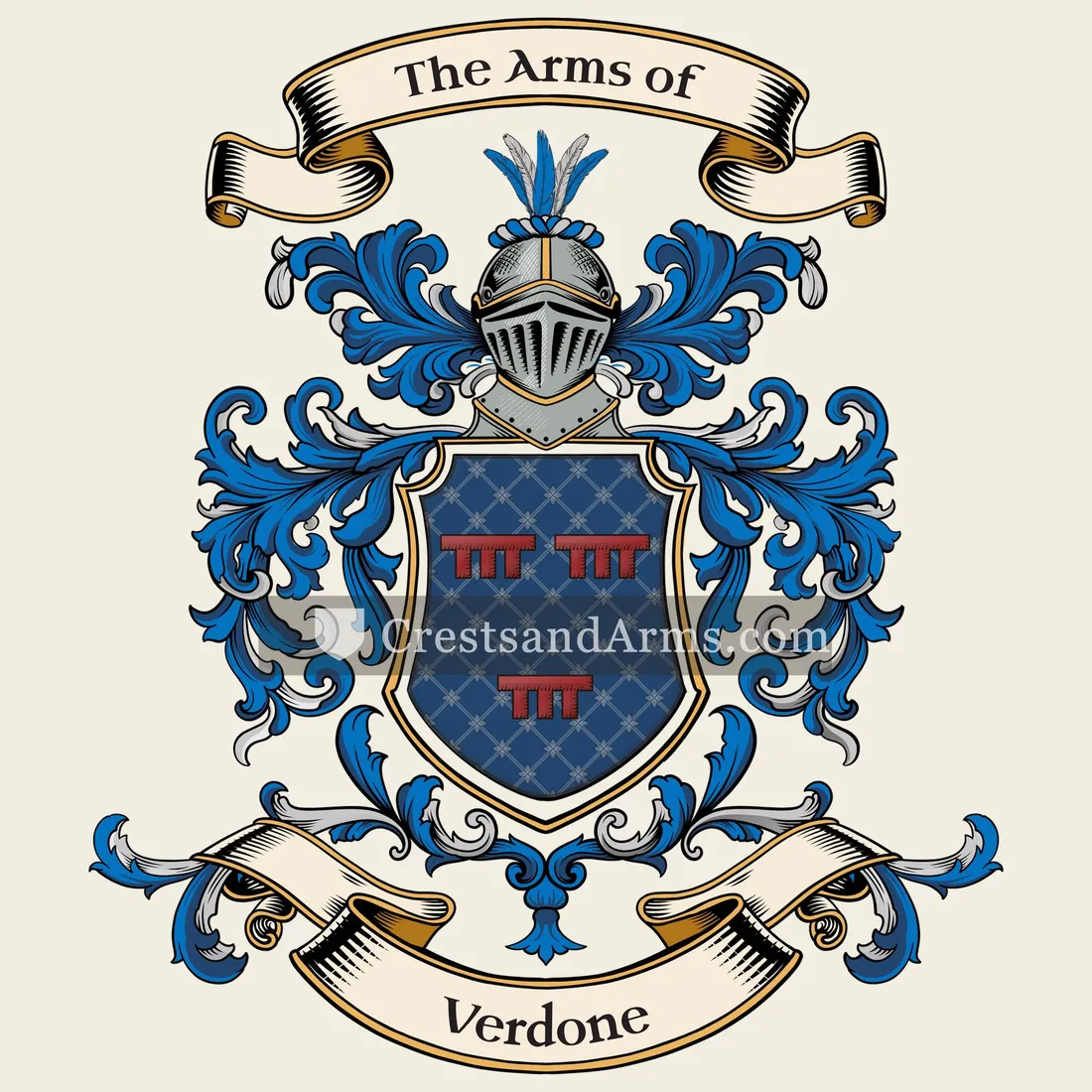
labelThe eldest son, during his father's life
Colours
Blue (Azure)Means: Loyalty and truth
Red (Gules)Means: Military strength
Historical info
Source
Sir Bernard Burke, The General Armory of England, Scotland, Ireland and Wales, London: Harrison & Sons, 1884
Blazon (the actual original written record)
“Az. fretty or, a label of three points gu”
DublinDublin, c. 1595
Digital archive packCoat of arms PNG, gold border print PDF, vector SVG and the certificate of authenticity. Sent to your email in minutes.
Map of Ireland showing where the Verdone arms are recorded
The Verdone arms were recorded in Dublin, c. 1595.
Dublin was the seat of government in Ireland and the place where grants were sought and recorded. Families with business at the castle or the courts settled nearby, and settling there put their arms on record.
This is where the arms were entered in the register. Families often moved to other parts of the country, so the same name can turn up in more than one region.
The body that granted and recorded arms in Ireland in this period.
Elizabeth I of England
Sovereign of the period
Elizabeth I of England
1558–1603
Reigning in Switzerland when the Verdone arms are first recorded.
How Arms Worked in Ireland
The Ulster King of Arms granted coats of arms to individuals who proved their social standing and good character. These symbols were typically inherited by all legitimate descendants of the original holder. If a family branch wanted a unique look, they could apply for a specific change to their design through the office to ensure their identity remained distinct.
Granting authority
The Ulster King of Arms acted as the official body that regulated and issued all coats of arms throughout Ireland.
How they got arms
Families obtained their arms through formal grants issued by the office after proving their eligibility and paying the required fees.
Where arms were recorded
All official grants were recorded in the registers held by the Ulster King of Arms starting from the year 1552.
The family's standing
Recorded among the armigerous families of Dublin.
Origin & History of the Verdone Family in Ireland
The Verdone family name first appears in the historical record of Dublin during the late sixteenth century, specifically around 1595. At this time, the city was a bustling center of trade and administration under English influence, and families like the Verdones were often part of the emerging urban middle class. While the name itself has roots that suggest a connection to the Italian word for green, its presence in Ireland indicates that the family likely integrated into the local merchant or professional communities of the Pale. These early members lived during a period of significant political tension, as the city served as a gateway for continental European influences and shifting loyalties. By establishing themselves in Dublin, the family became part of the complex social fabric of a city that was rapidly changing from a medieval stronghold into a modern colonial capital.
Verdone Meaning & Related Branches
Root word
viridis
Latin term meaning green or flourishing
This name
VerdoneDerived from a nickname for someone associated with the color green or fresh vegetation
also spelled
Verdoun
Verdonne
Verdun
Documented Sources
J. B. Rietstap, Armorial Général, Gouda: G. B. van Goor Zonen, 1884–87
Archives d'État de Genève, Registres paroissiaux et d'état civil
Baud, Henri, Le Genevois: de l'Antiquité à nos jours, 1985
Gautier, Adolphe, Les origines de la famille genevoise, 1874
Digital archive packCoat of arms PNG, gold border print PDF, vector SVG and the certificate of authenticity. Sent to your email in minutes.


 lionCourage, strength and royalty
 lionCourage, strength and royalty



 labelThe eldest son, during his father's life