Map of France showing where the Versailles arms are recorded
The Versailles arms were recorded in Ile-de-France, c. 1663.
Ile-de-France is the country around Paris, and proximity to the court mattered. Families who served the crown were rewarded with land near it, and land near the capital carried arms almost as a matter of course.
This is where the arms were entered in the register. Families often moved to other parts of the country, so the same name can turn up in more than one region.
The body that granted and recorded arms in France in this period.
Louis XIV of France
Sovereign of the period
Louis XIV of France
1643–1715
Reigning in France when the Versailles arms are first recorded.
How Arms Worked in France
In France, a coat of arms was a mark of honor that passed down through the male line to all legitimate descendants. Families often used the same shield without changes to show their shared heritage. If a branch wanted to stand out, they could add a small mark to their shield to show their specific place in the family tree.
Granting authority
The Juge d'armes de France acted as the official authority that regulated and verified coats of arms across the country.
How they got arms
Families typically inherited their arms from ancestors, though they could also receive them through royal grants or by proving their noble status.
Where arms were recorded
Coats of arms were officially recorded in the Armorial Général de France, which began its main collection in the year 1696.
The family's standing
Recorded among the armigerous families of Ile-de-France.
Origin & History of the Versailles Family in France
The family name Versailles originates from the historic region of the Île-de-France, where the name became tied to the local landscape long before the area was transformed by royal construction. By 1663, records indicate that members of the family were already established within this territory, living among the rural communities that predated the massive expansion of the nearby palace. The name itself is derived from the Latin word *versare*, which describes a place where the earth has been turned or plowed. This suggests that the earliest ancestors of the family were likely farmers or landholders who worked the soil in the fertile plains surrounding Paris. As the French monarchy began to centralize power in the region during the seventeenth century, the family remained part of the local fabric, witnessing the rapid transition of their home from a quiet provincial setting into the center of European political life.
Versailles Meaning & Related Branches
Root word
versare
Latin verb meaning to turn, rotate, or plow repeatedly.
This name
VersaillesRefers to a location with turned earth, likely indicating a place that was plowed or cleared.
also spelled
Versail
Versay
Documented Sources
J. B. Rietstap, Armorial Général, Gouda: G. B. van Goor Zonen, 1884–87
Boutier, Jean, Dewerpe, Alain, and Nord, David, Un village sous l'Ancien Régime: La vie quotidienne à Versailles, 1984
Archives nationales de France, Minutier central des notaires de Paris, Series Y
Digital archive packCoat of arms PNG, gold border print PDF, vector SVG and the certificate of authenticity. Sent to your email in minutes.


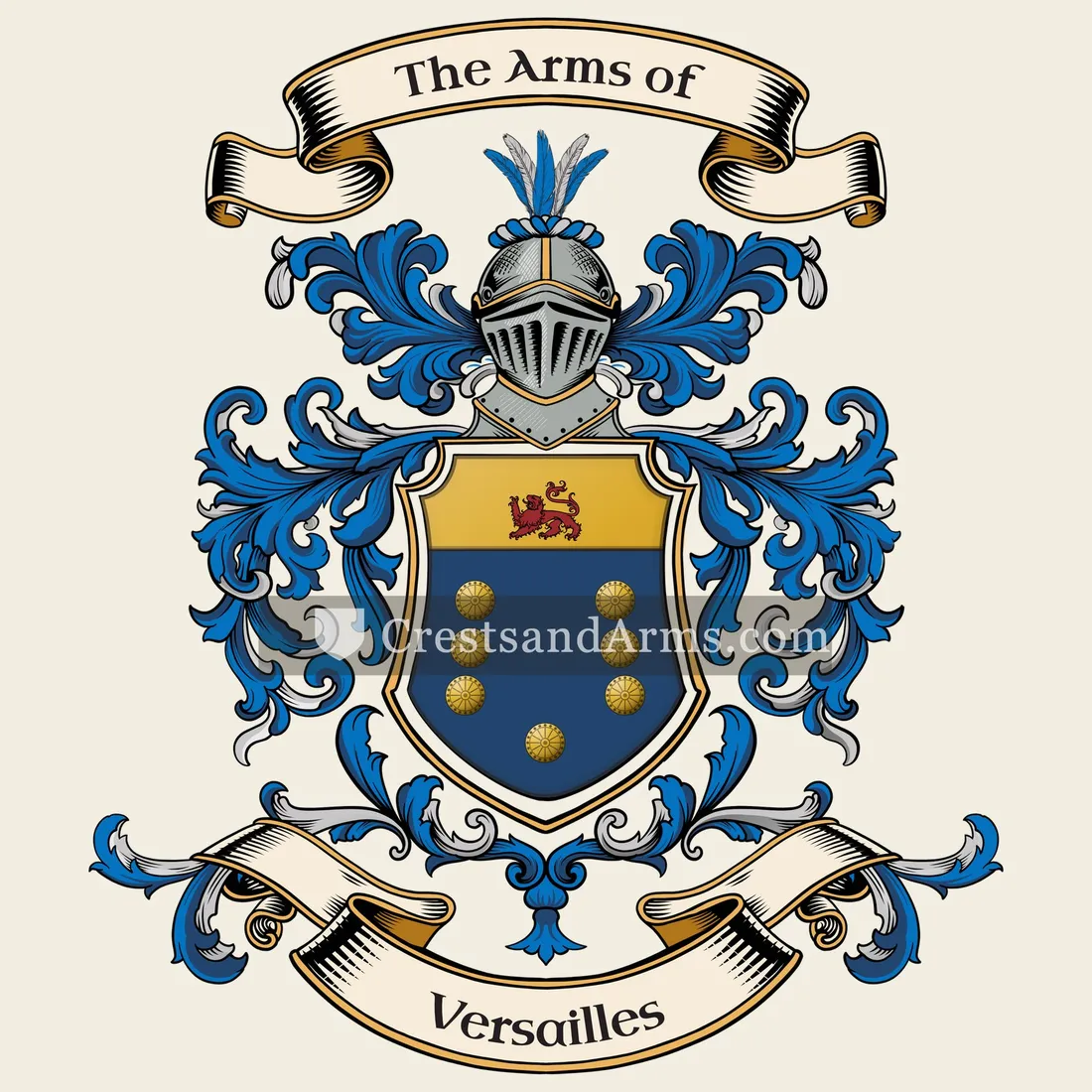
 chiefAuthority, wisdom and dominion
 roundelA coin, and one who has been to the crusades
 lionCourage, strength and royalty
 chiefAuthority, wisdom and dominion
 roundelA coin, and one who has been to the crusades
 lionCourage, strength and royalty