Map of Italy showing where the Vescio arms are recorded
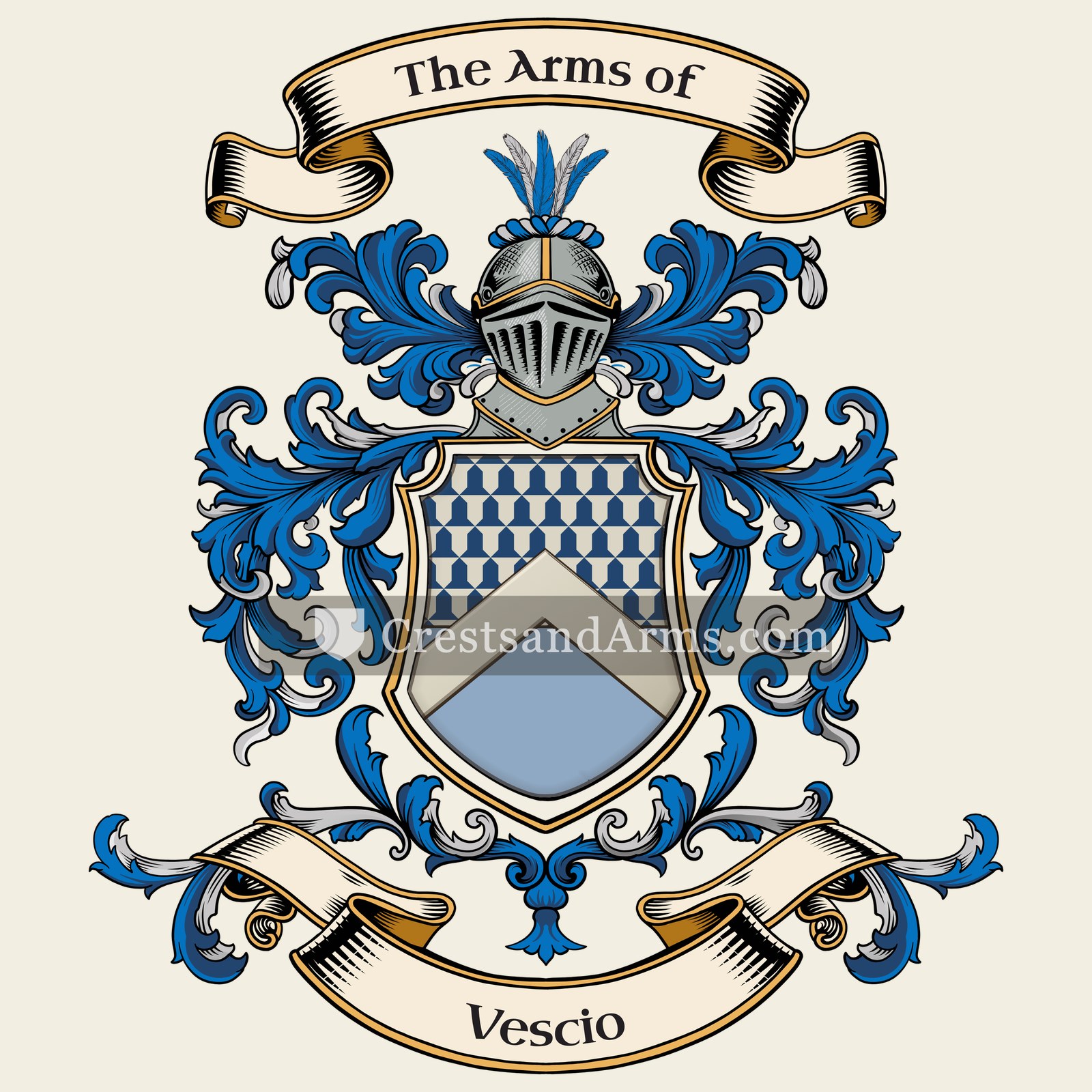
The Vescio arms were recorded in Italy, c. 1775.
Arms such as these were typically recorded in Venice.
Venice ran on trade, and its great families were merchants before they were anything else. The city kept a formal list of its noble houses, and a name on that list carried arms as a matter of record.
This is where the arms were entered in the register. Families often moved to other parts of the country, so the same name can turn up in more than one region.
The body that granted and recorded arms in Italy in this period.
Alvise Giovanni Mocenigo
Sovereign of the period
Alvise Giovanni Mocenigo
1763–1778
Reigning in Italy when the Vescio arms are first recorded.
How Arms Worked in Italy
In the Italian states, coats of arms were often used by noble families to show their status and history. These symbols were passed down through the generations to all legitimate male descendants. Younger branches of a family usually kept the original design but sometimes added small changes to distinguish their specific line from the main branch.
Granting authority
Various local rulers and city governments controlled the use of coats of arms across the different Italian states.
How they got arms
Families often assumed their own arms or received them as official grants from local lords, popes, or city councils.
Where arms were recorded
Arms were recorded in local city archives or private family books rather than in one single national register.
The family's standing
Recorded among the armigerous families of Italy.
Origin & History of the Vescio Family in Italy
The Vescio family name is deeply rooted in the historical landscape of Italy, with documented evidence placing members of the family in Venice by 1775. During this period, Venice was a bustling center of trade, art, and political influence, serving as a gateway between Western Europe and the Mediterranean. Families living in the city at that time often participated in the complex social structures of the Venetian Republic, which relied heavily on maritime commerce and skilled craftsmanship. The name itself is believed to be linked to the Italian word for bishop, suggesting that early ancestors may have held roles within the church or served in administrative positions for local religious institutions. As the family established itself in the region, they became part of the vibrant urban culture that defined late eighteenth-century Venice. By integrating into the life of the city, the Vescio family contributed to the long-standing traditions and the unique historical identity of the Venetian people.
Vescio Meaning & Related Branches
Root word
Vescovo
An ecclesiastical official or high-ranking church leader.
This name
VescioA nickname or occupational surname referring to someone who served a bishop.
also spelled
Vyechio
Viechyo
Vekyo
Veechyo
Documented Sources
J. B. Rietstap, Armorial Général, Gouda: G. B. van Goor Zonen, 1884–87
Archivio di Stato di Venezia, Anagrafe di Venezia, Sezione XVIII
Cessi, Roberto, Storia della Repubblica di Venezia, 1944
Lane, Frederic C., Venice, A Maritime Republic, 1973
Digital archive packCoat of arms PNG, gold border print PDF, vector SVG and the certificate of authenticity. Sent to your email in minutes.


 chevronProtection, and faithful service completed
 chevronProtection, and faithful service completed