Map of Spain showing where the Villanueva arms are recorded
The Villanueva arms were recorded in Castile, c. 1722.
Castile was the heart of Spain and the source of most of its noble families. Land won in the long wars against the Moors was granted out to fighting men, and a man granted land was granted arms along with it.
This is where the arms were entered in the register. Families often moved to other parts of the country, so the same name can turn up in more than one region.
The body that granted and recorded arms in Spain in this period.
Philip V of Spain
Sovereign of the period
Philip V of Spain
1714–1724
Reigning in Spain when the Villanueva arms are first recorded.
How Arms Worked in Spain
In Spain, a coat of arms was considered a form of property that belonged to the entire family line. These arms were passed down from a father to all his children equally. Younger branches of the family usually kept the original design without needing to add any special marks to distinguish their specific line.
Granting authority
The Cronista Rey de Armas was the official body that regulated and granted coats of arms throughout Spain.
How they got arms
Families often obtained their arms through royal grants or by proving their noble status to the official heraldic authority.
Where arms were recorded
Coats of arms were officially recorded in the registers of the Cronista Rey de Armas starting in 1496.
The family's standing
Recorded among the armigerous families of Castile.
Origin & History of the Villanueva Family in Spain
The surname Villanueva is a topographic name that originated in the medieval period of the Iberian Peninsula. It is derived from the Spanish words "villa," meaning a town or settlement, and "nueva," meaning new. This name was typically given to individuals who lived in or founded a newly established village, which was a common occurrence during the centuries of the Reconquista as populations moved into reclaimed lands. By the early 18th century, the family had firmly established roots in the region of Castile. During this era, the social structure of Castile relied heavily on land ownership and local administrative roles, and families like the Villanuevas often participated in the agricultural and civic development of their local parishes. Their presence in 1722 reflects a period of stability in central Spain where families were increasingly documented in local church registers and municipal records as they solidified their place within the community.
Villanueva Meaning & Related Branches
Root word
Villa Nova
Latin for new estate or new settlement.
This name
VillanuevaRefers to someone who lived in a newly established town or village.
also spelled
Vilanueva
Documented Sources
J. B. Rietstap, Armorial Général, Gouda: G. B. van Goor Zonen, 1884–87
Moll, Francesc de B., Els llinatges catalans, 1959
Pescador del Hoyo, María del Carmen, Apellidos en España, 1996


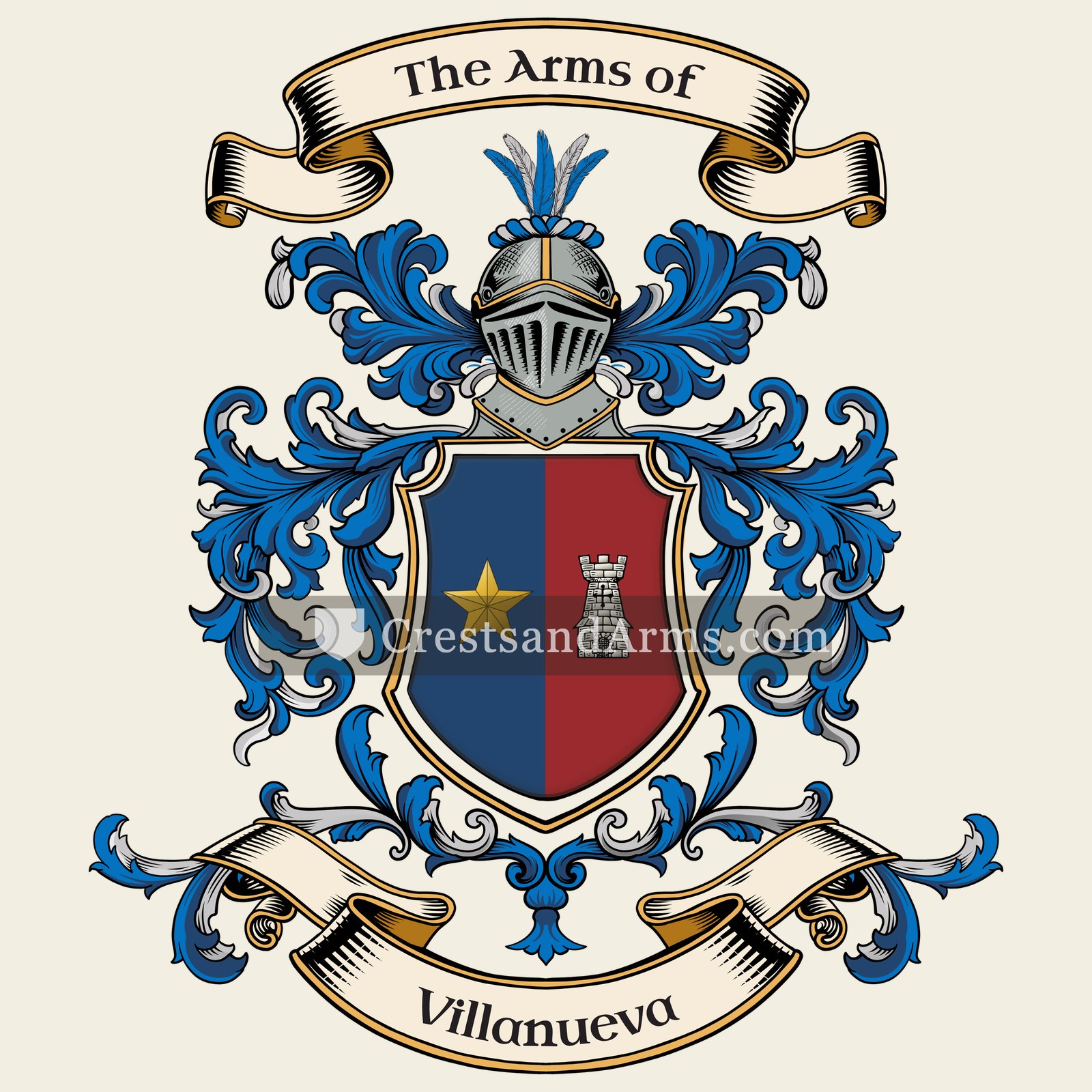
 mulletThe third son, and a divine quality from above
 towerGrandeur and solidity, and a stronghold defended
 mulletThe third son, and a divine quality from above
 towerGrandeur and solidity, and a stronghold defended