A record of documented arms, meaning and origin, researched for the Villaseca family lines. Documented in 2 countries.
Reg. 4658 · Spanish, W–Z
Coat of Arms & Family Crest Details
Symbols on this shield
towerGrandeur and solidity, and a stronghold defended
Colours
Green (Vert)Means: Hope
Gold (Or)Means: Generosity
Silver (Argent)Means: Peace and sincerity
Historical info
Source
J. B. Rietstap, Armorial Général, Gouda: G. B. van Goor Zonen, 1884–87
Blazon (the actual original written record)
“De sin. à un mur crén. d'arg., maçonné de sa., en p., sommé d'une main sen. appaumée de carn., tenant une banderole d'or flottant à sen. et faisant retour à dextre; à la bord. d'or, ch. de cinq chainons brisés d'azur, 2 en chef, 2 en flancs et 1 en p.”
AndalusiaAndalusia, c. 1722
Digital archive packCoat of arms PNG, gold border print PDF, vector SVG and the certificate of authenticity. Sent to your email in minutes.
Map of Spain showing where the Villaseca arms are recorded
The Villaseca arms were recorded in Andalusia, c. 1722.
Andalusia was the last part of Spain taken back from the Moors, and the land was shared out among the men who took it. A grant of land came with a grant of arms, so the region produced a great many.
This is where the arms were entered in the register. Families often moved to other parts of the country, so the same name can turn up in more than one region.
The body that granted and recorded arms in Spain in this period.
Philip V of Spain
Sovereign of the period
Philip V of Spain
1714–1724
Reigning in Spain when the Villaseca arms are first recorded.
How Arms Worked in Spain
In Spain, a coat of arms was considered a form of property that belonged to the entire family line. These arms were passed down from a father to all his children equally. Younger branches of the family usually kept the original design without needing to add any special marks to distinguish their specific line.
Granting authority
The Cronista Rey de Armas was the official body that regulated and granted coats of arms throughout Spain.
How they got arms
Families often obtained their arms through royal grants or by proving their noble status to the official heraldic authority.
Where arms were recorded
Coats of arms were officially recorded in the registers of the Cronista Rey de Armas starting in 1496.
The family's standing
Recorded among the armigerous families of Andalusia.
Origin & History of the Villaseca Family in Spain
The surname Villaseca originates from the Spanish language and translates literally to "dry town" or "dry village." This name likely began as a topographic descriptor, used to identify families who lived in or hailed from a specific rural settlement characterized by arid land. By the early 18th century, the family had established a notable presence in the Andalusia region of southern Spain. During this era, Andalusia was a hub of agricultural activity and colonial trade, providing a stable environment for families to grow and integrate into local society. The name reflects the deep connection between Spanish surnames and the geography of the Iberian Peninsula, serving as a permanent link to the specific landscapes where these ancestors first settled and built their lives.
Coat of Arms & Family Crest Details
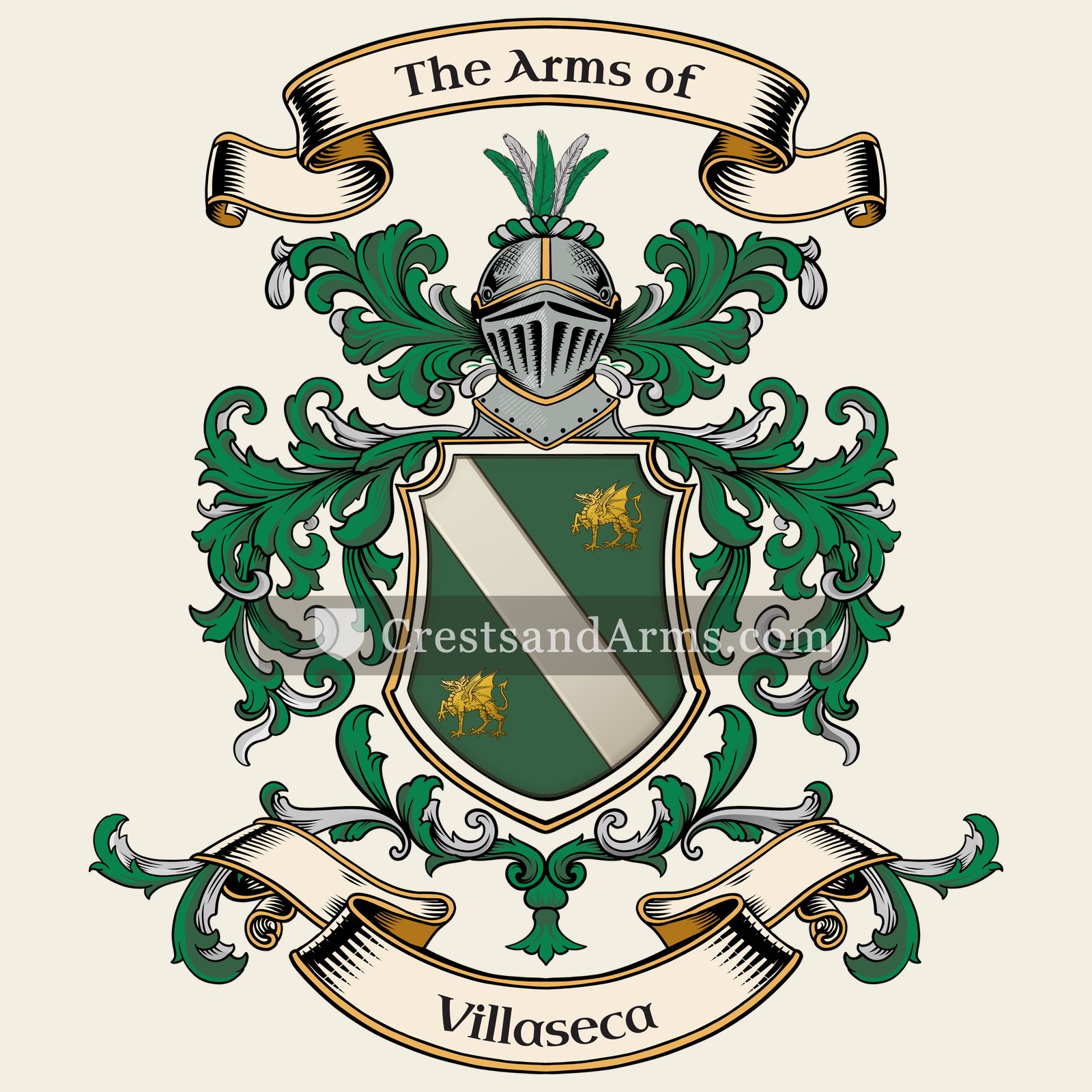
Symbols on this shield
bendDefence, and the scarf of a commander
dragonA most valiant defender of treasure
Colours
Green (Vert)Means: Hope
Silver (Argent)Means: Peace and sincerity
Gold (Or)Means: Generosity
Historical info
Source
J. B. Rietstap, Armorial Général, Gouda: G. B. van Goor Zonen, 1884–87
Blazon (the actual original written record)
“De sin. à la bande ondée d'arg., engoulée de deux têtes de dragon d'or. Trois cq. cour. C.: 1º trois pl. d'aut., une de sin. entre deux d'arg.; 2º un griffon iss. d'or; 3º trois pl. d'aut., une de sin. entre deux d'or. L.: à dextre d'arg. et de sin., à sen. d'or et de sin. D.: AVE MARIA.”
Austriac. 1844
Digital archive packCoat of arms PNG, gold border print PDF, vector SVG and the certificate of authenticity. Sent to your email in minutes.
Map of Austria showing where the Villaseca arms are recorded
The Villaseca arms were recorded in Austria, c. 1844.
Arms such as these were typically recorded in Tyrol.
Tyrol was mountain country in western Austria, where the valleys were held by families who had been there a very long time. Old tenure counted for more than money, and old families carried arms.
This is where the arms were entered in the register. Families often moved to other parts of the country, so the same name can turn up in more than one region.
Region
Tyrol
First recorded
1844
Granting Authority for the Villaseca Arms
Imperial and Royal chancery
Sodacan · CC BY-SA 3.0
The body that granted and recorded arms in Austria in this period.
Ferdinand I of Austria
Sovereign of the period
Ferdinand I of Austria
1835–1848
Reigning in Spain when the Villaseca arms are first recorded.
How Arms Worked in Austria
Austrian coats of arms were often linked directly to noble titles granted by the Emperor. These symbols belonged to the entire family line rather than just one individual. When a family grew, new branches kept the original design without needing to change it. This system allowed all members of a noble house to share the same identity across many generations.
Granting authority
The Imperial and Royal chancery managed all heraldic matters and controlled the official granting of arms throughout the Austrian lands.
How they got arms
Families typically received their arms through a formal imperial decree that often accompanied the elevation of a person to noble status.
Where arms were recorded
Official records of these grants were kept in the Imperial Register of Nobility which began its formal documentation process in 1453.
The family's standing
Recorded among the armigerous families of Austria.
Origin & History of the Villaseca Family in Austria
The family name Villaseca is rooted in the Spanish language, meaning dry town or dry villa, yet its presence in the Austrian region of Tyrol by 1844 reveals a fascinating story of migration and adaptation. During the nineteenth century, the Austro-Hungarian Empire served as a crossroads for travelers, merchants, and officials moving across the continent. When members of the Villaseca family settled in the mountainous landscape of Tyrol, they likely integrated into the local administrative or mercantile structures that defined the region at the time. Because Tyrol was a vital link between the Italian states and the German-speaking lands, families with Mediterranean origins often found roles as intermediaries in trade or governance. By the mid-1800s, these early settlers had established a foothold in the local community, transitioning from their ancestral roots to become part of the diverse social fabric of the Alpine provinces. This movement highlights how families during this era navigated the shifting borders and cultural exchanges that shaped modern Central Europe.
Related Branches & Arms
Root word
Villa and Seca
Latin villa meaning country house and siccus meaning dry or arid.
This name
VillasecaRefers to a settlement or estate located on dry, barren, or uncultivated land.
also spelled
Vilaseca
Related arms
Vilasecavariant spelling
Documented Sources
J. B. Rietstap, Armorial Général, Gouda: G. B. van Goor Zonen, 1884–87
Moll, Francesc de B., Els llinatges catalans: Catalunya, País Valencià, Illes Balears, 1959
Pescador del Hoyo, María del Carmen, Apellidos en España, 1996
Archivo General de Andalucía, Sección de Protocolos Notariales, 1722
Digital archive packCoat of arms PNG, gold border print PDF, vector SVG and the certificate of authenticity. Sent to your email in minutes.


 towerGrandeur and solidity, and a stronghold defended
 towerGrandeur and solidity, and a stronghold defended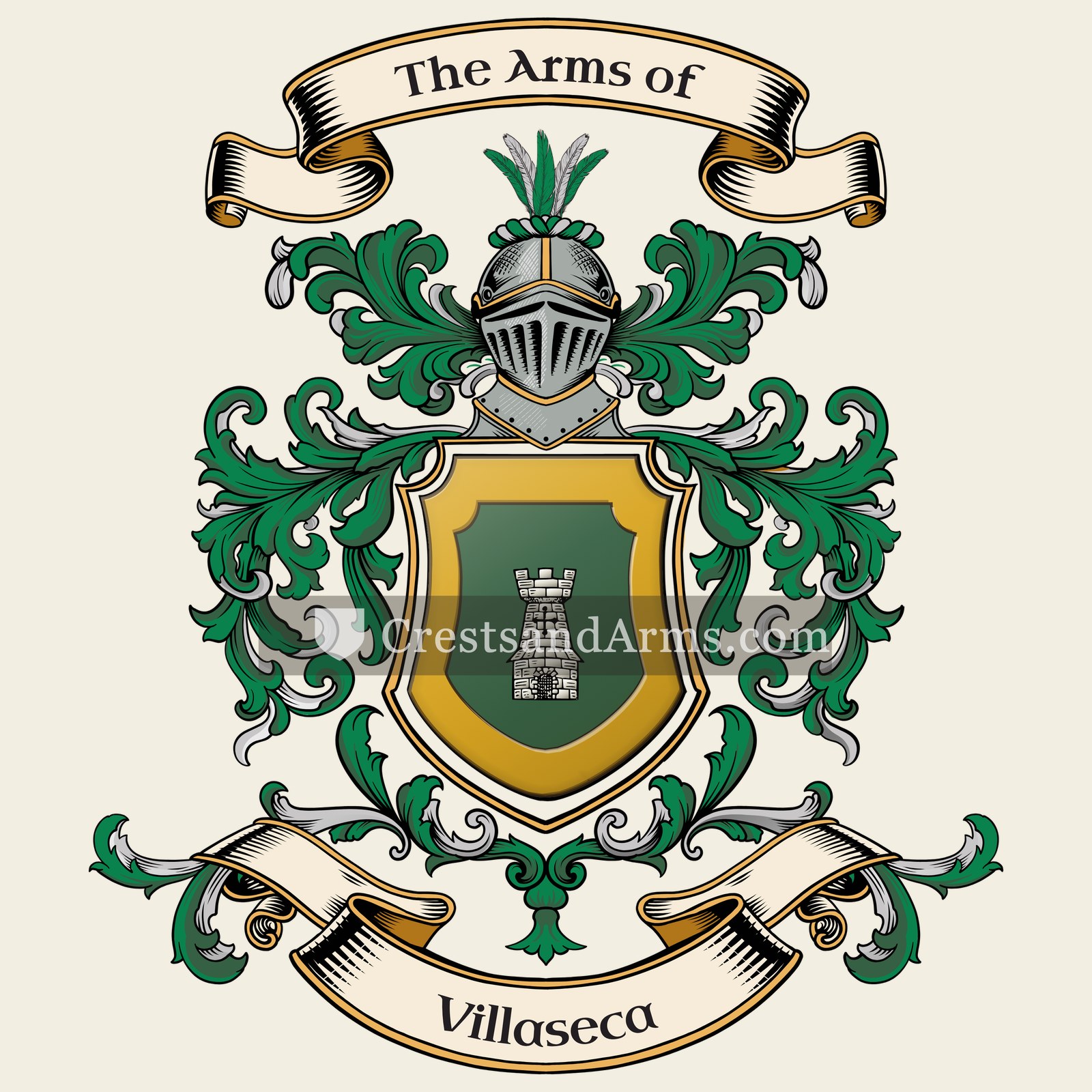


 bendDefence, and the scarf of a commander
 dragonA most valiant defender of treasure