Map of France showing where the Vogler arms are recorded
The Vogler arms were recorded in Strasbourg, c. 1663.
This is where the arms were entered in the register. Families often moved to other parts of the country, so the same name can turn up in more than one region.
The body that granted and recorded arms in France in this period.
Louis XIV of France
Sovereign of the period
Louis XIV of France
1643–1715
Reigning in France when the Vogler arms are first recorded.
How Arms Worked in France
In France, a coat of arms was a mark of honor that passed down through the male line to all legitimate descendants. Families often used the same shield without changes to show their shared heritage. If a branch wanted to stand out, they could add a small mark to their shield to show their specific place in the family tree.
Granting authority
The Juge d'armes de France acted as the official authority that regulated and verified coats of arms across the country.
How they got arms
Families typically inherited their arms from ancestors, though they could also receive them through royal grants or by proving their noble status.
Where arms were recorded
Coats of arms were officially recorded in the Armorial Général de France, which began its main collection in the year 1696.
The family's standing
Recorded among the armigerous families of France.
Origin & History of the Vogler Family in France
The family name Vogler has deep roots in the Alsace region, a territory that has long served as a cultural bridge between France and Germany. By 1663, records confirm that members of the Vogler family were well-established residents of Strasbourg. During this period, the city was a vibrant center of trade and intellectual life, placing the family at the heart of a region undergoing significant political shifts. The name itself is derived from the Middle High German word for a bird catcher or a fowler, suggesting that the family’s earliest ancestors likely held occupations related to hunting or wildlife management. As residents of a major urban hub, the Voglers were part of a diverse community of craftsmen and merchants who helped shape the unique identity of the Alsatian people. Their presence in Strasbourg during the seventeenth century reflects a time when families were deeply tied to the local guilds and the daily commerce of the city.
Coat of Arms & Family Crest Details
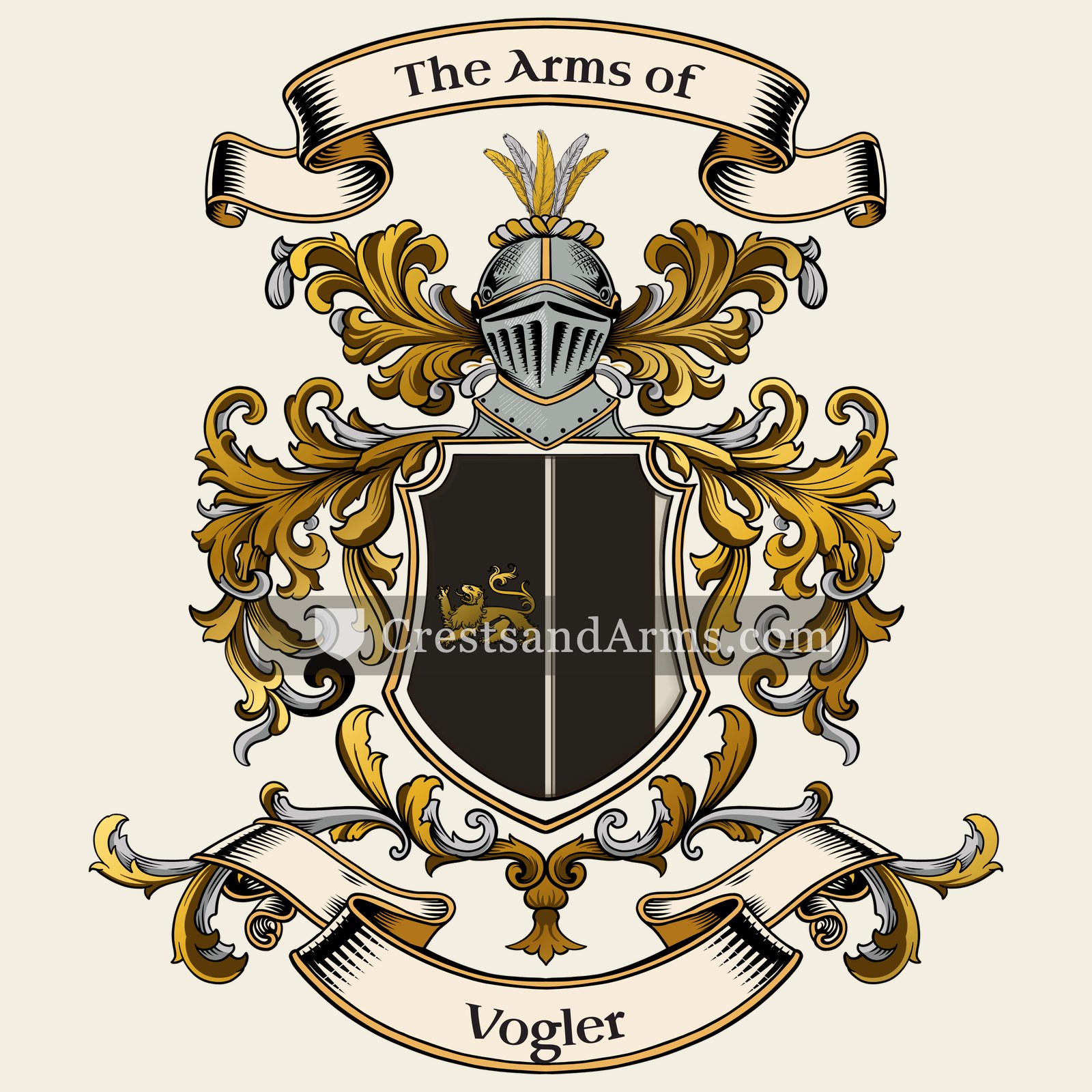
Symbols on this shield
paleMilitary strength, and a fortified defence
lionCourage, strength and royalty
Colours
Black (Sable)Means: Constancy
Silver (Argent)Means: Peace and sincerity
Gold (Or)Means: Generosity
Historical info
Source
J. B. Rietstap, Armorial Général, Gouda: G. B. van Goor Zonen, 1884–87
Blazon (the actual original written record)
“Parti: au 1 de sa. au lion d'or; au 2 coupé d'arg. sur sa., au pal de l'un en l'autre. Cq. cour. C.: un lion d'or, assis de front, orné de chaque côté de trois pl. d'aut., une d'or entre deux d'arg., enfoncées dans sa tête, ses épaules et ses flancs. L.: d'arg. et de sa.”
FranconiaFranconia, c. 1765
Digital archive packCoat of arms PNG, gold border print PDF, vector SVG and the certificate of authenticity. Sent to your email in minutes.
Map of Germany showing where the Vogler arms are recorded
The Vogler arms were recorded in Franconia, c. 1765.
Franconia was a patchwork of small territories in central Germany, full of minor landowners and prosperous market towns. So many separate households held land there that the region produced a great many coats of arms.
This is where the arms were entered in the register. Families often moved to other parts of the country, so the same name can turn up in more than one region.
The body that granted and recorded arms in Germany in this period.
Francis I, Holy Roman Emperor
Sovereign of the period
Francis I, Holy Roman Emperor
1745–1765
Reigning in France when the Vogler arms are first recorded.
How Arms Worked in Germany
In the Holy Roman Empire, coats of arms were often granted to individuals by the Emperor or his representatives. These arms were then passed down through the generations to all legitimate descendants of the original holder. Younger branches of a family usually kept the same shield design without needing to change it, as the arms belonged to the entire lineage.
Granting authority
The Holy Roman Emperor held the sole power to grant new coats of arms throughout his vast imperial territories.
How they got arms
Families typically obtained their coats of arms through a formal imperial grant or by proving their noble status to the authorities.
Where arms were recorded
These grants were officially recorded in the Imperial Chancery registers, which began keeping formal records of such honors during the Middle Ages.
The family's standing
Recorded among the armigerous families of Franconia.
Origin & History of the Vogler Family in Germany
The surname Vogler is a classic example of a German occupational name that emerged during the Middle Ages. It is derived from the Middle High German word *vogelaere*, which translates to a bird catcher or a fowler. In a time when wild game was a vital source of food and feathers were highly valued for bedding and writing quills, the person responsible for trapping birds held a distinct and necessary role in the community. By the time records place the family in the Franconia region in 1765, the name had long transitioned from a description of a trade into a stable hereditary surname. Families bearing this name were typically integrated into the rural social structure of southern Germany, where they lived as farmers, craftsmen, or tradespeople. The history of the Vogler name reflects the practical way that medieval society identified individuals based on their daily contributions to the local economy.
Related Branches & Arms
Root word
Vogel
A Germanic term referring to a bird.
This name
VoglerAn occupational surname for a bird catcher or someone who kept birds.
also spelled
Vogeler
Related arms
Vogelervariant spelling
Documented Sources
J. B. Rietstap, Armorial Général, Gouda: G. B. van Goor Zonen, 1884–87
Archives de la Ville et de l'Eurométropole de Strasbourg, Registres paroissiaux et d'état civil
Himly, François-Jacques, Chronologie de la Basse-Alsace, 1972
Livet, Georges, Histoire de Strasbourg des origines à nos jours, 1980
Digital archive packCoat of arms PNG, gold border print PDF, vector SVG and the certificate of authenticity. Sent to your email in minutes.


 mountThe ground held, and steadfastness upon it
 falconOne eager and quick in pursuit
 mountThe ground held, and steadfastness upon it
 falconOne eager and quick in pursuit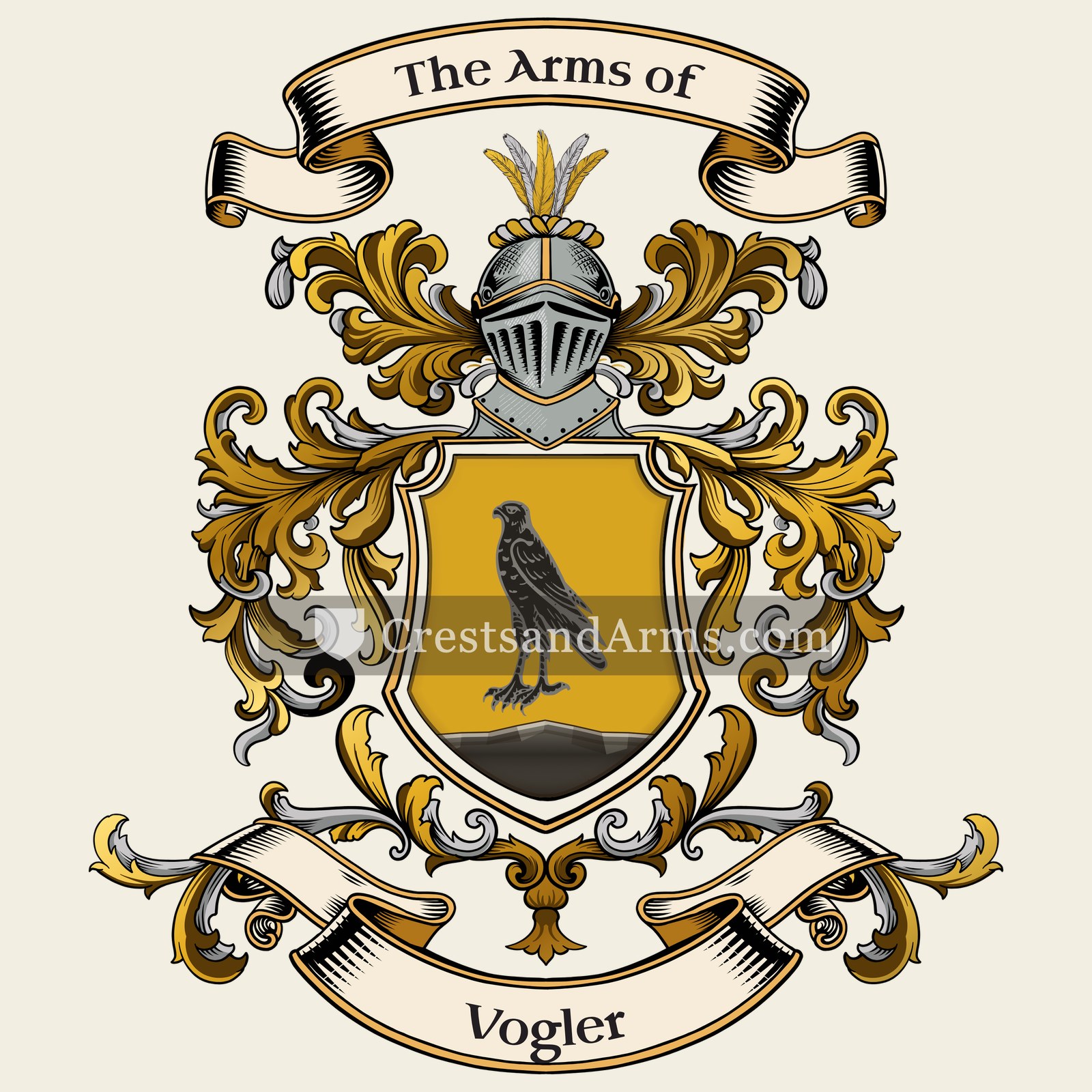


 paleMilitary strength, and a fortified defence
 lionCourage, strength and royalty