Map of Germany showing where the von Essen arms are recorded
The von Essen arms were recorded in Francfort s, c. 1767.
This is where the arms were entered in the register. Families often moved to other parts of the country, so the same name can turn up in more than one region.
The body that granted and recorded arms in Germany in this period.
Joseph II, Holy Roman Emperor
Sovereign of the period
Joseph II, Holy Roman Emperor
1765–1790
Reigning in Germany when the von Essen arms are first recorded.
How Arms Worked in Germany
In the Holy Roman Empire, coats of arms were often granted to individuals by the Emperor or his representatives. These arms were then passed down through the generations to all legitimate descendants of the original holder. Younger branches of a family usually kept the same shield design without needing to change it, as the arms belonged to the entire lineage.
Granting authority
The Holy Roman Emperor held the sole power to grant new coats of arms throughout his vast imperial territories.
How they got arms
Families typically obtained their coats of arms through a formal imperial grant or by proving their noble status to the authorities.
Where arms were recorded
These grants were officially recorded in the Imperial Chancery registers, which began keeping formal records of such honors during the Middle Ages.
The family's standing
Recorded among the armigerous families of Germany.
Origin & History of the von Essen Family in Germany
The family name von Essen emerged from the German tradition of identifying individuals by their place of origin. During the Middle Ages, people often adopted the name of their hometown to distinguish themselves from others in a growing society. In this case, the name indicates that the earliest ancestors likely hailed from the city of Essen in the Ruhr region of Germany. By the eighteenth century, the family had established a presence in the bustling trade hub of Frankfurt. Records confirm that family members were living in Frankfurt as early as 1767, a time when the city served as a vital center for commerce and banking in the Holy Roman Empire. As the family moved across German lands, they integrated into the social and professional structures of these urban centers, transitioning from their roots in the west to become part of the vibrant middle class in central Germany.
Coat of Arms & Family Crest Details
Symbols on this shield
owlWisdom and vigilance by night
treeLife, endurance and deep roots
Colours
Blue (Azure)Means: Loyalty and truth
Historical info
Source
J. B. Rietstap, Armorial Général, Gouda: G. B. van Goor Zonen, 1884–87
Blazon (the actual original written record)
“D'azur à une chouette au nat., bq. et m. d'or, perchée sur un chicot au nat., posé en fasce. C.: la chouette (moins le chicot), entre un vol d'azur et de gu. L. d'arg. et d'azur.”
CourlandCourland, c. 1772
Digital archive packCoat of arms PNG, gold border print PDF, vector SVG and the certificate of authenticity. Sent to your email in minutes.
Map of Poland showing where the von Essen arms are recorded
The von Essen arms were recorded in Courland, c. 1772.
Courland was Baltic coast country held in large estates by a small number of families. They kept their land for generations and served as officers abroad, and both landholding and service brought arms with them.
This is where the arms were entered in the register. Families often moved to other parts of the country, so the same name can turn up in more than one region.
Region
Courland
First recorded
1772
Granting Authority for the von Essen Arms
Ennoblement by the Sejm
Author: Olek Remesz · CC BY-SA 3.0
The body that granted and recorded arms in Poland in this period.
Stanisław August Poniatowski
Sovereign of the period
Stanisław August Poniatowski
1764–1795
Reigning in Germany when the von Essen arms are first recorded.
How Arms Worked in Poland
Polish noble families shared a single coat of arms across many different surnames, creating large clans rather than individual designs. These symbols were held collectively by all members of the clan regardless of their specific family name. When a new family joined the nobility, they were adopted into an existing clan and began using that group's established shield.
Granting authority
The Sejm, which was the Polish parliament, held the power to grant noble status and the right to bear arms.
How they got arms
Families typically received their coat of arms through a formal act of ennoblement granted by the Sejm for distinguished service.
Where arms were recorded
These grants were officially recorded in the Crown Metrica, which served as the central archive for state documents starting in the sixteenth century.
The family's standing
Recorded among the armigerous families of Courland.
Origin & History of the von Essen Family in Poland
The von Essen family established a significant presence in the Baltic region long before their formal recognition in various administrative records. By the time the family was documented in Courland in 1772, they had already spent generations navigating the complex political landscape of Northern Europe. As the borders of the Polish-Lithuanian Commonwealth shifted, members of the family moved through territories that connected the Baltic coast to the Polish interior. They often served as military officers and local administrators, roles that allowed them to integrate into the regional nobility while maintaining their distinct family identity. Their movement into these areas was driven by the need to manage land and participate in the governance of the borderlands. Over time, the family became deeply embedded in the social fabric of the region, bridging the gap between the German-speaking administrative classes and the local Polish aristocracy.
Coat of Arms & Family Crest Details
Symbols on this shield
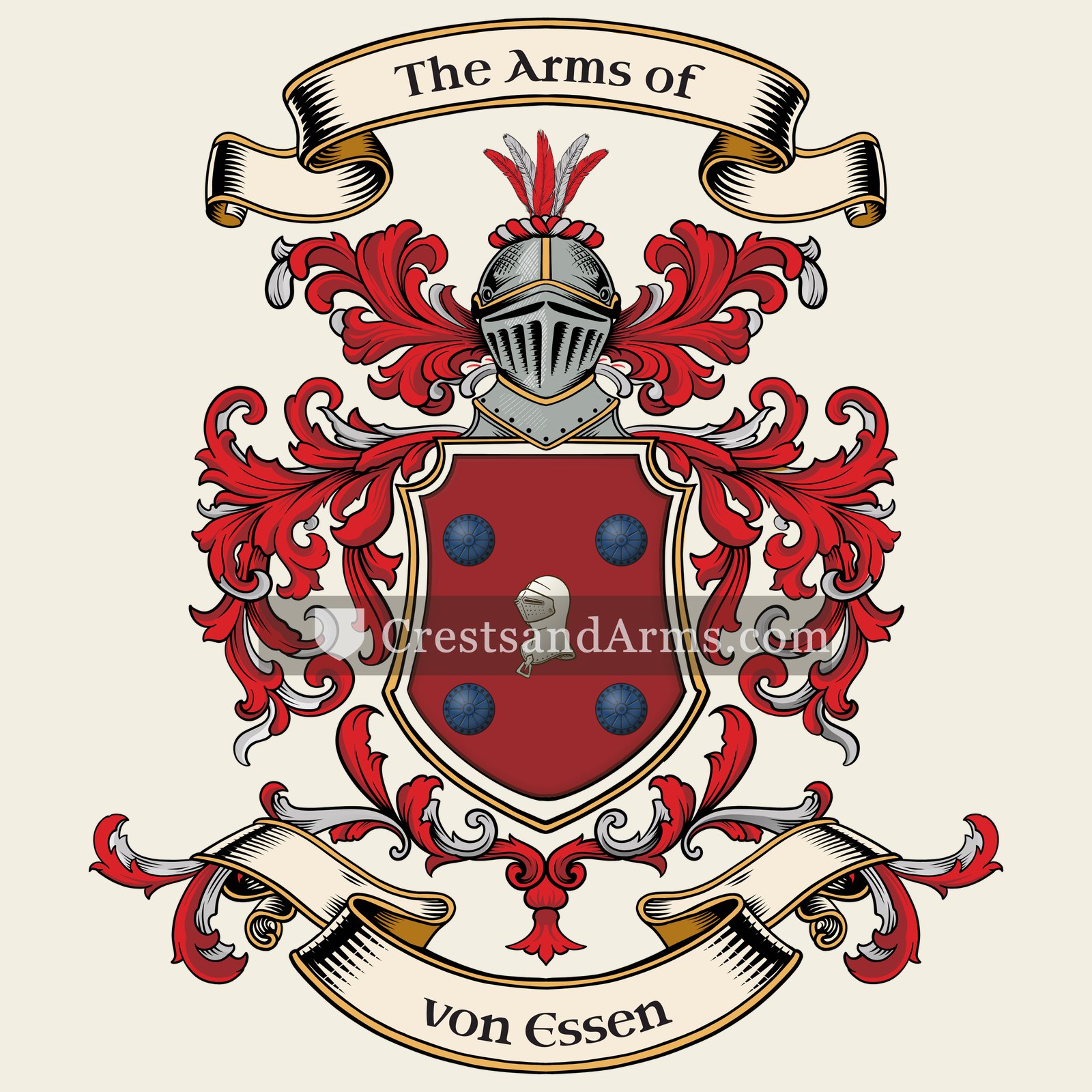
cantonA mark of honour granted by the sovereign
helmetWisdom and security in defence
roundelA coin, and one who has been to the crusades
Colours
Red (Gules)Means: Military strength
Silver (Argent)Means: Peace and sincerity
Blue (Azure)Means: Loyalty and truth
Historical info
Source
J. B. Rietstap, Armorial Général, Gouda: G. B. van Goor Zonen, 1884–87
Blazon (the actual original written record)
“De gu. à un casque de tournoi d'arg., doublé de sa., taré de front, acc. de quatre boules d'azur dans les cantons de l'écu. C.: une queue de paon, au nat., entre deux bannières, de gu. et d'azur.”
Finlandc. 1663
Digital archive packCoat of arms PNG, gold border print PDF, vector SVG and the certificate of authenticity. Sent to your email in minutes.
Map of Finland showing where the von Essen arms are recorded
The von Essen arms were recorded in Finland, c. 1663.
Arms such as these were typically recorded in Uusimaa.
Uusimaa was the Finnish coast facing Sweden, and the part of the country most closely tied to Stockholm. Its landowners and officers served the Swedish crown, and that service is what put their arms on record.
This is where the arms were entered in the register. Families often moved to other parts of the country, so the same name can turn up in more than one region.
The body that granted and recorded arms in Finland in this period.
How Arms Worked in Finland
Nobility in Finland held the exclusive right to register their coats of arms with the House of Nobility. These symbols were tied to the family name and were inherited by all members of the noble house. If a family branch moved or changed status, they kept their original design to maintain their identity within the official records.
Granting authority
The Finnish House of Nobility served as the official body that managed and protected all noble coats of arms.
How they got arms
Families received their arms through formal letters of nobility or by having their existing ancestral symbols confirmed by the House.
Where arms were recorded
All approved coats of arms were officially recorded in the Finnish House of Nobility Armorial starting in 1818.
The family's standing
Recorded among the armigerous families of Finland.
Origin & History of the von Essen Family in Finland
The von Essen family established their roots in Finland during the seventeenth century, a time when the region was part of the Swedish Empire. Historical records confirm that members of the family were settled in the Uusimaa region by 1663. As was common for families of that era, they integrated into the local administration and military structures that defined the social hierarchy of the time. The name itself reflects a connection to the broader Baltic and German-speaking nobility, which often moved across borders to serve the crown in various official capacities. By settling in Uusimaa, the family became part of the landowning class that helped shape the governance and cultural development of southern Finland during the early modern period. Their presence in the region during this century marks the beginning of a long-standing influence that would see the family name persist in Finnish history for generations.
Related Branches & Arms
Root word
Es
A Germanic term referring to an ash tree.
This name
von EssenRefers to a person who lived near or worked with ash trees.
also spelled
Essen
Related arms
Essenvariant spelling
Documented Sources
J. B. Rietstap, Armorial Général, Gouda: G. B. van Goor Zonen, 1884–87
Bredt, Ernst Wilhelm. Die Geschichte der Stadt Essen. 1904
Frankfurt am Main Stadtarchiv. Bürgerbuch der Stadt Frankfurt am Main. 1767
Digital archive packCoat of arms PNG, gold border print PDF, vector SVG and the certificate of authenticity. Sent to your email in minutes.


 cross symbolChristian faith and service
 cross symbolChristian faith and service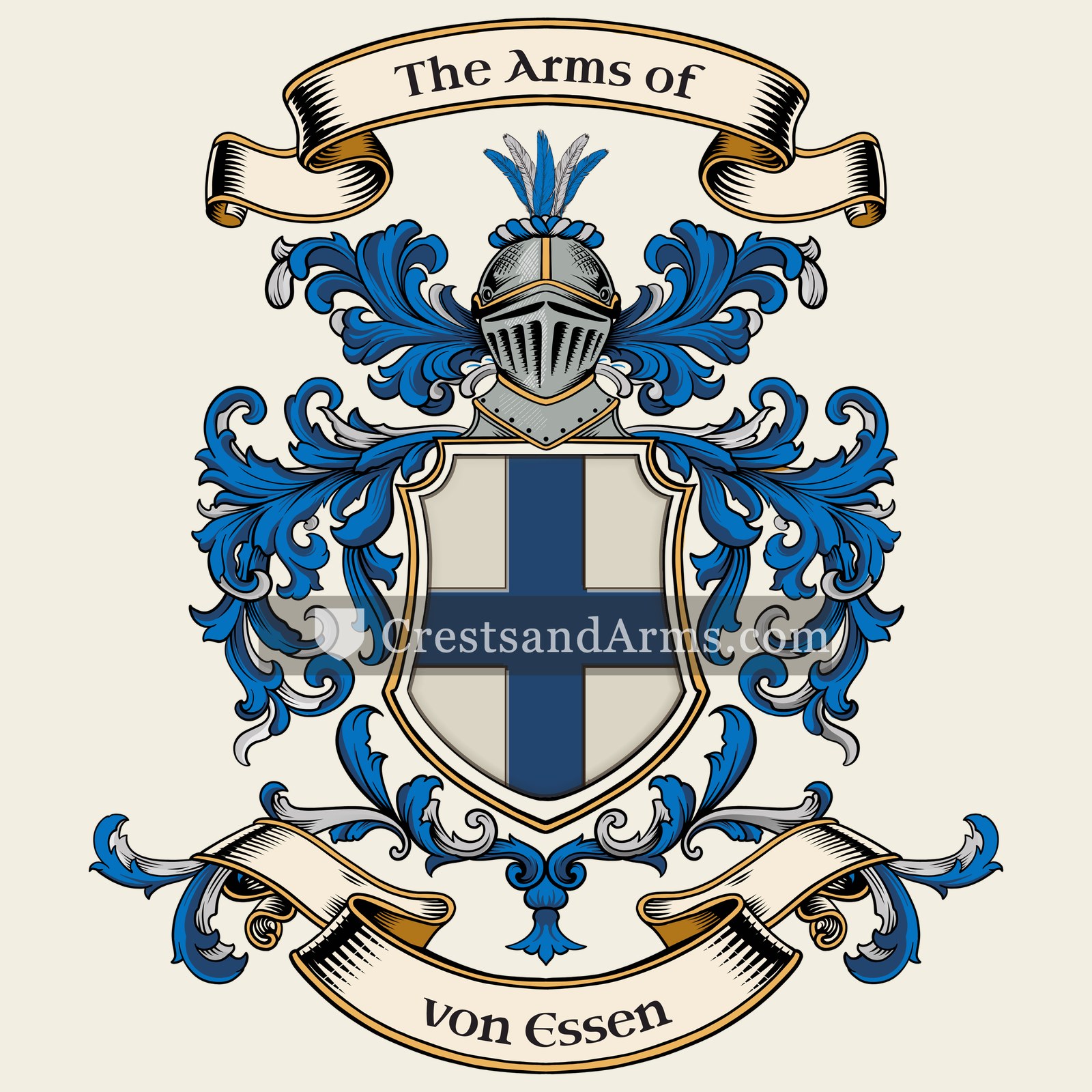


 owlWisdom and vigilance by night
 treeLife, endurance and deep roots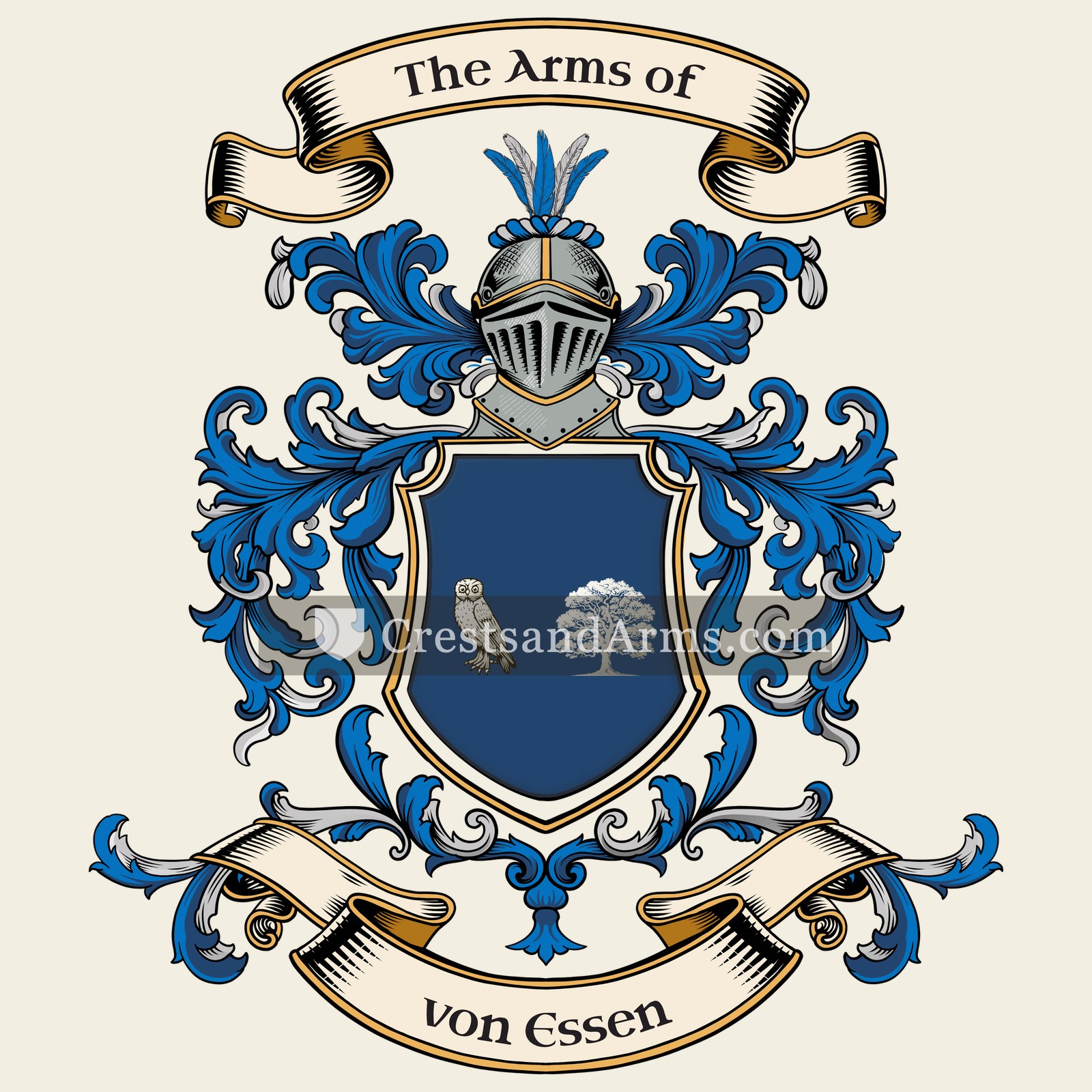


 cantonA mark of honour granted by the sovereign
 helmetWisdom and security in defence
 roundelA coin, and one who has been to the crusades