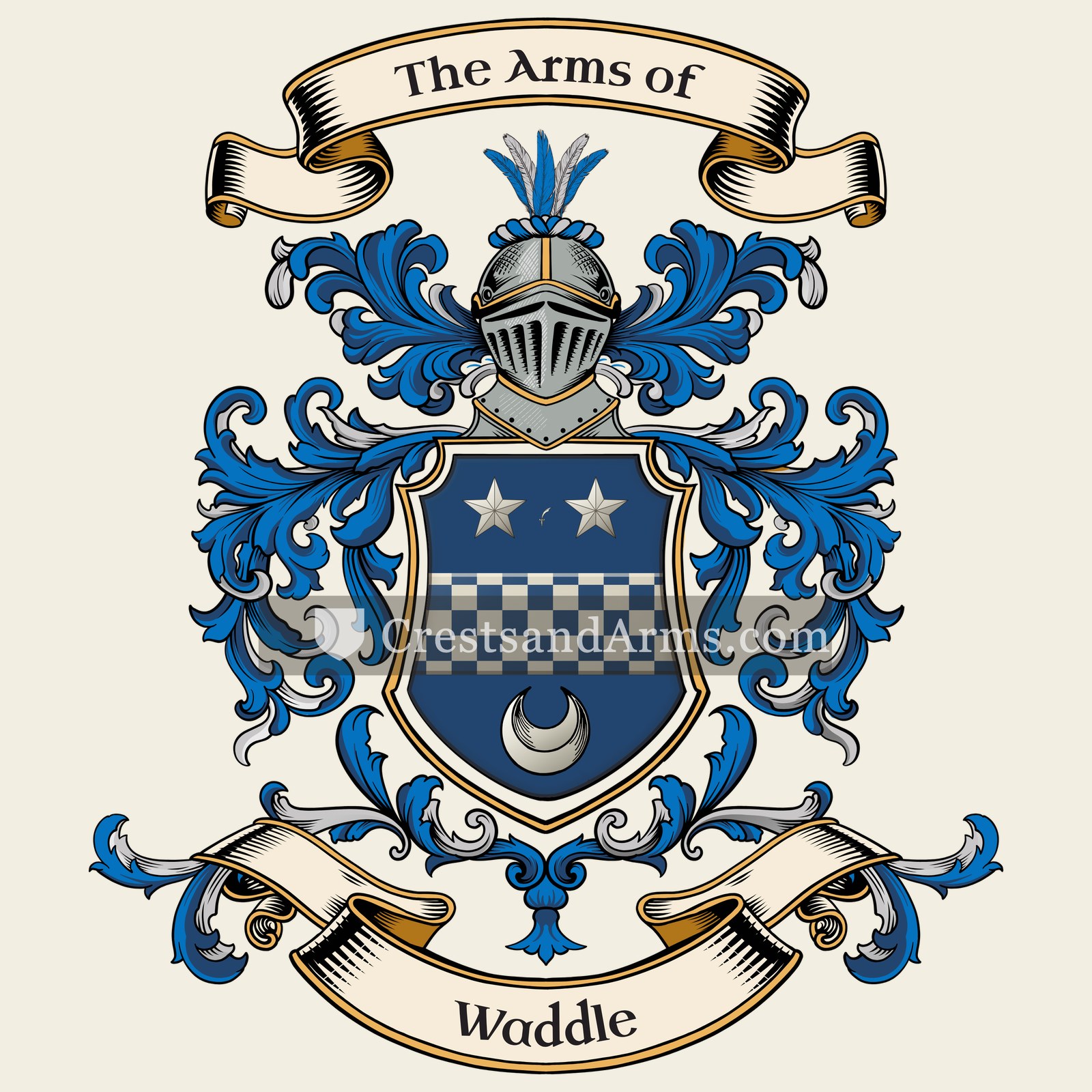
A record of documented arms, meaning and origin, researched for the Waddle family of Belgium.
Reg. 8167 · Belgian, W–Z
Coat of Arms & Family Crest Details
Symbols on this shield
fessThe military belt, and readiness to serve
chequyConstancy, and the counting-board
swordJustice, and military honour
mulletThe third son, and a divine quality from above
crescentHonour by the sovereign, and the second son
Colours
Blue (Azure)Means: Loyalty and truth
Silver (Argent)Means: Peace and sincerity
Historical info
Source
J. B. Rietstap, Armorial Général, Gouda: G. B. van Goor Zonen, 1884–87
Blazon (the actual original written record)
“D'azur à une épée, acc. en chef de deux étoiles et en p. d'un croiss., le tout d'arg.; à la fasce échiq. d'arg. et d'azur, br. sur le tout. C.: un bras arm., brandissant une épée, le tout au nat.”
BrabantBrabant, c. 1737
Digital archive packCoat of arms PNG, gold border print PDF, vector SVG and the certificate of authenticity. Sent to your email in minutes.
Map of Belgium showing where the Waddle arms are recorded
The Waddle arms were recorded in Brabant, c. 1737.
Brabant lay at the heart of the Low Countries, where the trade routes met. Its towns were wealthy and its landowners many, and both kinds of family kept arms, which is why the region is so heavily represented.
This is where the arms were entered in the register. Families often moved to other parts of the country, so the same name can turn up in more than one region.
The body that granted and recorded arms in Belgium in this period.
Charles VI, Holy Roman Emperor
Sovereign of the period
Charles VI, Holy Roman Emperor
1711–1740
Reigning in Belgium when the Waddle arms are first recorded.
How Arms Worked in Belgium
In Belgium, a coat of arms is considered personal property that is passed down through the male line to legitimate descendants. Families often use the same shield design across generations to show their shared heritage. If a branch of the family wants to change the design, they must apply for an official update to their specific version of the arms.
Granting authority
The Conseil héraldique is the official body that regulates and approves all coats of arms in Belgium.
How they got arms
Families obtain their coats of arms through formal royal grants or by confirming their historical right to use existing designs.
Where arms were recorded
All approved coats of arms are officially recorded in the public registers of the Conseil héraldique since 1844.
The family's standing
Recorded among the armigerous families of Brabant.
Origin & History of the Waddle Family in Belgium
The surname Waddle is believed to have roots as a descriptive nickname, likely originating from Middle English terms that referred to a person's distinctive way of walking. By the early 18th century, the family had established a notable presence in the region of Brabant, which spans parts of modern-day Belgium and the Netherlands. Records from 1737 indicate that members of the family were integrated into the local community during a period of significant social and economic change in the Low Countries. As families moved across borders for trade or agricultural opportunities, the name evolved in spelling and pronunciation to suit local languages. This migration pattern suggests that the early Waddle ancestors were likely mobile individuals who adapted to new environments while maintaining their family identity across generations.
Related Branches & Arms
Root word
Wad
Old Germanic element meaning a pledge or a promise.
This name
WaddleA locational or occupational surname referring to someone who lived near a ford or worked as a wader.
also spelled
Wadel
Documented Sources
J. B. Rietstap, Armorial Général, Gouda: G. B. van Goor Zonen, 1884–87
Debrabandere, Frans. Woordenboek van de familienamen in België en Noord-Frankrijk. 2003
Leibniz-Institut für Länderkunde. Atlas zur Geschichte der deutschen Sprache und Literatur. 1998
Digital archive packCoat of arms PNG, gold border print PDF, vector SVG and the certificate of authenticity. Sent to your email in minutes.


 fessThe military belt, and readiness to serve
 chequyConstancy, and the counting-board
 swordJustice, and military honour
 mulletThe third son, and a divine quality from above
 crescentHonour by the sovereign, and the second son
 fessThe military belt, and readiness to serve
 chequyConstancy, and the counting-board
 swordJustice, and military honour
 mulletThe third son, and a divine quality from above
 crescentHonour by the sovereign, and the second son