Map of Wales showing where the Waiters arms are recorded
The Waiters arms were recorded in Carmarthen, c. 1647.
Carmarthenshire was south-west Welsh country of river valleys and hill farms. Land was held in a great many small estates, and each one brought its own claim to a coat of arms.
This is where the arms were entered in the register. Families often moved to other parts of the country, so the same name can turn up in more than one region.
The body that granted and recorded arms in Wales in this period.
Charles I of England
Sovereign of the period
Charles I of England
1625–1649
Reigning in Wales when the Waiters arms are first recorded.
How Arms Worked in Wales
English heraldry allowed arms to be shared by all legitimate descendants of the original owner. These symbols were treated as personal property that moved through the generations to all children. While the eldest son kept the original design, other family members could use the same shield without needing to change it or register their own unique versions.
Granting authority
The College of Arms in London has regulated the use of coats of arms throughout England and Wales since 1484.
How they got arms
Families typically obtained their coats of arms through a formal grant from the Crown or by proving their ancient right to them.
Where arms were recorded
All official coats of arms are recorded in the registers kept at the College of Arms, which date back to the fifteenth century.
The family's standing
Recorded among the armigerous families of Carmarthen.
Origin & History of the Waiters Family in Wales
The surname Waiters is primarily an occupational name, historically derived from the Middle English word "waiter," which referred to a watchman or a guard. By the mid-seventeenth century, the name had established a firm presence in the Welsh town of Carmarthen. Records confirm that members of the family were living in this area by 1647, a time when Carmarthen served as a vital administrative and market hub for southwest Wales. During this period, families in the region often adopted surnames that reflected their trade or their position within the local community. As the town grew in importance, the Waiters family likely integrated into the social fabric of the county, transitioning from their original roles as watchmen or attendants into the broader merchant and labor classes of the Welsh countryside. Their presence in 1647 suggests they were part of the steady population growth that defined the town during the aftermath of the English Civil War.
Coat of Arms & Family Crest Details
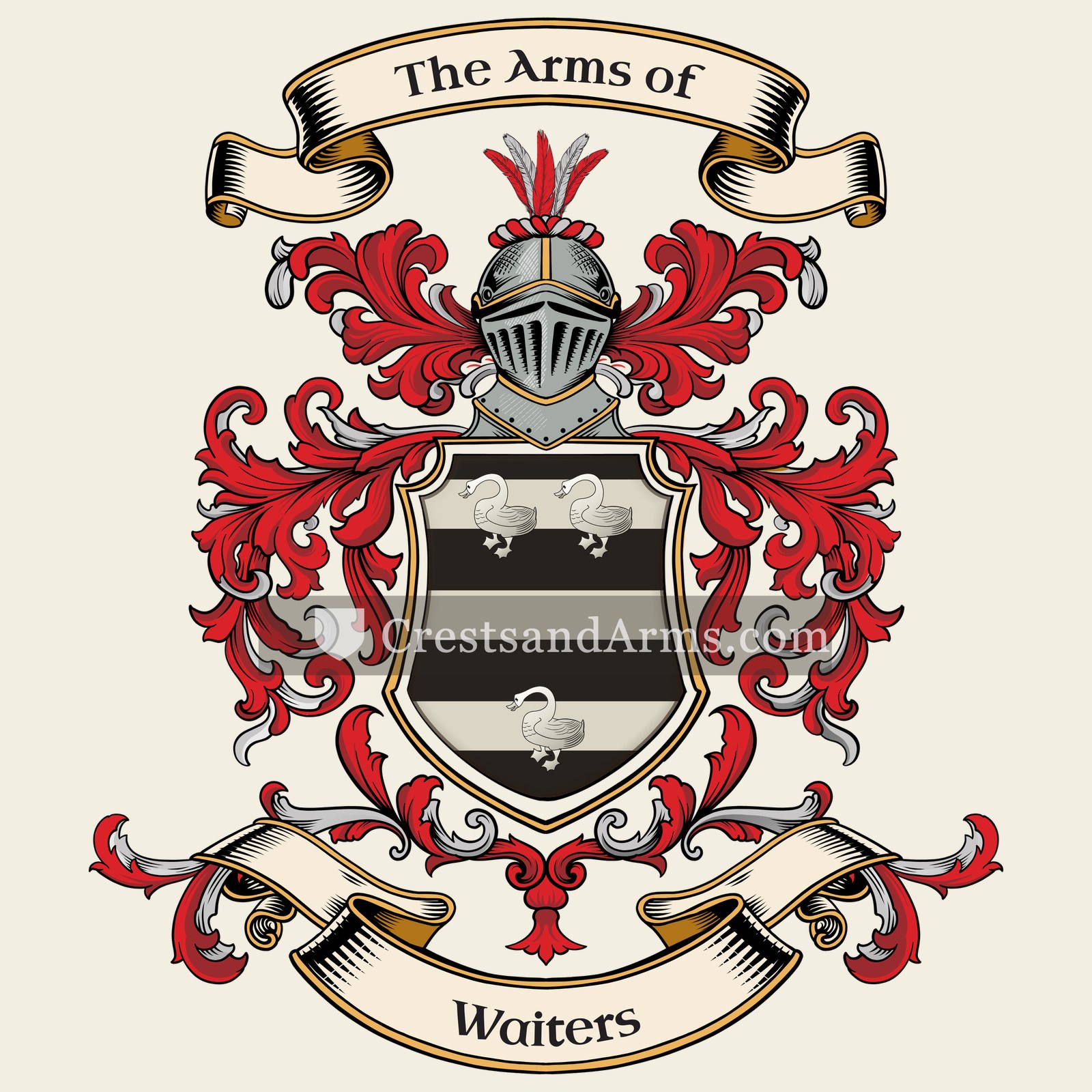
Symbols on this shield
swanGrace, light and the poet's art
Colours
Black (Sable)Means: Constancy
Silver (Argent)Means: Peace and sincerity
Historical info
Source
Sir Bernard Burke, The General Armory of England, Scotland, Ireland and Wales, London: Harrison & Sons, 1884
Blazon (the actual original written record)
“Sa. three bars wavy betw. as many swans ar”
KentLenham · Kent, c. 1620
Digital archive packCoat of arms PNG, gold border print PDF, vector SVG and the certificate of authenticity. Sent to your email in minutes.
Map of England showing where the Waiters arms are recorded
The Waiters arms were recorded in Kent, c. 1620.
Kent sits between London and the short crossing to Europe, and the trade passing through made it wealthy. Merchant families bought land with that money, and it was landowners who took coats of arms.
This is where the arms were entered in the register. Families often moved to other parts of the country, so the same name can turn up in more than one region.
The body that granted and recorded arms in England in this period.
James VI and I
Sovereign of the period
James VI and I
1603–1625
Reigning in Wales when the Waiters arms are first recorded.
How Arms Worked in England
English heraldry allowed arms to be shared by all legitimate descendants of the original owner. These symbols were treated as personal property that moved through the generations to all children. While the eldest son kept the original design, other family members could use the same shield without needing to change it or register their own unique versions.
Granting authority
The College of Arms in London has regulated the use of coats of arms throughout England and Wales since 1484.
How they got arms
Families typically obtained their coats of arms through a formal grant from the Crown or by proving their ancient right to them.
Where arms were recorded
All official coats of arms are recorded in the registers kept at the College of Arms, which date back to the fifteenth century.
The family's standing
Recorded among the armigerous families of Kent.
Origin & History of the Waiters Family in England
The surname Waiters is an occupational name that emerged in medieval England to describe someone who worked as a guard, a watchman, or a servant in a noble household. By the early 17th century, the family had established a notable presence in the county of Kent. During this period, Kent was a bustling region shaped by its proximity to the English Channel and its role in maritime trade. Families living in this area often worked in agriculture or local administration, and the name suggests that early ancestors likely held positions of responsibility or service within their local communities. As the family settled into the landscape of Kent by 1620, they became part of the social fabric of a region known for its deep historical roots and its importance to the English economy. Over time, the name evolved from a simple job title into a permanent family identifier that was passed down through generations.
Related Branches & Arms
Root word
Waitier
Old French term for a watchman or guard.
This name
WaitersAn occupational surname for someone employed as a guard or attendant.
also spelled
Watteres
Wataris
Wateris
Documented Sources
Sir Bernard Burke, The General Armory of England, Scotland, Ireland and Wales, London: Harrison & Sons, 1884
National Library of Wales, Carmarthenshire Quarter Sessions Records
The National Archives, Hearth Tax Returns for Carmarthenshire
Charles, B. G., The Place-Names of Pembrokeshire, 1992
Reaney, P. H., A Dictionary of English Surnames, 1995
Digital archive packCoat of arms PNG, gold border print PDF, vector SVG and the certificate of authenticity. Sent to your email in minutes.


 bordureA difference between branches of one family
 griffinValour and vigilance, guarding great treasure
 bordureA difference between branches of one family
 griffinValour and vigilance, guarding great treasure


 swanGrace, light and the poet's art