Map of Britain showing where the Wake arms are recorded
The Wake arms were recorded in Britain, c. 1407.
Arms such as these were typically recorded in Kent.
Kent sits between London and the short crossing to Europe, and the trade passing through made it wealthy. Merchant families bought land with that money, and it was landowners who took coats of arms.
This is where the arms were entered in the register. Families often moved to other parts of the country, so the same name can turn up in more than one region.
The body that granted and recorded arms in Britain in this period.
Henry IV of England
Sovereign of the period
Henry IV of England
1399–1413
Reigning in Britain when the Wake arms are first recorded.
How Arms Worked in Britain
English heraldry allowed arms to be shared by all legitimate descendants of the original owner. These symbols were treated as personal property that moved through the generations to all children. While the eldest son kept the original design, other family members could use the same shield without needing to change it or register their own unique versions.
Granting authority
The College of Arms in London has regulated the use of coats of arms throughout England and Wales since 1484.
How they got arms
Families typically obtained their coats of arms through a formal grant from the Crown or by proving their ancient right to them.
Where arms were recorded
All official coats of arms are recorded in the registers kept at the College of Arms, which date back to the fifteenth century.
The family's standing
Recorded among the armigerous families of Britain.
Origin & History of the Wake Family in Britain
The surname Wake has deep roots in the English landscape, evolving from a descriptive nickname into a formal family name during the Middle Ages. The name likely originated from the Old English word "wæcn," which refers to someone who was watchful or alert. By the time the family was firmly established in Kent in 1407, they were part of a growing class of landowners and local officials who helped shape the rural economy of the region. During this period, the Wakes were often involved in the administration of manors and the management of local trade, which allowed them to secure their status within the community. As the family spread across southern England, they became tied to the shifting social structures of the late medieval era. Their presence in historical records from the early fifteenth century highlights how families of that time maintained their influence through local governance and stable land ownership.
Coat of Arms & Family Crest Details
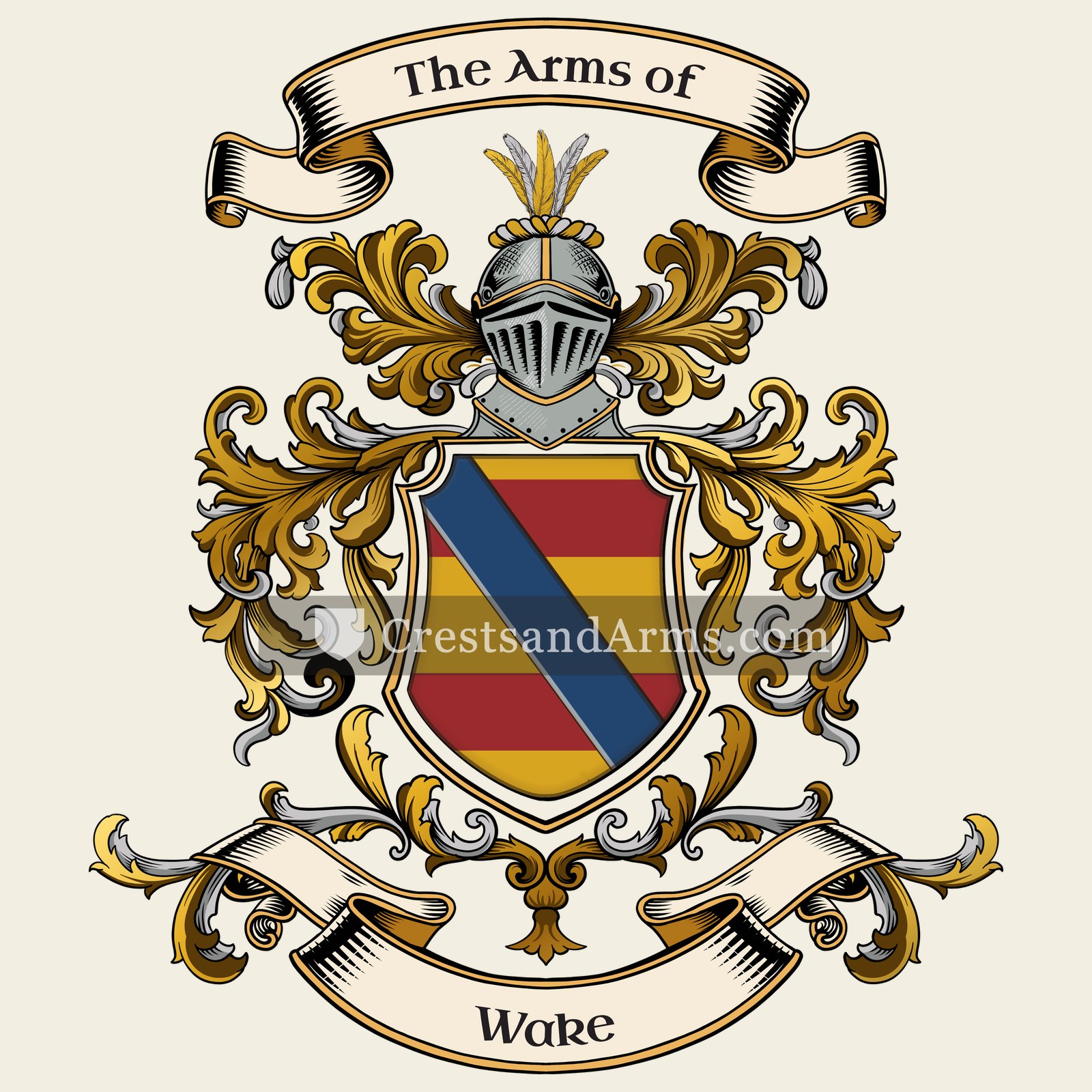
Symbols on this shield
bendDefence, and the scarf of a commander
Colours
Gold (Or)Means: Generosity
Red (Gules)Means: Military strength
Blue (Azure)Means: Loyalty and truth
Historical info
Source
Sir Bernard Burke, The General Armory of England, Scotland, Ireland and Wales, London: Harrison & Sons, 1884
Blazon (the actual original written record)
“Or, two bars gu. a bend az. (another, of the first)”
KentKent, c. 1620
Digital archive packCoat of arms PNG, gold border print PDF, vector SVG and the certificate of authenticity. Sent to your email in minutes.
Map of England showing where the Wake arms are recorded
The Wake arms were recorded in Kent, c. 1620.
Kent sits between London and the short crossing to Europe, and the trade passing through made it wealthy. Merchant families bought land with that money, and it was landowners who took coats of arms.
This is where the arms were entered in the register. Families often moved to other parts of the country, so the same name can turn up in more than one region.
The body that granted and recorded arms in England in this period.
James VI and I
Sovereign of the period
James VI and I
1603–1625
Reigning in Britain when the Wake arms are first recorded.
How Arms Worked in England
English heraldry allowed arms to be shared by all legitimate descendants of the original owner. These symbols were treated as personal property that moved through the generations to all children. While the eldest son kept the original design, other family members could use the same shield without needing to change it or register their own unique versions.
Granting authority
The College of Arms in London has regulated the use of coats of arms throughout England and Wales since 1484.
How they got arms
Families typically obtained their coats of arms through a formal grant from the Crown or by proving their ancient right to them.
Where arms were recorded
All official coats of arms are recorded in the registers kept at the College of Arms, which date back to the fifteenth century.
The family's standing
Recorded among the armigerous families of Kent.
Origin & History of the Wake Family in England
The surname Wake is rooted in the Old English word *wacu*, which originally referred to a vigil or a festive gathering held at night. In early medieval England, this name likely functioned as a descriptive nickname for a person who was known for being watchful, alert, or perhaps someone who participated in local religious festivals. By the time the family established a presence in Kent during the early 17th century, the name had been passed down through generations as a stable hereditary surname. Families living in Kent in 1620 were part of a region deeply involved in trade and maritime activity, which often led to the movement of families across the English countryside. While the name began as a simple descriptor of a person’s character or habits, it eventually became a permanent marker of identity that linked these early settlers to their long-standing English heritage.
Related Branches & Arms
Root word
wacan
Old English verb meaning to be awake or to watch.
This name
WakeA nickname for a watchful, alert, or vigilant person.
also spelled
Wacke
Wayke
Related arms
Wackevariant spelling
Documented Sources
J. B. Rietstap, Armorial Général, Gouda: G. B. van Goor Zonen, 1884–87
Reaney, P.H., A Dictionary of English Surnames, 1958
Hasted, Edward, The History and Topographical Survey of the County of Kent, 1797
The National Archives, Court of Common Pleas: Plea Rolls, CP 40
Kent History and Library Centre, Kent Archives Catalogue: Manorial Records, U series
Digital archive packCoat of arms PNG, gold border print PDF, vector SVG and the certificate of authenticity. Sent to your email in minutes.


 fessThe military belt, and readiness to serve
 roundelA coin, and one who has been to the crusades
 fessThe military belt, and readiness to serve
 roundelA coin, and one who has been to the crusades


 bendDefence, and the scarf of a commander