Map of France showing where the Waldron arms are recorded
The Waldron arms were recorded in Boston, c. 1725.
Arms such as these were typically recorded in Bretagne.
More families held coats of arms in Bretagne than anywhere else in France. The land was divided into many small estates rather than a few large ones, so far more households counted as gentry, and each needed a shield of its own to be told apart.
This is where the arms were entered in the register. Families often moved to other parts of the country, so the same name can turn up in more than one region.
The body that granted and recorded arms in France in this period.
Louis XV of France
Sovereign of the period
Louis XV of France
1715–1774
Reigning in France when the Waldron arms are first recorded.
How Arms Worked in France
In France, a coat of arms was a mark of honor that passed down through the male line to all legitimate descendants. Families often used the same shield without changes to show their shared heritage. If a branch wanted to stand out, they could add a small mark to their shield to show their specific place in the family tree.
Granting authority
The Juge d'armes de France acted as the official authority that regulated and verified coats of arms across the country.
How they got arms
Families typically inherited their arms from ancestors, though they could also receive them through royal grants or by proving their noble status.
Where arms were recorded
Coats of arms were officially recorded in the Armorial Général de France, which began its main collection in the year 1696.
The family's standing
Recorded among the armigerous families of France.
Origin & History of the Waldron Family in France
The roots of the Waldron name in France are deeply connected to the rugged landscape and distinct culture of the Bretagne region. By the early eighteenth century, families bearing this name were well-established within the local communities of western France. During this period, Bretagne functioned as a semi-autonomous province with its own unique traditions and social structures. Families like the Waldrons often lived as tenant farmers or skilled tradespeople who contributed to the local economy of the coastal towns and rural parishes. Life in 1725 Bretagne was defined by strong ties to the Catholic Church and the seasonal rhythms of agriculture and maritime trade. As members of the regional population, these early ancestors navigated the challenges of life under the French monarchy while maintaining the specific customs that defined their home province. Their presence in these historical records highlights a legacy of resilience and integration into the complex social fabric of pre-revolutionary France.
Meaning of the Waldron family crest colors & symbols
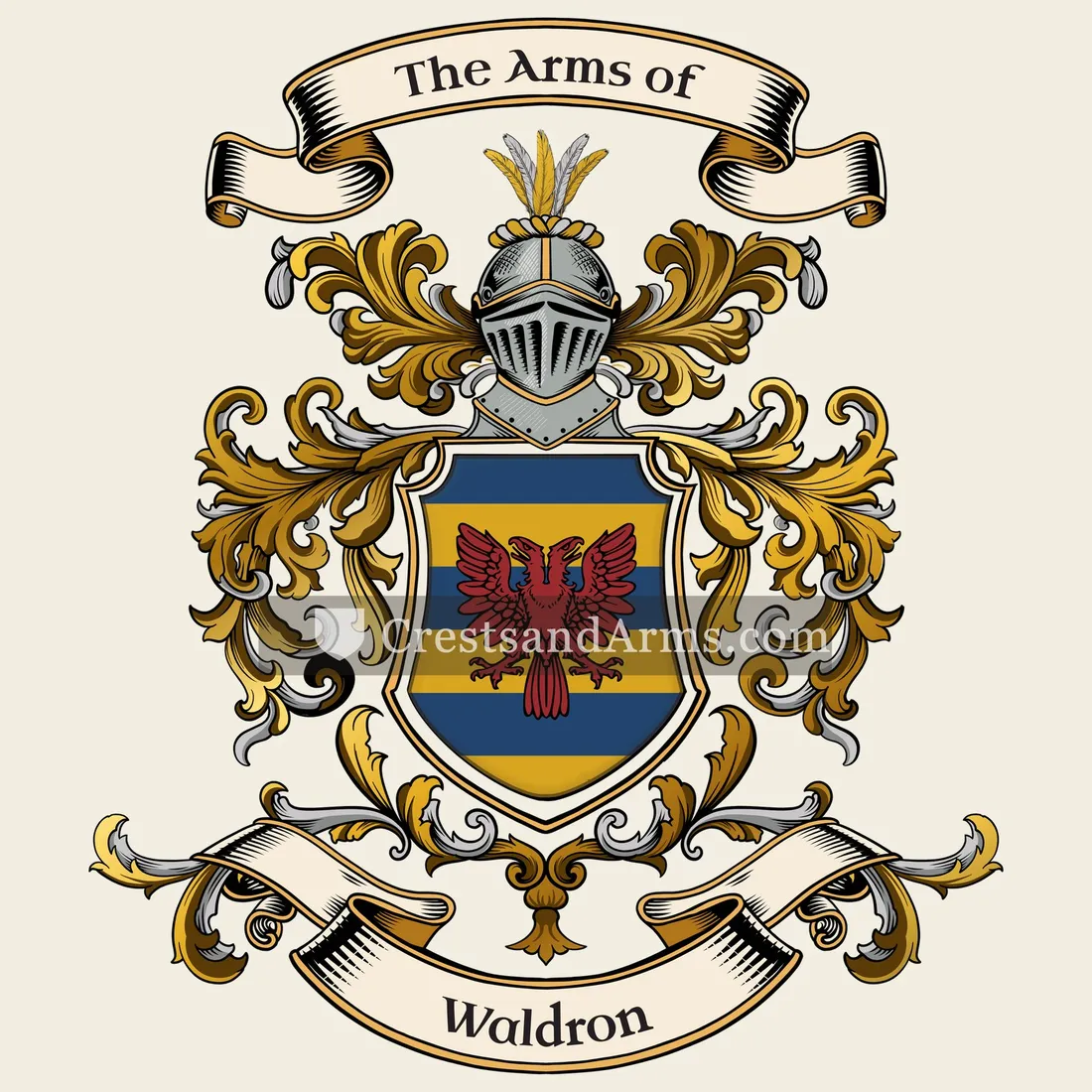
Symbols on this shield
eagleNobility, strength and a keen mind
Colours
Gold (Or)Means: Generosity
Red (Gules)Means: Military strength
Blue (Azure)Means: Loyalty and truth
Historical info
Source
Sir Bernard Burke, The General Armory of England, Scotland, Ireland and Wales, London: Harrison & Sons, 1884
Blazon (the actual original written record)
“Barry of six or and az. an eagle displ. with two heads gu”
GloucesterPucklechurch · Gloucester, c. 1620
Digital archive packCoat of arms PNG, gold border print PDF, vector SVG and the certificate of authenticity. Sent to your email in minutes.
Map of England showing where the Waldron arms are recorded
The Waldron arms were recorded in Gloucester, c. 1620.
Gloucestershire had good farmland, a cloth trade in its valleys and a river carrying goods to Bristol. All three made money, and money bought the estates that brought arms with them.
This is where the arms were entered in the register. Families often moved to other parts of the country, so the same name can turn up in more than one region.
The body that granted and recorded arms in England in this period.
James VI and I
Sovereign of the period
James VI and I
1603–1625
Reigning in France when the Waldron arms are first recorded.
How Arms Worked in England
English heraldry allowed arms to be shared by all legitimate descendants of the original owner. These symbols were treated as personal property that moved through the generations to all children. While the eldest son kept the original design, other family members could use the same shield without needing to change it or register their own unique versions.
Granting authority
The College of Arms in London has regulated the use of coats of arms throughout England and Wales since 1484.
How they got arms
Families typically obtained their coats of arms through a formal grant from the Crown or by proving their ancient right to them.
Where arms were recorded
All official coats of arms are recorded in the registers kept at the College of Arms, which date back to the fifteenth century.
The family's standing
Recorded among the armigerous families of Gloucester.
Origin & History of the Waldron Family in England
The name Waldron has deep roots in England, where it emerged as a locational surname derived from old Germanic and Anglo-Saxon elements. The name is often linked to the village of Waldron in East Sussex, which was recorded in the Domesday Book as Walderne. Over several centuries, families bearing this name migrated across the English countryside, eventually establishing a notable presence in the city of Gloucester by the early 17th century. By 1620, records indicate that members of the Waldron family were active participants in the social and economic life of this historic cathedral city. This period was a time of significant transition, as families began to move more freely between rural parishes and growing urban centers. The presence of the Waldron name in Gloucester during this era highlights the family's transition from local landholders to established members of an evolving English society.
Waldron Meaning & Related Branches
Root word
Walther
Derived from Germanic elements meaning ruler of the army.
This name
WaldronA locational surname referring to one who lived near a forest or a wooded hill.
also spelled
Walderon
Waldren
Walderne
Waldryn
Related arms
Walronsame arms
de Doyssimilar arms
Walrondsimilar arms
Waldernvariant spelling
Documented Sources
J. B. Rietstap, Armorial Général, Gouda: G. B. van Goor Zonen, 1884–87
Archives départementales du Morbihan, Série B (Fonds de la sénéchaussée)
Archives départementales du Finistère, Série E (État civil et registres paroissiaux)
Croix, Alain, La Bretagne aux 16e et 17e siècles: la vie, la mort, la foi, 1981
Le Moigne, Jean-Jacques, Histoire de la Bretagne, 1986
Digital archive packCoat of arms PNG, gold border print PDF, vector SVG and the certificate of authenticity. Sent to your email in minutes.


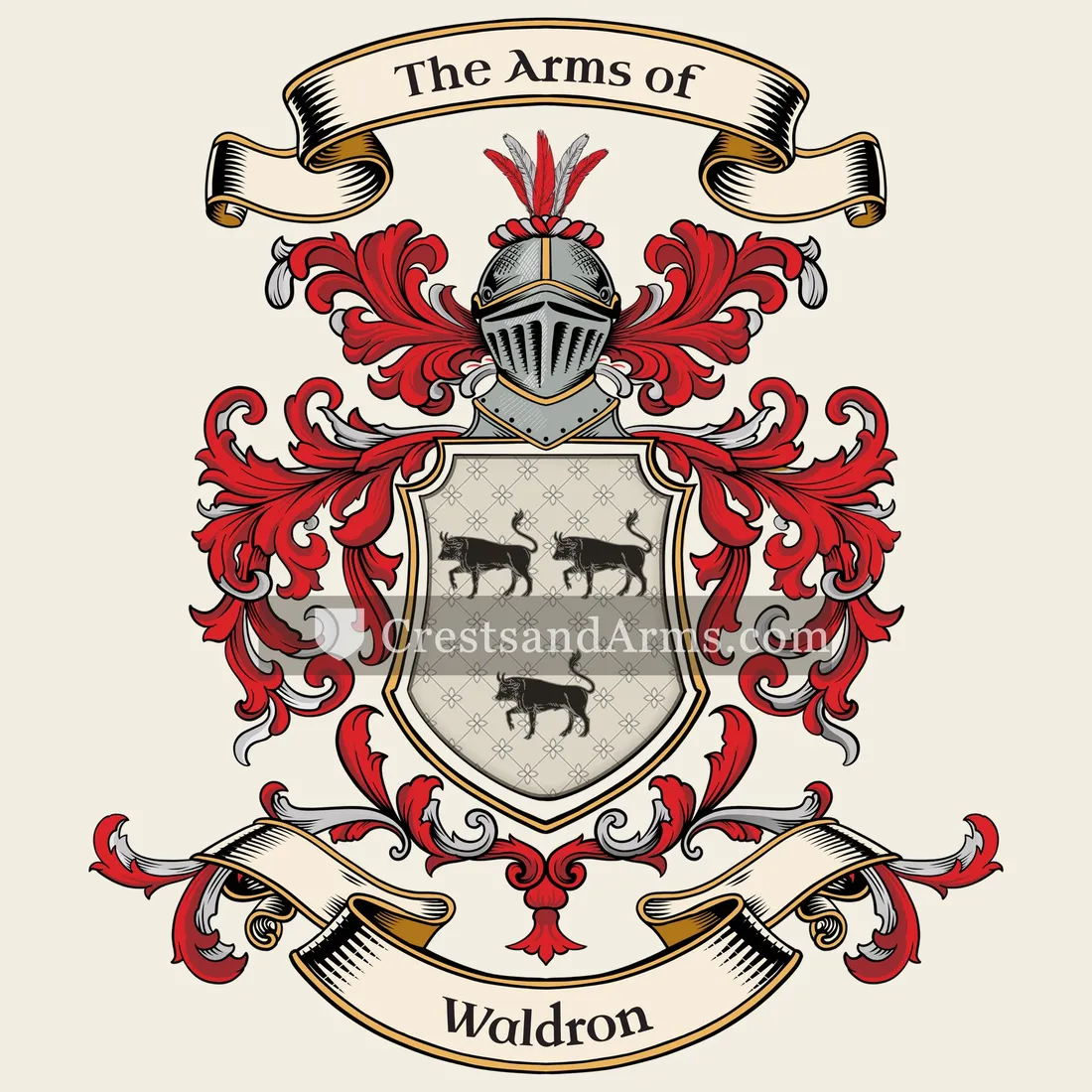
 bullValour and generosity
 bullValour and generosity


 eagleNobility, strength and a keen mind