Map of Britain showing where the Wallace arms are recorded
The Wallace arms were recorded in Philadelphie, c. 1700.
Arms such as these were typically recorded in Kent.
Kent sits between London and the short crossing to Europe, and the trade passing through made it wealthy. Merchant families bought land with that money, and it was landowners who took coats of arms.
This is where the arms were entered in the register. Families often moved to other parts of the country, so the same name can turn up in more than one region.
The body that granted and recorded arms in Britain in this period.
William III of England
Sovereign of the period
William III of England
1694–1702
Reigning in Britain when the Wallace arms are first recorded.
How Arms Worked in Britain
English heraldry allowed arms to be shared by all legitimate descendants of the original owner. These symbols were treated as personal property that moved through the generations to all children. While the eldest son kept the original design, other family members could use the same shield without needing to change it or register their own unique versions.
Granting authority
The College of Arms in London has regulated the use of coats of arms throughout England and Wales since 1484.
How they got arms
Families typically obtained their coats of arms through a formal grant from the Crown or by proving their ancient right to them.
Where arms were recorded
All official coats of arms are recorded in the registers kept at the College of Arms, which date back to the fifteenth century.
The family's standing
Recorded among the armigerous families of Britain.
Origin & History of the Wallace Family in Britain
The surname Wallace has deep roots in the British Isles, primarily emerging as a descriptor for people of Welsh or Cumbrian origin living in areas dominated by other cultures. In the medieval period, the name functioned as a way to identify someone as a foreigner or a stranger, specifically referring to those who spoke a Brittonic language rather than the prevailing tongue of the region. While the name is most famously associated with the Scottish borders and the lowlands, families bearing the name gradually migrated across Britain over several centuries. By the year 1700, records confirm that members of the Wallace family had established themselves in Kent, reflecting the broader movement of people toward the south of England during the early modern era. This shift shows how a name that once identified a person as an outsider eventually became a settled part of the local population in diverse regions across the country.
Coat of Arms & Family Crest Details
Symbols on this shield
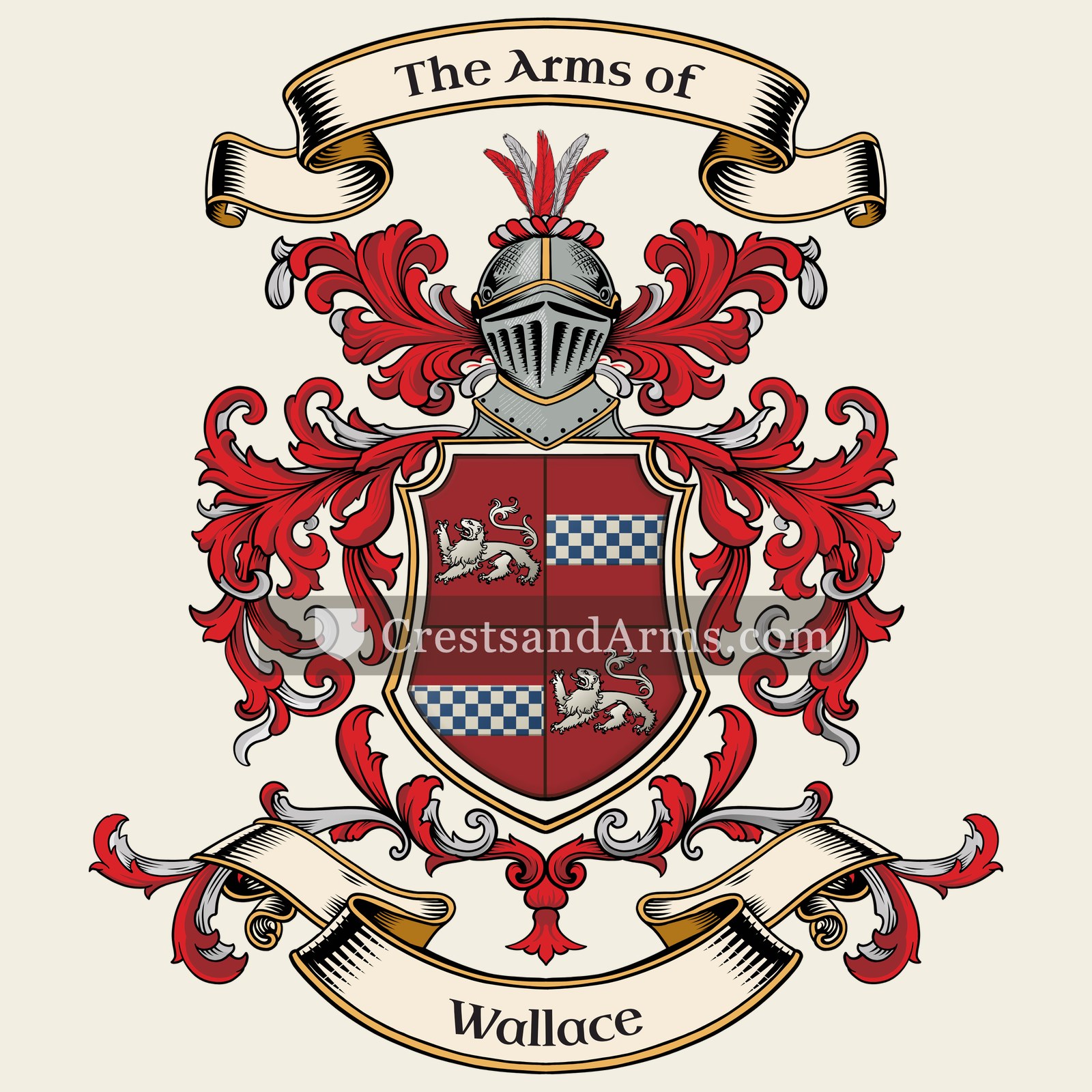
fessThe military belt, and readiness to serve
chequyConstancy, and the counting-board
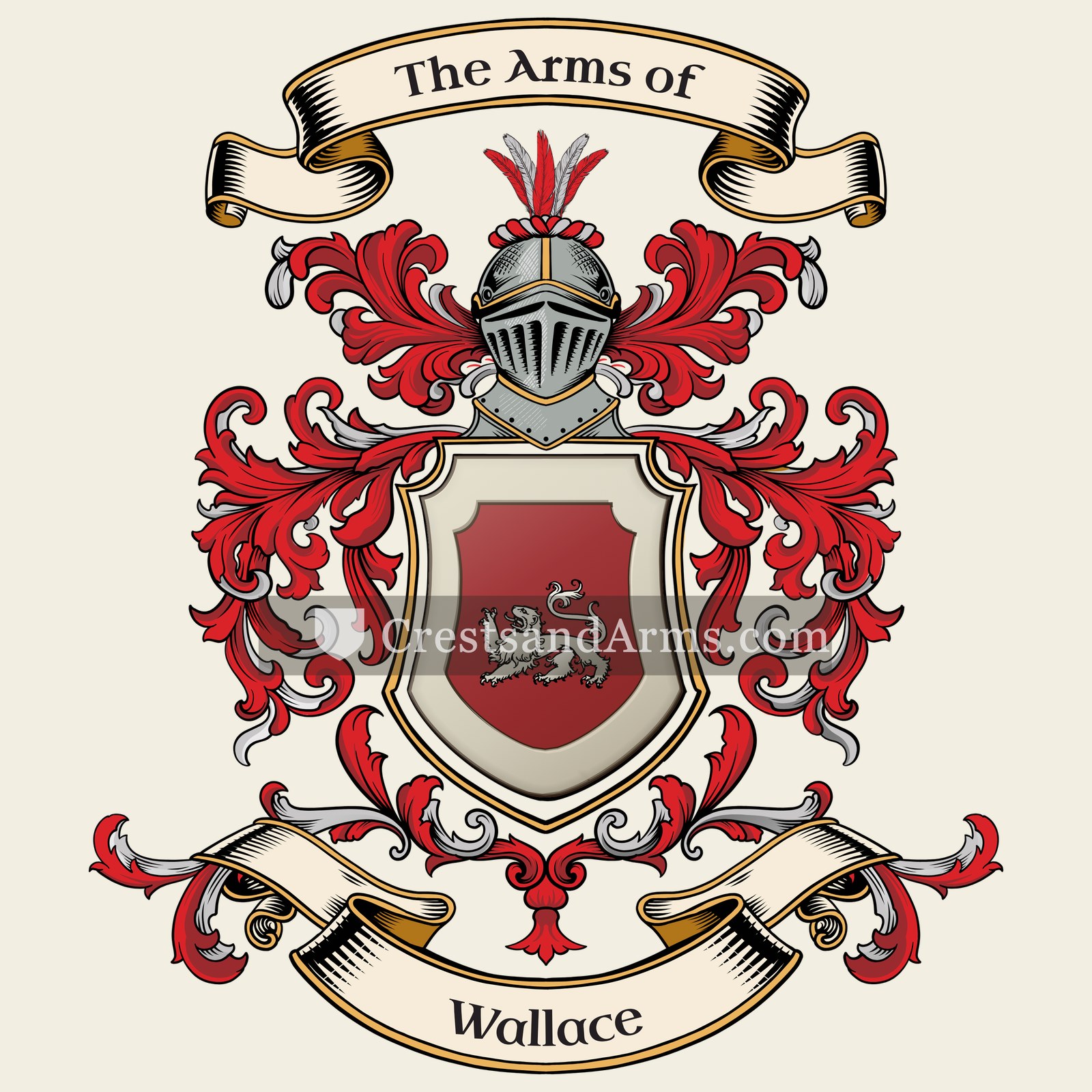
lionCourage, strength and royalty
Colours
Red (Gules)Means: Military strength
Blue (Azure)Means: Loyalty and truth
Silver (Argent)Means: Peace and sincerity
Historical info
Source
Sir Bernard Burke, The General Armory of England, Scotland, Ireland and Wales, London: Harrison & Sons, 1884
Blazon (the actual original written record)
“Quarterly, 1st and 4th, gu. a lion ramp. ar., for WALLACE; 2nd and 3rd, gu. a fess chequy ar. and az., for LINDSAY”
AyrCraigie · Ayr, c. 1669
Digital archive packCoat of arms PNG, gold border print PDF, vector SVG and the certificate of authenticity. Sent to your email in minutes.
Map of Scotland showing where the Wallace arms are recorded
The Wallace arms were recorded in Ayr, c. 1669.
Ayrshire was farming country along Scotland's south-west coast, held in a great many small estates. Its lairds were numerous rather than rich, and each holding brought its own claim to arms.
This is where the arms were entered in the register. Families often moved to other parts of the country, so the same name can turn up in more than one region.
The body that granted and recorded arms in Scotland in this period.
Charles II of England
Sovereign of the period
Charles II of England
1660–1685
Reigning in Britain when the Wallace arms are first recorded.
How Arms Worked in Scotland
Scottish heraldry is unique because it treats a coat of arms as a piece of personal property protected by law. Only one person can own a specific design at any given time. When a family grows, the head keeps the original shield while other relatives must apply for their own distinct version with slight changes to prove their specific identity.
Granting authority
The Court of the Lord Lyon acts as the official body that regulates and controls all heraldic matters throughout Scotland.
How they got arms
Individuals obtain a legal right to their arms through a formal petition process that confirms their identity and family connection.
Where arms were recorded
All valid coats of arms are officially entered into the Public Register of All Arms and Bearings starting from 1672.
The family's standing
Recorded among the armigerous families of Ayr.
Origin & History of the Wallace Family in Scotland
The surname Wallace is deeply rooted in the history of Scotland, originating from the Old French word *waleis*, which translates to "foreigner" or "Welshman." This name was likely given to people of Brythonic descent who settled in the Scottish Lowlands during the early medieval period. By the time the name became established in the region of Ayr, the family had become well-integrated into the local social and economic life of the Scottish countryside. While the name is most famously associated with the independence movement of the thirteenth century, subsequent generations continued to build their lives as landowners and community members in the west of Scotland. By the year 1669, records confirm that the Wallace family was firmly settled in Ayr, reflecting a long history of continuity in that specific area. This presence in the region highlights how the family name evolved from a label for outsiders into a prominent part of the local Scottish identity over several centuries.
Coat of Arms & Family Crest Details
Symbols on this shield
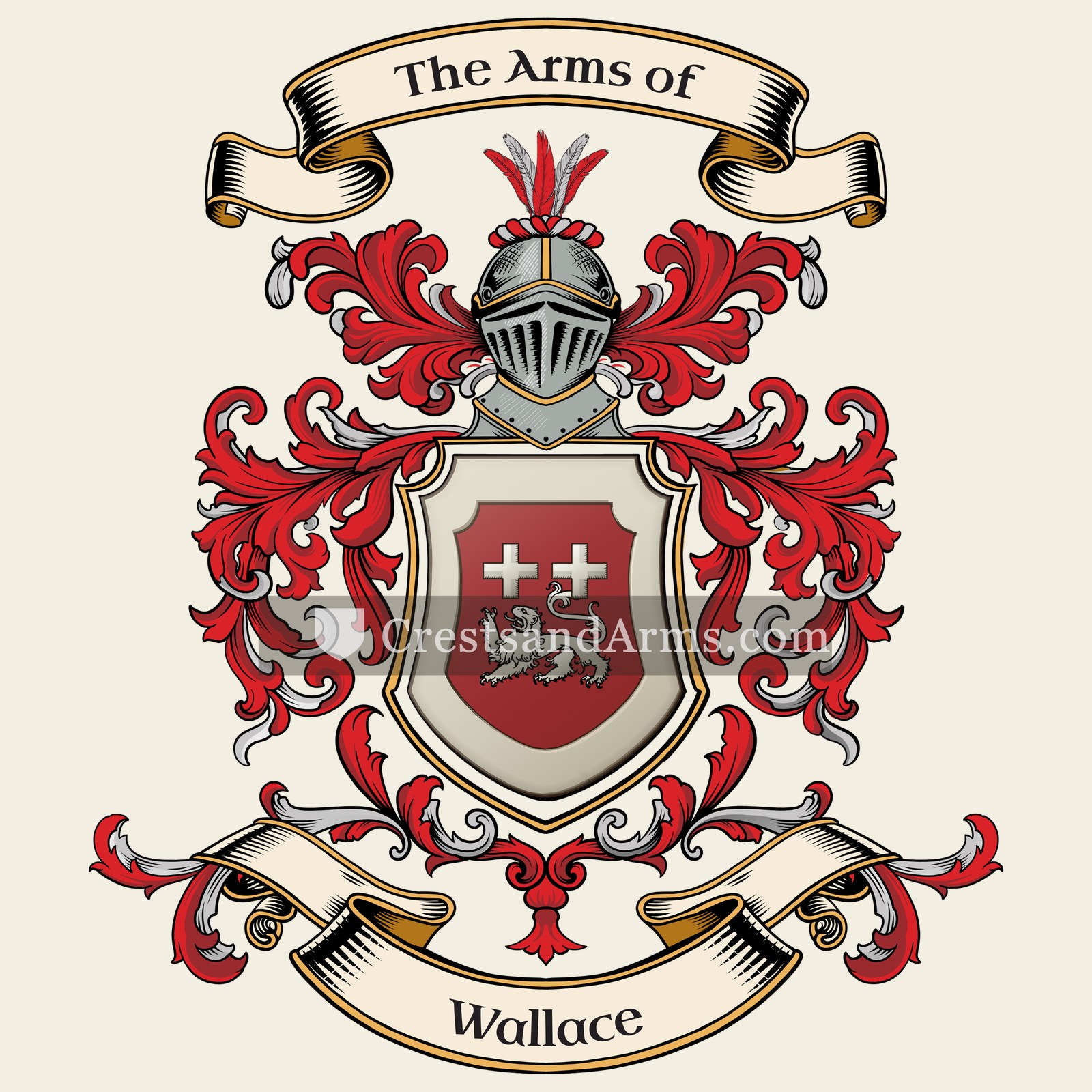
cross symbolChristian faith and service
bordureA difference between branches of one family
lionCourage, strength and royalty
Colours
Red (Gules)Means: Military strength
Silver (Argent)Means: Peace and sincerity
Historical info
Source
Sir Bernard Burke, The General Armory of England, Scotland, Ireland and Wales, London: Harrison & Sons, 1884
Blazon (the actual original written record)
“Gu. a lion ramp. in chief two crosses patonce ar. all within a border invected compony erm. and az”
NorthumberlandAsholme · Northumberland, c. 1620
Digital archive packCoat of arms PNG, gold border print PDF, vector SVG and the certificate of authenticity. Sent to your email in minutes.
Map of England showing where the Wallace arms are recorded
The Wallace arms were recorded in Northumberland, c. 1620.
Northumberland was border country facing Scotland, raided and fought over for three hundred years. Families held their land in return for defending it, and a defending household carried a shield.
This is where the arms were entered in the register. Families often moved to other parts of the country, so the same name can turn up in more than one region.
The body that granted and recorded arms in England in this period.
James VI and I
Sovereign of the period
James VI and I
1603–1625
Reigning in Britain when the Wallace arms are first recorded.
How Arms Worked in England
English heraldry allowed arms to be shared by all legitimate descendants of the original owner. These symbols were treated as personal property that moved through the generations to all children. While the eldest son kept the original design, other family members could use the same shield without needing to change it or register their own unique versions.
Granting authority
The College of Arms in London has regulated the use of coats of arms throughout England and Wales since 1484.
How they got arms
Families typically obtained their coats of arms through a formal grant from the Crown or by proving their ancient right to them.
Where arms were recorded
All official coats of arms are recorded in the registers kept at the College of Arms, which date back to the fifteenth century.
The family's standing
Recorded among the armigerous families of Northumberland.
Origin & History of the Wallace Family in England
The surname Wallace has deep roots in the border regions between England and Scotland, where families often moved across shifting political boundaries. By the early 17th century, records confirm that members of the Wallace family were well-established in Northumberland. This area was a volatile frontier known for its distinct culture and the presence of families who lived by farming and local trade. Living in Northumberland during the 1620s meant that these individuals were part of a society recovering from centuries of border conflict. The name itself is historically linked to the term for a foreigner or a Welshman, reflecting the diverse ethnic origins of the people living in northern Britain during the Middle Ages. As the family settled into life in Northumberland, they became part of the local social fabric, contributing to the agricultural and community development of the region long before the modern era.
Wallace Meaning & Related Branches
Root word
Waleis
Old French term for a foreigner or a Welsh person.
This name
WallaceA surname historically used to denote someone of Welsh or Celtic origin.
also spelled
Wallis
Wallice
Wallas
Related arms
Macdonaldsimilar arms
Wallisvariant spelling
Campbellrecorded with Wallace, same area
Cuthbertrecorded with Wallace, same area
Documented Sources
J. B. Rietstap, Armorial Général, Gouda: G. B. van Goor Zonen, 1884–87
Black, George F. The Surnames of Scotland: Their Origin, Meaning, and History. 1946
Reaney, P.H. and Wilson, R.M. A Dictionary of English Surnames. 1991
The National Archives, Kew. Prerogative Court of Canterbury Wills, 1384-1858
Digital archive packCoat of arms PNG, gold border print PDF, vector SVG and the certificate of authenticity. Sent to your email in minutes.


 lionCourage, strength and royalty
 lionCourage, strength and royalty


 fessThe military belt, and readiness to serve
 chequyConstancy, and the counting-board


 cross symbolChristian faith and service
 bordureA difference between branches of one family